A stamp duty calculator estimates the duty your state or territory government charges when you buy property. It works from three things: where the property is, what it is worth and your circumstances as a buyer. Moneysmart names these as the factors that decide how much you pay. The most reliable stamp duty calculator is the official tool run by the revenue office in the state or territory where the property is.
This guide is for home buyers, first home buyers, investors and business owners who want a realistic duty figure before they sign a contract. It covers which official tool to use, what to have ready, how first home buyer relief changes the result and which records to keep after you pay the duty.
Stamp duty is also called transfer duty or just duty. It is a state and territory tax, not a federal one. business.gov.au says it applies to certain documents and transactions, including:
- transfers of property, such as real estate, a business or certain shares
- motor vehicle registrations and transfers
- insurance policies, leases and mortgages
- hire purchase agreements
Moneysmart says the amount you pay depends on where the property is located, its value and your circumstances, and first home buyers should check whether they are eligible for an exemption, rebate or concession. There is no single national rate, so a figure quoted for one state tells you little about another.
According to Moneysmart, the amount you pay depends on where the property is, its value and your circumstances, and first home buyers should check whether they are eligible for an exemption, rebate or concession. First, duty is a buying cost you have to save for on top of your deposit. Second, the ATO counts stamp duty paid on an investment property as part of what it cost to buy. Its worked example on indexing the cost base lists stamp duty alongside the deposit and solicitor's fees. That is why the duty assessment belongs in your long-term records, and why it can matter for capital gains tax when you later sell.
This guide covers duty on property purchases. Duty on a car is assessed separately, and our guide to Queensland vehicle duty covers that.
Key takeaways
- Stamp duty, also called transfer duty, is set by each state and territory. A reliable estimate has to come from the revenue office where the property is located.
- Moneysmart says the amount depends on the property's location, its value and your circumstances as a buyer.
- First home buyers should check whether they qualify for an exemption, rebate or concession before they rely on a reduced figure.
- Moneysmart suggests saving a 20% deposit plus enough for buying costs such as stamp duty, legal fees and inspections.
- Keep the duty assessment and the date you paid it. The ATO's cost base example lists stamp duty as one of the costs of buying a property.
Stamp Duty Calculator: Estimate the Duty on Your Property Purchase
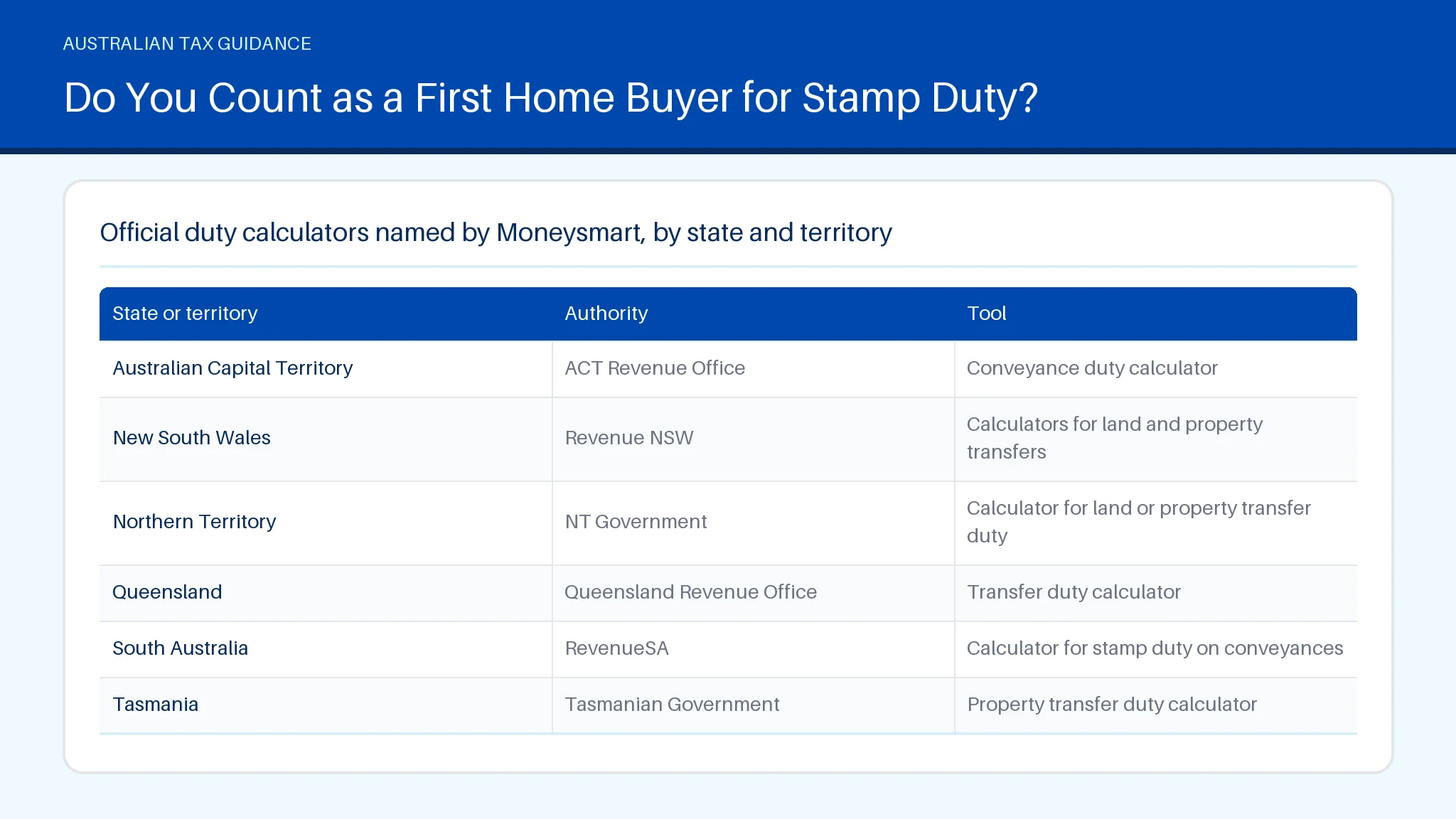
The official stamp duty calculator from the revenue office in the property's state or territory gives you a working estimate of the duty on a purchase. Moneysmart says the amount depends on where the property is, its value and your circumstances. It links to official tools for the ACT, New South Wales, the Northern Territory, Queensland, South Australia and Tasmania.
Before you rely on an estimate, check these points:
- Location and value: use the tool for the state or territory where the property is, and enter the price you expect to pay.
- Your circumstances: Moneysmart suggests first home buyers check whether they can get an exemption, rebate or concession. Moneysmart also notes that a concession or exemption can reduce the money you need upfront.
- Scope: duty is only one buying cost. Moneysmart also lists conveyancing fees, legal costs, search fees and pest and building reports.
- Refinancing: Moneysmart says you may have to pay stamp duty when you refinance.
| State or territory | Authority | Tool |
|---|---|---|
| Australian Capital Territory | ACT Revenue Office | Conveyance duty calculator |
| New South Wales | Revenue NSW | Calculators for land and property transfers |
| Northern Territory | NT Government | Calculator for land or property transfer duty |
| Queensland | Queensland Revenue Office | Transfer duty calculator |
| South Australia | RevenueSA | Calculator for stamp duty on conveyances |
| Tasmania | Tasmanian Government | Property transfer duty calculator |
Moneysmart suggests saving a deposit of 20% of the purchase price, plus enough to cover buying costs such as duty, legal fees and inspections. If you buy an investment property, Moneysmart notes that you may have to pay capital gains tax if you later sell it for more than you paid. The ATO explains that the cost base includes the amount paid plus incidental costs of acquiring the asset. Keep your purchase records so you can check them against the ATO's list. The Deductit deduction library covers ongoing costs.
How Stamp Duty Is Worked Out in Each State and Territory
Stamp duty is a state and territory charge, not an ATO tax. Moneysmart says the amount you pay depends on where the property is, its value and your circumstances. It points buyers to the official calculator for each jurisdiction.
A stamp duty calculator only works with the inputs you give it. Use the official tool for the state or territory where the property is.
- Name of the tax: Moneysmart uses the name transfer duty and notes it is sometimes called stamp duty. The official tools include the ACT Revenue Office conveyance duty calculator, the Queensland Revenue Office transfer duty calculator, RevenueSA's calculator for duty on conveyances and the Tasmanian Government property transfer duty calculator. Revenue NSW and the NT Government also publish calculators for land and property transfers.
- Concessions: Moneysmart says you may be eligible for a concession or exemption, depending on where you live. First home buyers should check whether they qualify for an exemption, rebate or concession before relying on a result.
- Refinancing: Moneysmart warns that you may have to pay stamp duty when you refinance. Include it when you compare switching costs.
Moneysmart notes that the amount you pay depends on where the property is located, its value and your circumstances, and it points buyers to each state or territory revenue office's own calculator, so use that tool for duty and treat federal topics such as the ATO late lodgement penalty for overdue tax returns as a separate question. Keep your contract, settlement statement and duty assessment notice together. For an investment property, the ATO cost base guide includes the money you paid for an asset and the incidental costs of buying it. These records may matter when you sell.
Stamp Duty Exemptions and Concessions for First Home Buyers
Depending on where you live, you may be eligible for a stamp duty concession or exemption as a first home buyer, according to Moneysmart. Moneysmart notes that stamp duty is also called transfer duty, and a concession or exemption can cut the money you need upfront.
Moneysmart's guide to buying a house says the amount you pay depends on:
- where the property is located
- the property's value
- your circumstances
Moneysmart suggests first home buyers check whether they're eligible for an exemption, rebate or concession. It links to the official stamp duty calculators run by state and territory revenue offices, such as Revenue NSW and the Queensland Revenue Office. Location affects the amount, so use the calculator for the state or territory where the property is.
Moneysmart also suggests a deposit savings goal of 20% of the purchase price, plus enough to cover buying costs such as stamp duty, legal fees and inspections. If you qualify for a concession, that buying cost is smaller.
You can't claim stamp duty on your own home as an income tax deduction. The ATO's cost base guide counts the incidental costs of acquiring an asset as part of its cost base for capital gains tax. Keep your settlement statement and duty assessment notice. Working from home is a separate topic, and our guide to working from home tax deductions in Australia covers it.
NSW First Home Buyer Duty Relief: Who Is Eligible
Revenue NSW decides who gets first home buyer duty relief in NSW. The ATO does not. Moneysmart says the amount of transfer duty (often called stamp duty) you pay depends on where the property is, what it's worth and your circumstances. It tells first home buyers to check whether they can get an exemption, rebate or concession. For NSW, it points buyers to the Revenue NSW calculators for land and property transfers.
Moneysmart says the duty you pay depends on where the property is, its value and your circumstances, and it suggests first home buyers check whether they are eligible for an exemption, rebate or concession, so work through these points before you rely on a figure:
- Whether your property value falls within an exemption or concession range for your contract date.
- Whether you are buying a home or vacant land to build on.
- Whether every buyer, including a spouse or partner, meets the first home buyer conditions.
- What occupancy conditions apply after settlement.
Moneysmart notes that a concession or exemption can reduce the money you need upfront. It suggests saving 20% of the purchase price plus buying costs such as stamp duty, legal fees and inspections. To plan that goal, start with a take-home pay estimate from your gross salary.
Keep your contract and settlement statement. The ATO's cost base guidance counts the money paid for an asset and certain incidental costs of acquiring it. These records matter if capital gains tax applies later.
Do You Count as a First Home Buyer for Stamp Duty?
Buyer stamp duty is worked out by applying the duty rules of the property's state or territory to its value, then adjusting for any relief you qualify for. Being a first home buyer is one of the most common reasons for that adjustment. Moneysmart tells first home buyers to check whether they are eligible for an exemption, rebate or concession. business.gov.au confirms that concessions and exemptions are available in some circumstances.
Here is a practical way to work it out:
- Open the official tool for the state or territory where the property is.
- Enter the purchase price or value.
- Answer every question about your circumstances accurately, including whether this is your first home.
- Write down the duty before relief, the relief applied and the final amount.
- Read the eligibility conditions for that relief on the revenue office website.
Each state decides which kinds of relief it offers and on what terms. That means a stamp duty calculator built for one state cannot tell you whether you qualify in another. A result showing reduced or nil duty is only an estimate based on your answers. It is not a decision about your eligibility.
One useful habit is to run the estimate twice: once with first home buyer relief and once without. If your savings goal only works with the relief, you can see exactly how much depends on the revenue office confirming your eligibility before settlement.
How Does a Stamp Duty Calculator Work Across Australian States?
How much stamp duty you pay comes down to three inputs: the state or territory where the property is, the property's value and your circumstances. Each state and territory runs its own stamp duty calculator on its own rules, so the same price can lead to different duty amounts in different places. business.gov.au lists the revenue offices for all eight states and territories, and Moneysmart links straight to the official calculators.
What you need before you start
- The property address, to confirm the state or territory.
- The purchase price or the value in the contract.
- Your buyer details, including whether you are a first home buyer.
- Whether you are buying personally or through a business. business.gov.au confirms that a business buying property also pays duty to its state or territory government.
- A list of your other buying costs, such as legal fees and inspections.
Once you have the figure, add it to your savings goal. Moneysmart suggests saving a 20% deposit plus enough to cover buying costs such as stamp duty, legal fees and inspections. For a $700,000 purchase, the deposit part of that goal is $140,000, and the duty comes on top of it.
Property duty is a state charge, so it is not part of Deductit's tax deduction calculators. Those cover income tax and deductions.
Foreign Purchaser Surcharge Duty on NSW Residential Property
If you are a foreign person buying residential property in NSW, check whether a surcharge applies on top of ordinary transfer duty before you set your budget. Moneysmart says the duty you pay depends on where the property is, its value and your circumstances. It directs NSW buyers to the Revenue NSW calculators for land and property transfers (Moneysmart, Buying a house). Your residency or citizenship status is one of those circumstances. Moneysmart says the duty you pay depends on where the property is, its value and your circumstances, and it points NSW buyers to the Revenue NSW calculators for land and property transfers to work out the amount.
- Budgeting: Moneysmart suggests saving 20% of the purchase price, plus enough for buying costs such as stamp duty, legal fees and inspections. A surcharge increases those buying costs.
- Other upfront costs: Moneysmart lists stamp duty, conveyancing fees, legal costs, search fees, and pest and building reports as costs of buying an investment property (Moneysmart, Buying an investment property).
- Refinancing later: Moneysmart notes you may have to pay stamp duty when you refinance (Moneysmart, Switching home loans).
Keep your visa or citizenship evidence, the contract and your duty paperwork with your settlement records. The ATO explains that a CGT asset's cost base includes what you paid for it plus some incidental costs of buying it, such as fees paid to a legal adviser or agent (ATO, What is the cost base?). You can compare ongoing costs using the Deductit calculators.
How to Calculate Transfer Duty When Land Changes Ownership
According to Moneysmart, how much transfer duty (sometimes called stamp duty) you pay depends on where the property is located, its value and your circumstances. To get a figure, use the stamp duty calculator for the state or territory where the property is. Moneysmart's guide to buying a house lists these official tools, including the ACT Revenue Office conveyance duty calculator, the Queensland Revenue Office transfer duty calculator and the RevenueSA calculator for stamp duty on conveyances.
Your circumstances can change the result. Moneysmart says first home buyers should check whether they are eligible for an exemption, rebate or concession, which can reduce the money you need upfront. Moneysmart's guide to switching home loans also says you may have to pay stamp duty when you refinance.
Tips and common mistakes
- Using the wrong state's tool: where the property is located affects what you pay.
- Assuming relief applies: check your eligibility with the relevant revenue office before you count on a concession.
- Budgeting for duty alone: Moneysmart lists other buying costs, such as conveyancing fees, legal costs, search fees and pest and building reports.
- Throwing out the paperwork: the ATO's cost base guide counts the money paid for an asset and certain incidental costs of acquiring it. Keep your duty assessment and settlement records. They also help with a CGT review of a home or former home.
Summary
A stamp duty calculator only gives a useful estimate when it matches the state or territory where the property is. The duty depends on the property's value, the type of transaction and your circumstances. First home buyers should check whether they qualify for an exemption, rebate or concession before relying on a lower figure. Add the result to your deposit and other buying costs. Keep the duty assessment and the payment date, because the ATO counts stamp duty among the costs of buying an investment property. On the income tax side of owning property, the ATO's capital gains tax indexation example counts stamp duty paid on an investment property as one of the costs indexed in its cost base, so keep your duty records alongside the topics in the deduction library and your Deductit workspace. Your state revenue office decides how much duty you owe.
You may also find these related guides helpful: Vehicle Stamp Duty Calculator: What to Know, Pay Calculator Australia: Work Out Your Take Home Pay, Stamp Duty Calculator for Used Cars: What to Know, Tax Deductions For Real Estate Agents In Australia, Aus Financial Year: What to Know, and Balancing Account ATO: What It Means for Your Return.
Frequently asked questions
How to calculate buyer stamp duty?
To calculate buyer stamp duty, enter the property's value and your details into the official calculator for the state or territory where the property is. Moneysmart links to these tools and says the amount depends on location, value and your circumstances. Check whether you qualify for a first home buyer exemption, rebate or concession. Then add the result to legal fees and inspections when you set your savings goal.
How much is stamp duty on a $1,000,000 house?
There is no single national figure for stamp duty on a $1,000,000 house. Each state and territory applies its own rules to the property's value and the buyer's circumstances. The same goes for an $800,000 purchase: the duty depends on where the property is and whether you qualify for any relief. To get a real figure, enter the price into the official tool for that state, such as the Queensland Revenue Office transfer duty calculator or the Revenue NSW calculators for land and property transfers. Under Moneysmart's 20% deposit guide, the deposit part of your savings goal would be $200,000 on a $1,000,000 house and $160,000 on an $800,000 one, with duty and other buying costs on top.
What is the current stamp duty rate in QLD?
The Queensland Revenue Office sets the current stamp duty rate in Queensland. It calls the tax transfer duty and publishes a transfer duty calculator that applies its current rules to your purchase. Use that calculator rather than a rate quoted somewhere else. The amount depends on the property's value and your circumstances, and a concession or exemption may apply in some cases.
How do I calculate stamp duty in Victoria?
Start with the property's value and location, then check the amount with the official Victorian government duty calculator. Moneysmart says the duty you pay depends on where the property is located, its value and your circumstances, and it directs buyers to state and territory government calculators. If you are a first home buyer, check whether you qualify for an exemption, rebate or concession. Add the estimate to your other buying costs, such as legal fees and inspections.
How to avoid stamp duty in Victoria?
Moneysmart doesn't describe a way to avoid stamp duty, but it does explain how the amount can come down. Moneysmart says transfer duty (sometimes called stamp duty) depends on where the property is, what it's worth and your circumstances. It also says that, depending on where you live, you may be eligible for a concession or exemption, which lowers the money you need upfront. If you're a first home buyer, Moneysmart suggests checking whether you're eligible for an exemption, rebate or concession. Check the current Victorian rules before you sign a contract.