A vehicle stamp duty calculator estimates the one-off state or territory tax you pay when a car is registered in your name, based on the vehicle's dutiable value and the rate scale that applies where it will be registered. It gives you a cost figure before you negotiate, not a tax ruling, and the revenue office in your state or territory makes the final assessment when the transfer or registration paperwork is lodged.
This guide is for private buyers, sole traders and small business owners who need to budget accurately for a car purchase. It covers how each jurisdiction sets its rate, what counts as dutiable value, which concessions and exemptions commonly apply, and what you need before you start working out a figure. It also covers the part most pages skip: what the duty means at tax time if the vehicle is used for work or business.
Before you use any vehicle stamp duty calculator, gather four things. First, the purchase price including GST and any luxury car tax. Second, an honest view of market value, which matters most for private sales, gifts and cars bought below market. Third, whether the car is new, demonstrator or used. Fourth, the vehicle category, because passenger cars, utes, vans, heavy vehicles and low-emission vehicles often sit on different scales. Engine cylinders, carrying capacity or CO2 emissions also matter in some jurisdictions.
Stamp duty is separate from registration fees, compulsory third party insurance and plate charges. Those are billed alongside duty but calculated differently, so a duty estimate alone will understate the total amount payable on the day.
Key takeaways
- Vehicle stamp duty is a state and territory tax on registering or transferring a motor vehicle, so the rate you pay depends on where the vehicle is registered, not where you bought it.
- Every jurisdiction calculates duty on the dutiable value, which is the higher of the purchase price (including GST and any luxury car tax) and the vehicle's market value.
- A vehicle stamp duty calculator helps you estimate the cost before you sign, but the final assessment is made by the state revenue office when transfer or registration documents are lodged.
- Concessions and exemptions exist for eligible buyers such as pensioners, primary producers, charities and family transfers, and several jurisdictions apply lower rates to low-emission vehicles.
- Stamp duty on a vehicle is not an income tax deduction in itself, but it can form part of the cost base or the depreciable cost of a business vehicle, so keep the purchase and registration paperwork.
How Queensland Charges Stamp Duty on Vehicles
Stamp duty in Queensland is a state tax, called transfer duty, that applies when dutiable property changes hands, including land, business assets and motor vehicles. Vehicle registration duty is the motor vehicle arm of that system and is administered by the Queensland Revenue Office, which sets the rates and assesses what you owe when you register or transfer a vehicle.
Queensland is distinctive because it bands vehicle duty by engine type rather than by a single flat percentage. A hybrid or electric car sits in the lowest band, a four cylinder or two rotor petrol car in the next, then six cylinder or three rotor vehicles, then seven or more cylinders at the highest rate. The duty is charged per $100 of dutiable value, which means a buyer choosing between two cars at the same price can face different duty purely because of the engine under the bonnet.
That design has a practical consequence a generic vehicle stamp duty calculator can miss: the cylinder count on the compliance plate, not the badge on the boot, drives the band. Check the vehicle's specification before you assume a rate.
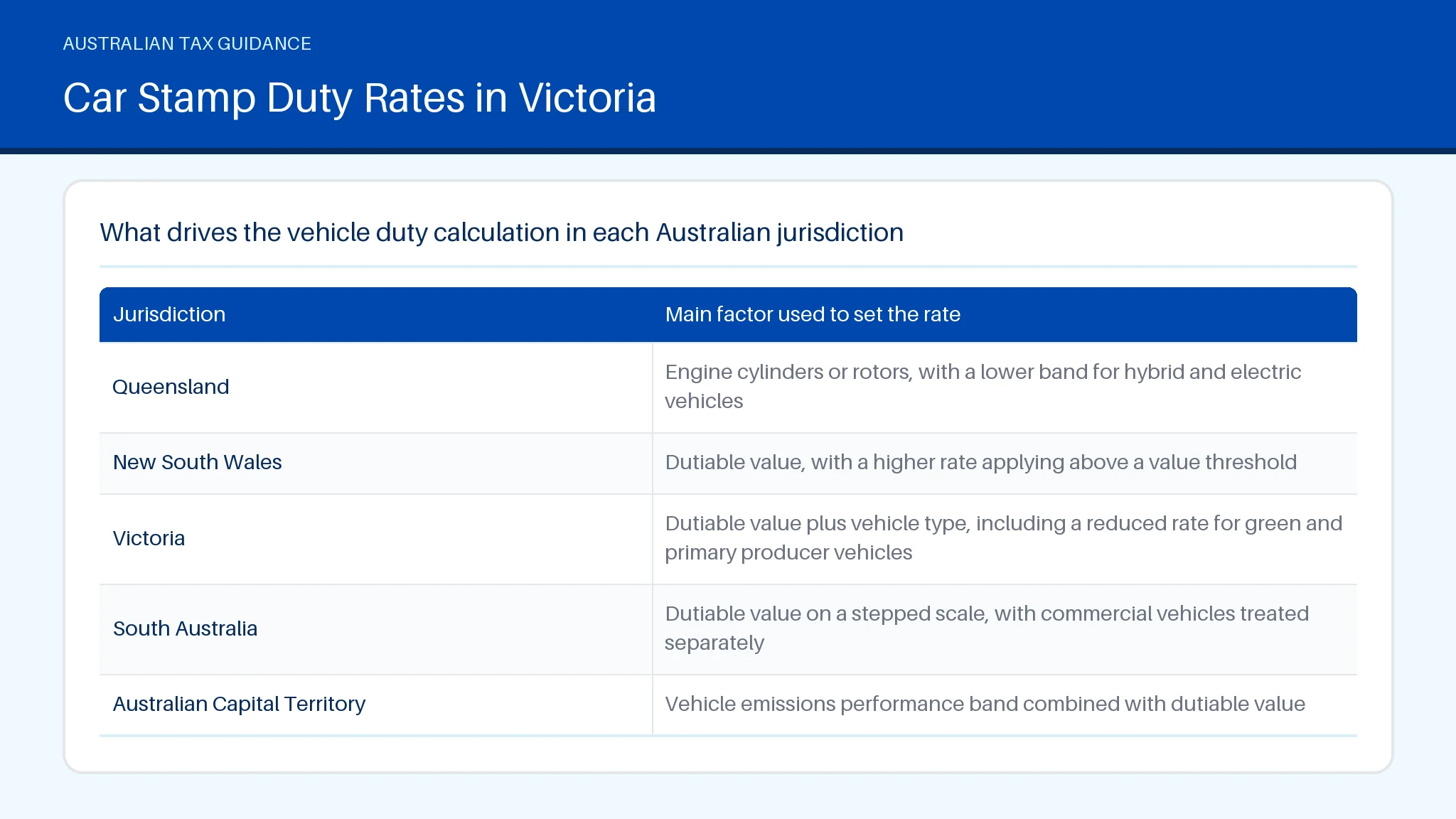
| Jurisdiction | Main factor used to set the rate |
|---|---|
| Queensland | Engine cylinders or rotors, with a lower band for hybrid and electric vehicles |
| New South Wales | Dutiable value, with a higher rate applying above a value threshold |
| Victoria | Dutiable value plus vehicle type, including a reduced rate for green and primary producer vehicles |
| South Australia | Dutiable value on a stepped scale, with commercial vehicles treated separately |
| Australian Capital Territory | Vehicle emissions performance band combined with dutiable value |
Duty Payable When You Buy a Car
Duty is payable by the buyer, not the seller, and it falls due when the vehicle is registered or the registration is transferred into the new owner's name. Dealers usually collect it as part of the drive-away price and remit it with the registration application. In a private sale you pay it yourself at the transport or revenue office counter, or online, within the transfer window your jurisdiction sets.
The amount is calculated on dutiable value, which is the higher of what you paid and what the vehicle is worth. Trade-ins do not reduce it. If you trade a car in at $12,000 against a $45,000 purchase, duty is assessed on $45,000, not the $33,000 you hand over. Dealer delivery charges, accessories fitted before delivery and luxury car tax generally form part of the value too.
Run your figure through a vehicle stamp duty calculator before you negotiate, then compare it against the dealer's quoted on-road costs line by line. For business buyers, the Deductit tax deduction calculators can help you work through what happens to the vehicle cost after purchase.
Exemptions and Concessions on Vehicle Transfer Duty
Exemptions remove duty entirely, while concessions reduce the rate or the value on which duty is charged. The categories differ by jurisdiction, but the common grounds are consistent enough to check before you pay.
- Transfers between spouses or de facto partners, and transfers following a relationship breakdown under a court order or binding agreement.
- Transfers to a beneficiary or executor from a deceased estate.
- Eligible pensioner and concession card holders, often limited to one vehicle.
- Primary producers registering vehicles used in a farming business.
- Registered charities, and vehicles modified for a person with a disability.
- Repossessed, re-registered or dealer trading stock vehicles in defined circumstances.
Most exemptions require a declaration and supporting evidence at the time of lodgement rather than a refund claim later, so a vehicle stamp duty calculator that shows full duty may overstate what you actually owe. Confirm the current conditions with your state or territory revenue office, because eligibility tests and vehicle value caps change between budgets.
Working Out Vehicle Stamp Duty in South Australia
South Australia applies a stepped scale to the vehicle's dutiable value, with each band charging a fixed dollar amount per $100 of value above the previous band. Revenue SA distinguishes between commercial vehicles, which include utes and vans designed primarily to carry goods, and non-commercial passenger vehicles, with commercial vehicles generally assessed on a more favourable scale.
Two practical points matter for South Australian buyers. The scale is stepped, not flat, so a small increase in price near a band boundary can lift duty by more than you expect, which is worth testing before you agree on a price. And the classification question is decided by the vehicle's design and carrying capacity, not how you intend to use it, so a dual cab assumed to be commercial may not be. Check the classification on the registration paperwork rather than relying on the sale listing.
Car Stamp Duty Rates in the Australian Capital Territory
Stamp duty is a tax that state and territory governments charge on certain transactions, including transfers of land and the registration or transfer of a motor vehicle. It is a transaction tax rather than an annual charge, so you pay once per transfer, and the revenue funds state and territory services. The Commonwealth and the ATO have no role in setting or collecting it.
Stamp duty on a car is the component of that tax charged when a vehicle's registration is issued or transferred. It is calculated on the vehicle's dutiable value, and it sits alongside the registration fee and compulsory third party premium rather than replacing them.
You need to pay stamp duty at the point the registration or transfer is lodged. For a dealer sale that is usually built into the drive-away price and handled on your behalf. For a private sale or an interstate vehicle being registered locally, payment is due when you lodge the transfer or registration application, and jurisdictions apply penalties if the transfer is lodged late.
Stamp duty is calculated by applying the rate scale that your jurisdiction sets to the dutiable value of the vehicle. Some jurisdictions express that rate as a percentage, others as a dollar amount per $100 of value, and most use bands so that higher value vehicles attract a higher effective rate.
The ACT takes a different route again. Rather than banding purely on value or engine size, it uses a vehicle emissions performance scheme that places new vehicles into emissions bands, with the lowest emitting vehicles attracting the most favourable treatment and the highest emitting vehicles the least. The ACT Revenue Office publishes the band for each model, so check your specific variant: the same nameplate can sit in different bands depending on the engine and drivetrain fitted.
Car Stamp Duty Rates in New South Wales
New South Wales charges motor vehicle registration duty on a two tier value scale. Vehicles up to a set dutiable value threshold are charged at a lower rate per $100 of value, and the portion of value above that threshold is charged at a higher rate, so duty on an expensive car climbs steeply once the threshold is passed. Revenue NSW publishes the current threshold and both rates.
Duty is assessed on the higher of the price paid and market value, and Revenue NSW can substitute its own valuation where a sale price looks well below market. That matters for family sales and gifted cars, where a nominal $1 price does not produce a nominal duty bill. Keep the dealer invoice or a written private sale receipt, since it is the primary evidence of what you paid.
Car Stamp Duty Rates in Victoria
Car stamp duty in Victoria is charged per $200 of the vehicle's dutiable value, with the rate depending on the vehicle type and value. The State Revenue Office of Victoria applies a reduced rate to green passenger cars and primary producer passenger vehicles, a standard rate to other passenger cars up to the luxury threshold, and progressively higher rates to passenger cars above that threshold. Non-passenger vehicles such as utes, vans and motorcycles sit on their own lower rate.
You pay stamp duty on a car in Victoria when the vehicle is registered or the registration is transferred. VicRoads collects it with the registration or transfer application, which means a dealer purchase has it folded into the drive-away figure while a private buyer pays it at lodgement, within the transfer period Victoria allows.
Stamp duty is payable on a used car in Victoria. Duty applies to the transfer of registration regardless of the vehicle's age, and for a used car the value is assessed when transfer documents are lodged rather than when you shook hands on the deal. Age reduces duty only because it reduces market value, not because used vehicles are treated differently. The one common exception is a vehicle already registered in your name that you are simply renewing, which is not a transfer and attracts no duty.
Estimating Motor Vehicle Registration Duty in New South Wales
You generally do pay motor vehicle duty if you move to Victoria with your car and register it there, because registering a vehicle in a new jurisdiction is a dutiable registration event. Victoria provides relief where the vehicle was already registered in your name interstate and you are relocating, but the relief has conditions about prior registration in the same name and the timing of the move, so confirm your position with the State Revenue Office before you lodge rather than assuming duty will not apply. The same principle runs in reverse for someone moving into New South Wales with a Victorian car.
To estimate NSW duty, start with the dutiable value, split it at the published threshold, apply the lower rate to the first portion and the higher rate to the balance, then add the registration fee and CTP premium separately. A written estimate also helps when you are comparing interstate purchases, since buying cheaply in another state does not change the duty you pay to register the car at home.
Estimating the Duty Payable on Registering a Motor Vehicle
The most common mistakes in a duty estimate are predictable. Buyers deduct the trade-in before calculating duty, use the ex-GST price, forget luxury car tax on expensive vehicles, or treat a drive-away price as if duty were excluded from it. Each of these produces a figure that will not match the assessment at the counter.
Three habits avoid the problem. Calculate duty on the gross purchase price including GST and luxury car tax, check the vehicle's engine, emissions band or body classification against your jurisdiction's scale, and test the figure at a price slightly above your target in case negotiation pushes you into the next band.
Keep the invoice, the transfer form and the duty receipt together. If the vehicle is used for work, those documents support the cost base you later rely on for business motor car expenses, and a vehicle log book substantiates the business use percentage the ATO expects.
Summary
Eligibility for a lower rate or an exemption turns on who you are and what the vehicle is, calculation turns on dutiable value and your jurisdiction's scale, and record-keeping turns on holding the invoice, transfer form and duty receipt. A vehicle stamp duty calculator gives you a budgeting estimate, while the revenue office makes the assessment. Deductit's deduction finder and deduction library set out what vehicle costs may be claimable, without providing personal tax advice.
You may also find these related guides helpful: Car Stamp Duty Calculator QLD: Estimate Vehicle Duty, Pay Calculator Australia: Work Out Your Take Home Pay, PAYG Calc: Turn Gross Pay Into Take-Home Pay Estimates, Salary Calculator: Gross and Take Home Pay in Australia, Log Book Method: How to Claim Your Car Deduction, Working From Home Tax Deductions Australia, ABN Registration: How to Apply, Costs and Who Qualifies, and ATO Number: Which Line to Call for Your Tax Query.
Frequently asked questions
What value do I Enter?
Enter the higher of the purchase price and the market value at the time of registration or transfer. The purchase price should include GST and any luxury car tax, plus dealer delivery and accessories fitted before delivery. Do not subtract a trade-in, deposit or finance amount, because duty is assessed on the full value of the vehicle you acquire. For a used car the value is assessed when the transfer documents are lodged, so use a current market valuation rather than an older figure. If you are gifted a car or buy it from family below market, the revenue office will assess duty on market value, and a nominal price on the transfer form will not reduce the bill. Where you need the figure for a work vehicle, the Deductit deduction calculators work from the same purchase documentation.
Are electric vehicles exempt from stamp duty in Victoria?
Electric vehicles are not fully exempt from stamp duty in Victoria, but zero and low emission passenger cars can qualify for the reduced green passenger car rate the State Revenue Office of Victoria applies, provided the vehicle meets the published emissions criteria and value conditions. Queensland takes a similar approach by placing hybrid and electric vehicles in its lowest duty band, and the ACT uses emissions bands that favour the cleanest vehicles. These settings change with state budgets, so check the current rules with the relevant revenue office before relying on a quoted saving. If the electric vehicle is used in a business, the purchase price also feeds into depreciation and the instant asset write-off rules, and you can start a Deductit workspace to keep the purchase records and log book evidence together, or use the pay calculator if a novated lease changes your take home pay.