The aus financial year starts on 1 July and ends on 30 June the following calendar year. That single twelve month block is the period the Australian Taxation Office uses to measure your income, your deductions and the tax you have already paid, which is why almost every tax date you care about hangs off those two dates.
This guide is written for employees, sole traders, rental owners and small company directors who need to know what happens inside that cycle and when. It sets out the quarters, the dates that move money, the records you need to hold, and the decisions that are genuinely worth making before 30 June rather than after it.
Knowing the aus financial year dates matters for three practical reasons. First, timing changes which year an expense or a contribution lands in. Second, the quarterly rhythm of business activity statements and super guarantee payments sits inside the year and has its own deadlines. Third, your records have to match the year you are reporting, not the calendar year your bank statements are filed by.
Where numbers are involved, this guide points you to the tool that does the calculation. If you want to see how a pay period converts to annual figures, the Australian pay calculator handles the gross to net arithmetic, and the deduction library for Australian taxpayers explains what each expense category requires before you claim it.
Key takeaways
- The aus financial year runs from 1 July to 30 June, so 2026-27 covers 1 July 2026 to 30 June 2027.
- Individuals who lodge their own return generally have until 31 October to lodge for the year just ended, according to the ATO.
- The year splits into four quarters that drive BAS and super guarantee timing, with super needing to reach the fund by the due date rather than simply being paid.
- Most individuals cannot change the 30 June year end; a substituted accounting period needs ATO approval and applies mainly to companies with a genuine commercial reason.
- Records that support a claim, such as receipts, logbooks and work-from-home diaries, generally need to be kept for five years from lodgement.
Fiscal Year, Tax Year or FY: Terms Explained
Fiscal year, tax year, income year and FY all describe the same twelve month period in Australia. The ATO's own term is income year, written as 2026-27 or FY27, and it always means 1 July to 30 June. Nothing changes between the labels, so an expense that is eligible in the 2026-27 income year is the same expense that a bookkeeper would call an FY27 cost.
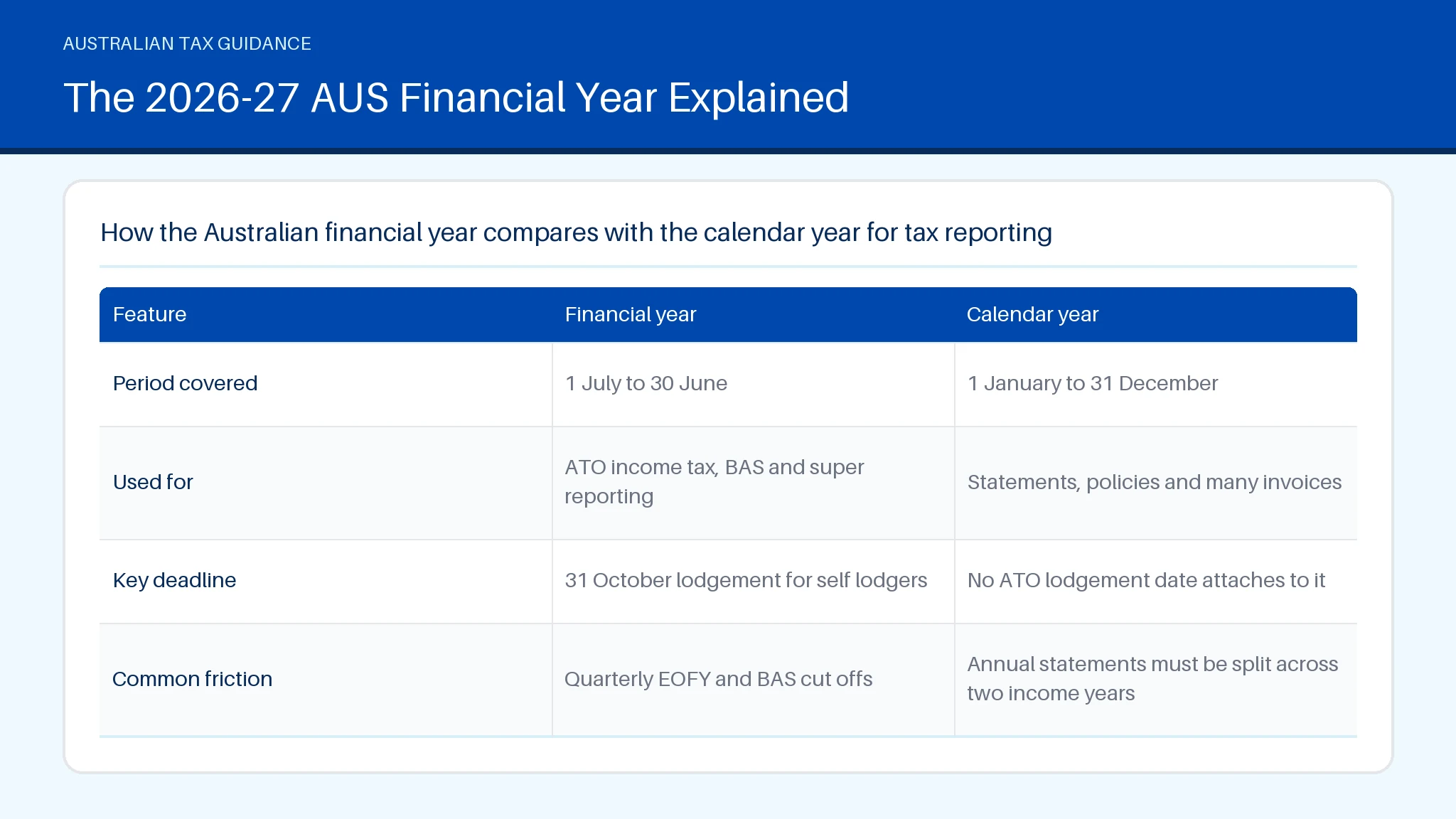
The distinction that does matter is between the aus financial year and the calendar year. Bank interest summaries, insurance policies and many subscriptions run on calendar dates, so you often have to split them before reporting.
| Feature | Financial year | Calendar year |
|---|---|---|
| Period covered | 1 July to 30 June | 1 January to 31 December |
| Used for | ATO income tax, BAS and super reporting | Statements, policies and many invoices |
| Key deadline | 31 October lodgement for self lodgers | No ATO lodgement date attaches to it |
| Common friction | Quarterly EOFY and BAS cut offs | Annual statements must be split across two income years |
Treat the financial year as the reporting frame and the calendar year as raw data you convert into it.
Smart Money Moves to Make Before 30 June
Timing decisions made before 30 June land in the year ending, and the same decision made on 1 July lands in the next one. That is the whole logic of EOFY planning, and it is worth a short, deliberate review rather than a last minute scramble.
- Pay deductible work or business costs you were going to incur anyway before the cut off, so the deduction falls in the current year.
- Make personal super contributions early enough that the fund receives them before 30 June, since the ATO treats the date the fund receives the money as the contribution date.
- Review bad debts, obsolete stock and assets you no longer use, because the write off must be decided before the year closes.
- Check whether income you can legitimately defer, such as an invoice issued in early July, sits better in the next year.
None of this changes what is deductible, only which Australian income year it belongs to. Before you commit, confirm the rule in the finance and tax deduction rules, and note that a June decision still needs documentation when the lodgement window opens. The aus financial year rewards planning, not rushing.
When Does the Australian Financial Year End?
The Australian financial year ends on 30 June and the next one begins the very next day, 1 July. There is no gap and no grace period: a transaction dated 30 June belongs to the year closing, and one dated 1 July belongs to the new year. End of financial year, usually shortened to EOFY, is simply that 30 June closing date and the weeks of reconciliation either side of it.
So the Australian financial year dates are fixed. The 2025-26 year ran from 1 July 2025 to 30 June 2026. The 2026-27 year runs from 1 July 2026 to 30 June 2027. The year is named by the two calendar years it straddles, which is why FY27 and 2026-27 point to the same twelve months.
The July to June pattern is a historical inheritance rather than a design choice. Australia's colonial administrations aligned their accounts with the British system in use at the time, and the Commonwealth kept a mid year balance date after Federation so that revenue collection and the Budget cycle did not collide with the Christmas and harvest period. Successive governments have left it alone because changing it would mean re-cutting every payroll, super and reporting system in the country.
The Australian financial year quarters follow directly from the start date:
- Quarter 1: 1 July to 30 September
- Quarter 2: 1 October to 31 December
- Quarter 3: 1 January to 31 March
- Quarter 4: 1 April to 30 June
Those quarters are what BAS and super guarantee obligations attach to, so businesses deal with the aus financial year four times over rather than once. Individuals mostly feel the 30 June boundary alone, though anyone with a rental property or share portfolio still needs quarterly discipline with records. For a full run through of the most recent cut off, see the guide to End of Financial Year 2025: Dates and ATO Deadlines.
Who Needs to Track the Financial Year Cycle
Anyone who earns assessable income in Australia is working inside the financial year cycle, but the amount of tracking required varies sharply. Employees with a single job and no deductions mostly need the 30 June boundary and nothing else, because their employer reports income through Single Touch Payroll and the data pre-fills.
- Sole traders and contractors, who manage income, expenses and often quarterly BAS lodgement themselves.
- Employers, who must finalise Single Touch Payroll reporting and meet super guarantee due dates each quarter.
- Rental property owners, who apportion interest, rates and repairs across the Australian financial year.
- Investors, who need settlement dates to work out which year a capital gain or loss falls in.
- Anyone claiming work from home or vehicle costs, where the ATO expects records kept across the year rather than reconstructed at EOFY.
If you are not sure which group you sit in, the deduction finder for Australian taxpayers maps your work and income types to the rules that apply, which is the fastest way to see how much EOFY preparation your situation actually needs.
2026-27 Key Dates and Deadlines at a Glance
The 2026-27 year opens on 1 July 2026 and closes on 30 June 2027, and the deadlines inside it repeat the same pattern every year. The dates below reflect the standard ATO due dates; where a due date falls on a weekend or public holiday, the ATO accepts lodgement and payment on the next business day.
- 1 July 2026: new year starts, prior year income statements progressively marked tax ready.
- 28 July 2026: quarter 4 super guarantee must be received by the fund, and the quarter 4 BAS deadline falls for self lodgers.
- 14 July 2026: employers finalise Single Touch Payroll for the prior year.
- 31 October 2026: lodgement deadline for individuals lodging their own prior year return, and the deadline to engage a registered tax agent.
- 28 October, 28 February, 28 April: remaining quarterly BAS and super dates across the year.
- 30 June 2027: final day to incur deductions for the 2026-27 year.
Keep the EOFY window and the lodgement window separate in your head. One is about when a cost counts; the other is about when the paperwork is due. The ATO publishes the full Australian due date list, and a missed deadline is treated differently from an EOFY timing choice.
Your End of Financial Year Checklist
A useful EOFY checklist separates three jobs: closing the books, confirming eligibility, and assembling evidence. Working through them in that order stops you claiming something you cannot substantiate.
- Reconcile bank and card accounts to 30 June and chase any missing invoices.
- Confirm the super your business paid has been received by each fund, not merely sent.
- Finalise Single Touch Payroll reporting if you employ staff, so employees see a tax ready income statement.
- Review asset purchases and whether each is immediately deductible or depreciated.
- Take stocktake figures and write off genuinely bad debts before the Australian financial year closes.
- Collect receipts, logbooks and diaries that support each of your deductions.
Most errors the ATO flags are not aggressive claims; they are ordinary claims with no supporting record. Running your figures through the Deductit tax deduction calculators during this step shows which inputs you are missing before you reach the lodgement stage.
Preparing Tax Records to Maximise Your Refund
Good records change your outcome because an eligible claim without evidence is not claimable. The ATO generally requires you to keep written records for five years from the date you lodge, and the record has to show the supplier, the amount, the nature of the goods or services and the date.
Three record habits make the biggest difference across an Australian financial year:
- Record apportionment as you go. A phone or internet bill needs a work use percentage based on a representative period, not an estimate made at EOFY.
- Keep contemporaneous diaries. Work from home hours and vehicle logbooks are only accepted when kept at the time.
- Match expenses to the year incurred, not the year paid, where the rules require it.
Before lodgement, check each category against its rule page and keep the evidence with your working papers. Storing it in your Deductit workspace keeps the figures and the supporting records together.
The 2026-27 AUS Financial Year Explained
The 2026-27 year is the income year covering 1 July 2026 to 30 June 2027, reported after it ends rather than during it. Income you earn and expenses you incur in that window belong to that return, even if the money moves later.
Two features of 2026-27 are worth planning around. First, rates and thresholds that apply are those legislated for the year itself, so an expense timed into 2026-27 is assessed against 2026-27 settings rather than the prior year. Second, super guarantee and BAS obligations for quarter 4 of 2025-26 fall due in July 2026, which means the first weeks of the new year still involve closing the old one.
For individuals, the practical sequence is: wait for your income statement to be marked tax ready, confirm pre-filled data against your own records, then complete your deductions before lodgement. The ATO cautions against lodging in early July while data is still incomplete, because amendments cost more time than waiting. Companies should check obligations through the small business deduction hub.
Full Calendar of Tax Obligations and Due Dates
A complete obligations calendar has four recurring layers rather than one list of dates. Mapping them once saves re-checking every quarter.
- Monthly: activity statements for businesses above the monthly reporting threshold, and PAYG amounts withheld from wages.
- Quarterly: BAS lodgement on 28 October, 28 February, 28 April and 28 July, plus super guarantee received by the fund by the same dates.
- Annual: payroll finalisation in July, income tax lodgement by 31 October for self lodgers, and later concessional dates where a registered agent is engaged before that date.
- Event based: capital gains on settlement, and reporting triggered by selling a property or business asset.
Put those four layers into one shared calendar with reminders a week before each date, because the ATO charges general interest on late payment regardless of the reason. Where your Australian financial year obligations overlap with pay reporting, the pay calculator guide explains what comes out of gross pay, and your Deductit review step brings the expenses you have logged into one place.
Summary
Every Australian income year runs 1 July to 30 June, splits into four quarters, and ends with a 31 October lodgement date for self lodgers. Eligibility depends on the rule for each expense, calculation depends on the year the cost was incurred, and records must be kept for five years. Deductit publishes the rules and calculators behind each category so you can prepare your own figures; it does not provide personal tax advice or lodge returns.
You may also find these related guides helpful: HECS Repayment Calculator: 2025-26 Rates and Thresholds, ATO Number: Which Line to Call for Your Tax Query, BAS Explained: What to Report, Lodge and When, PAYG Calc: Turn Gross Pay Into Take-Home Pay Estimates, Self Managed Super Fund: Rules, Costs and Trustee Duties, and Tax Return Australia: Deadlines, Deductions and Records.
Frequently asked questions
How much is $100,000 a year taxed in Australia?
A resident individual earning $100,000 in 2025-26 pays tax under the ATO's resident rates plus the 2% Medicare levy, which leaves take home pay in the low eighty thousands before any HECS repayment or salary sacrifice. The exact figure depends on your residency status, private health cover and any study loan, so run your own numbers through the salary calculator guide rather than relying on a single headline number.
What is the financial year in Australia for 2026?
The financial year in Australia for 2026 depends on which half of the calendar year you mean. Until 30 June 2026 you are in the 2025-26 income year, and from 1 July 2026 you are in 2026-27. Returns lodged during late 2026 report the 2025-26 year that has just closed.
What is the first day of financial year 2026?
The first day of financial year 2026 was 1 July 2025, because FY2026 is shorthand for the year ending 30 June 2026. If you mean the 2026-27 year, its first day is 1 July 2026. Naming conventions trip people up, so state the full range when it matters on a document.
How much will I earn after taxes if I make $120,000 a year in Australia?
Someone earning $120,000 in Australia keeps roughly the high nineties to around $100,000 after income tax and the Medicare levy, depending on offsets and deductions. Compulsory study loan repayments and salary sacrifice arrangements change that materially, and the Deductit get started page walks through the inputs you need before estimating a net figure.
Can you change your financial year-end in Australia?
Changing your financial year end in Australia is possible only with ATO approval through a substituted accounting period, and it is not available to individuals. The ATO generally grants it to companies and some trusts with a genuine commercial reason, such as aligning with an overseas parent's reporting date. Approval is discretionary, must be applied for before the period starts, and brings ongoing obligations to report on the substituted dates, so most Australian businesses stay on 30 June.