A car stamp duty calculator for Queensland works out the vehicle registration duty payable to the Queensland Government when a car is registered in a new owner's name. Queensland does not use a property-style sliding scale for vehicles. Instead, duty is charged as a dollar rate for every $100 of the vehicle's dutiable value, and the rate band is set by the engine: hybrid and electric vehicles, four cylinders or fewer, five or six cylinders, and seven or more cylinders each sit in a different band. Vehicles valued above $100,000 attract a higher rate again.
This guide is for private buyers, people moving to Queensland with a car, business owners adding a vehicle to the fleet, and anyone budgeting the full on-road cost of a purchase. It separates three things that often get blurred together: whether duty applies to your transaction, how the amount is calculated, and what paperwork you need to keep. That separation matters, because an exemption claim usually fails on records rather than on eligibility.
Duty is only one line in the on-road cost. Registration, the transfer fee, a compulsory third party premium and, for some buyers, a safety certificate also apply. Working the numbers before you negotiate helps you compare a dealer drive-away price against a private sale where you pay each cost separately.
If the car will be used for work or business, the duty you pay is also relevant later: it is part of the vehicle's cost for depreciation purposes rather than a straight claim. Our car expenses tax deduction guide explains how the Australian Taxation Office treats those costs once the car is on the road.
Key takeaways
- Queensland charges vehicle registration duty on the dutiable value of a car when it is registered or transferred, and the rate depends on how many cylinders the engine has or whether it is electric or hybrid.
- A car stamp duty calculator for Queensland should multiply the dutiable value by a per $100 rate, so the result moves with the engine type, not with a property-style sliding scale.
- Dutiable value is the higher of the purchase price and market value for a used car, and the list price including GST and accessories for a new car.
- Duty is paid to the Department of Transport and Main Roads at the time you lodge the transfer, generally within 14 days of taking delivery.
- Vehicle duty is a state cost, not an income tax deduction, but it can form part of the cost base used for depreciation when a car is used to earn income.
Car Stamp Duty Calculator QLD: Estimate Your Vehicle Duty Online
Stamp duty is a state and territory tax on certain transactions, and in Queensland the version that applies to cars is called vehicle registration duty. It is charged when a vehicle is registered for the first time, when registration is transferred to a new owner, or when a registered vehicle is modified in a way that changes its duty category. Across Australia, every state and territory charges a comparable vehicle duty, but each sets its own base, bands and concessions, so the same car costs a different amount to put on the road in each jurisdiction. Queensland's transfer duty on property is a separate tax with its own sliding scale and home concessions, and it should not be used to estimate a car.
A reliable car stamp duty calculator for Queensland needs only two inputs: the dutiable value and the engine or propulsion type. Payment is due to the Department of Transport and Main Roads when the transfer or registration application is lodged, which for a used car bought privately is generally within 14 days of acquiring the vehicle. Dealers usually collect the duty inside a drive-away price and lodge on your behalf.
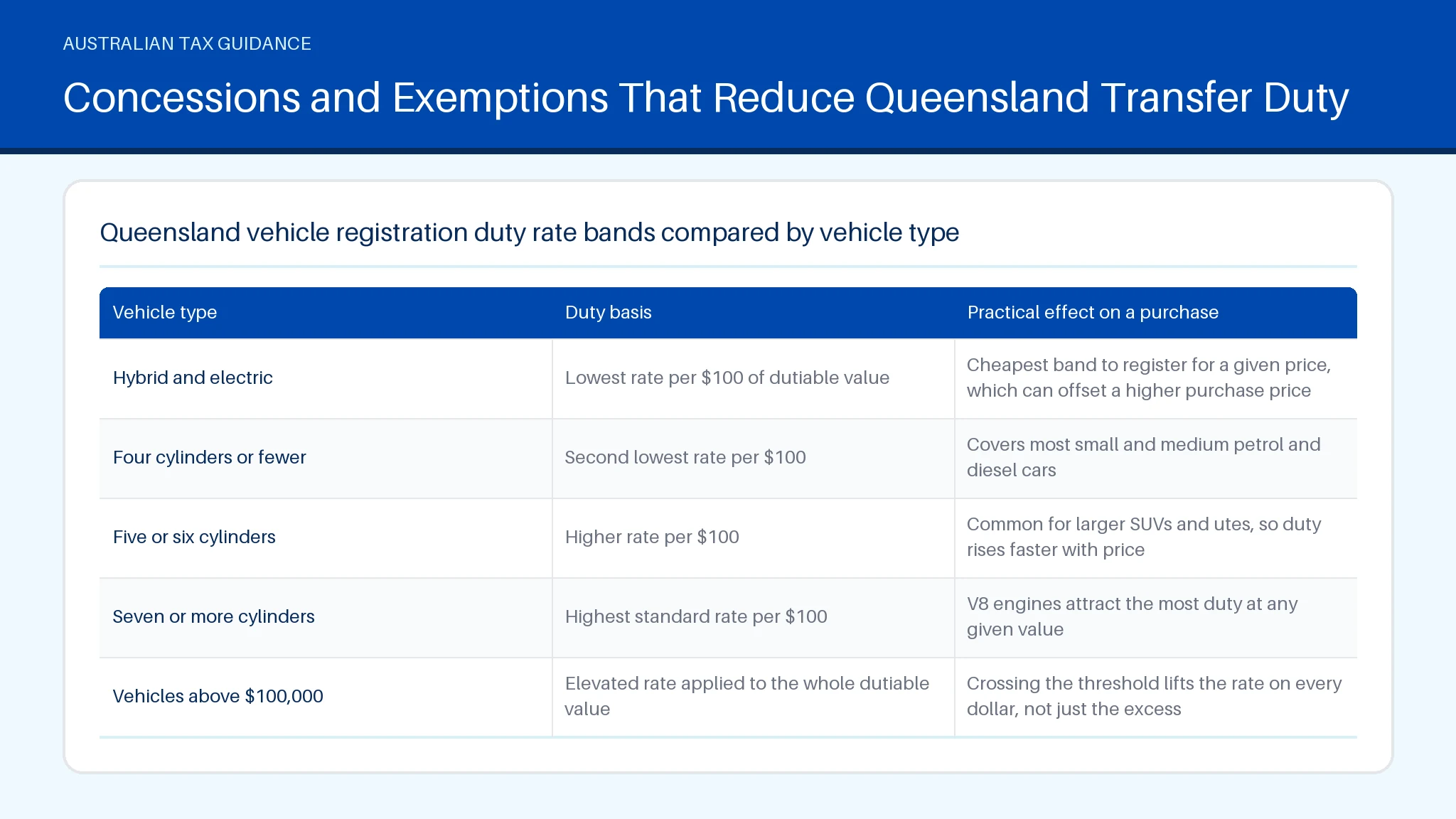
| Vehicle type | Duty basis | Practical effect on a purchase |
|---|---|---|
| Hybrid and electric | Lowest rate per $100 of dutiable value | Cheapest band to register for a given price, which can offset a higher purchase price |
| Four cylinders or fewer | Second lowest rate per $100 | Covers most small and medium petrol and diesel cars |
| Five or six cylinders | Higher rate per $100 | Common for larger SUVs and utes, so duty rises faster with price |
| Seven or more cylinders | Highest standard rate per $100 | V8 engines attract the most duty at any given value |
| Vehicles above $100,000 | Elevated rate applied to the whole dutiable value | Crossing the threshold lifts the rate on every dollar, not just the excess |
Confirm the current cents-per-$100 figures against the Queensland Revenue Office and Department of Transport and Main Roads schedules before you commit to a price, because rates are reviewed in state budgets.
How Queensland Charges Vehicle Transfer Duty on a Purchase Price
Queensland charges vehicle duty on the dutiable value of the car, which is not always the price written on the receipt. For a used vehicle, dutiable value is the higher of the price you actually paid and the vehicle's market value, so buying from a relative at a discount does not reduce the duty on its own. For a new vehicle, dutiable value is the manufacturer's list price including GST, luxury car tax where it applies, and the cost of accessories or modifications fitted before registration. Trade-in values are not deducted.
Duty then runs at a set rate for each $100 of dutiable value, rounded up to the next whole $100. Because the rate is flat within each band rather than tiered, a car stamp duty calculator QLB-style tool is simply doing a multiplication once it knows the engine type. The practical trap sits at the $100,000 threshold: a vehicle a few hundred dollars over it is charged the higher rate on its full value, so optional extras ordered before delivery can cost more than their sticker price. Any calculator you use should be tested at both sides of that threshold.
Working Out Queensland Transfer Duty for Your Own Vehicle
Working out your own figure takes four steps. First, confirm the dutiable value using the rules above. Second, identify the engine type from the compliance plate or the vehicle's registration certificate, since dealer marketing names are not reliable for cylinder counts. Third, divide the dutiable value by 100 and round up. Fourth, multiply by the rate for that band published by the Queensland Revenue Office.
Keep the workings with the sale paperwork. If you later claim a concession or the department queries the value, the evidence you need is the signed contract, the dated transfer form and any independent valuation. A shared duty estimate during a private sale also helps settle who is paying what before money changes hands. For the income side of the same budget, our pay calculator for Australian employees shows the take-home figure a repayment has to come out of.
Queensland Vehicle Stamp Duty Explained for the Current Year
Queensland vehicle stamp duty costs a set number of dollars for each $100 of dutiable value, with the rate fixed by engine type rather than rising through brackets. On a $30,000 four cylinder car, you are multiplying 300 units of $100 by the four cylinder rate; on the same car with a six cylinder engine, you are multiplying the same 300 units by a higher rate. That structure is why two cars at identical prices can carry noticeably different duty.
Duty becomes payable when you apply to register or transfer the vehicle, and the Department of Transport and Main Roads collects it at that point rather than issuing a separate bill later. Private buyers generally have 14 days from acquiring the vehicle to lodge the transfer, and late lodgement can attract a penalty on top of the duty. You can pay at a transport and motoring customer service centre, at a participating agency such as a QGAP office, or through the online transfer channel where your transaction is eligible. Dealers lodge and remit on your behalf when the duty is built into a drive-away price.
Duty is payable on a used car in Queensland in the same way as a new one, because the trigger is the change of registration, not the age of the vehicle. The difference is the valuation test: used vehicles are assessed on the higher of price paid and market value, which protects the revenue base against undervalued private sales. Keep the purchase paperwork, because it is the primary evidence of what you paid.
Using an Up to Date QLD Car Stamp Duty Calculator
An estimating tool is only as current as the rate table behind it. Before relying on a figure, check three things: that the tool names Queensland vehicle registration duty rather than property transfer duty, that it asks for engine or propulsion type, and that it applies the elevated rate above $100,000. A tool that asks only for price and state will usually be running a generic national formula.
Treat any estimate as a budgeting figure, not an assessment. The department assesses duty when the transfer is lodged, and it can substitute a market value if the declared price looks low. Our Australian tax and pay calculators follow the same principle: they show the working so you can check each input rather than trusting a single number.
Queensland Vehicle Duty Rates for the Current Financial Year
Queensland publishes its vehicle registration duty rates as cents per $100 of dutiable value for each category, and the Queensland Revenue Office is the authoritative source for the current financial year. Rates are reviewed through the state budget cycle, so a figure quoted in an older article or forum post may be out of date even when the structure has not changed.
Two details are worth confirming each year. The first is the hybrid and electric classification, which has been used to lower the entry cost of low emission vehicles and has been adjusted over time. The second is the high value threshold, currently applying above $100,000 of dutiable value. When you are comparing finance quotes or working out a business vehicle budget alongside your business operations deductions, use the published rate for the date of the transfer, not the date of the contract.
Where Queensland Sits Against Other Australian State Duty Rules
Queensland is unusual in setting vehicle duty by engine configuration. New South Wales, Victoria, South Australia and Western Australia each build their rates primarily around the vehicle's value, with Victoria adding categories for passenger cars above set price points and for green vehicles. The result is that a large engine, moderately priced car is relatively expensive to register in Queensland, while a high value four cylinder or electric vehicle can be comparatively cheap.
That matters if you are buying interstate. Duty is payable where the vehicle is registered, not where it is bought, so a Queensland resident purchasing in another state still pays Queensland duty when the car is registered here. Interstate purchases can also bring a second safety inspection and a fresh compulsory third party arrangement, which belong in the same budget as the duty itself.
Concessions and Exemptions That Reduce Queensland Transfer Duty
Queensland provides a limited set of vehicle duty exemptions and concessions rather than broad discounts. Common categories include transfers between spouses or on relationship breakdown, transfers resulting from a deceased estate, vehicles transferred to or from a trustee without a change in beneficial ownership, certain primary producer and charitable vehicles, and eligible modified vehicles for people with a disability. Some repossession and dealer trading stock transfers are also outside the duty net.
Eligibility is decided on the facts of the transfer, and most claims are made on the transfer form with supporting evidence attached. Keep the court order, grant of probate, statutory declaration or primary producer evidence with your records, because the exemption can be reviewed after the transfer is processed. The Queensland Revenue Office publishes the full list and the evidence each category requires, and that list is the only source worth relying on when a seller tells you a transfer is exempt.
Do You Pay Duty on a Used Car in Queensland?
Duty applies to a used car in Queensland whenever registration is transferred to a new owner, including private sales between individuals. Age, condition and kilometres do not remove the liability. What they do affect is market value, and because dutiable value is the higher of the price paid and market value, a genuinely rough vehicle sold cheaply will generally be assessed close to what you paid provided you can evidence the transaction.
Unregistered vehicles work differently in sequence rather than in substance: duty is assessed when you register the car in your name, and the registration application and safety certificate requirements come with it. If the car will earn income, record the duty with the purchase documents so the vehicle's cost is complete, then use the logbook method guide for the running costs and business motor car expenses for the rules that apply to a business vehicle.
Summary
Eligibility for Queensland vehicle duty turns on whether a registration or transfer takes place, not on the age of the car, with a defined list of exemptions. Calculation is a rate per $100 of dutiable value set by engine or propulsion type, with an elevated rate above $100,000. Records matter most where a concession is claimed or a low price is declared. A car stamp duty calculator gives a budgeting estimate only. Deductit publishes guides and calculators to help you check the numbers and your deduction eligibility, without providing personal tax advice.
You may also find these related guides helpful: Pay Calculator Australia: Work Out Your Take Home Pay, ATO Number: Which Line to Call for Your Tax Query, BAS Explained: What to Report, Lodge and When, Salary Calculator: Gross and Take Home Pay in Australia, Working From Home Tax Deductions Australia, ABN Registration: How to Apply, Costs and Who Qualifies, and Capital Gains Tax in Australia: Exemptions and Discounts.
Frequently asked questions
How to avoid paying stamp duty on a car in QLD?
Queensland vehicle duty can only be avoided where a published exemption applies, such as a transfer between spouses, a transfer under a deceased estate or court order, certain trustee transfers with no change in beneficial ownership, or an eligible modified vehicle for a person with a disability. There is no general discount for private sales or for declaring a low price, and understating value can attract reassessment and penalties. Check the Queensland Revenue Office exemption list and gather the required evidence before lodging the transfer.
How much stamp duty will I pay on a car?
The duty on your car depends on its dutiable value and its engine type. Hybrid and electric vehicles sit in the lowest band, four cylinder vehicles next, five and six cylinder vehicles above that, and seven or more cylinders highest, with an elevated rate for vehicles valued over $100,000. Take the dutiable value, round up to the next $100, and multiply by the published rate for your band. Confirm the current cents-per-$100 figure with the Queensland Revenue Office, since budget changes flow through to new transfers.
How do you calculate stamp duty in Queensland?
Queensland vehicle duty is calculated by dividing the dutiable value by 100, rounding up, and multiplying by the rate for the vehicle's category. Dutiable value is the higher of the price paid and market value for a used car, or the list price including GST, luxury car tax and pre-registration accessories for a new one. Trade-ins are not deducted. Property transfer duty in Queensland uses an entirely different sliding scale and home concessions, so do not borrow that method for a vehicle.
How do you calculate stamp duty on a car transfer?
Duty on a transfer is calculated on the vehicle's dutiable value at the date of the transfer, using the rate band for its engine or propulsion type. Start with the signed contract price, compare it with a market value estimate from comparable listings or a valuation, and use the higher figure. Apply the rate, then add the transfer fee, any registration transferred with the vehicle, the compulsory third party premium and a safety certificate where one is required, so you are budgeting the full on-road cost rather than the duty alone.
What is the formula for calculating stamp duty?
The formula is dutiable value divided by 100, rounded up to the next whole unit, multiplied by the dollar rate per $100 for the vehicle category. For a business vehicle, keep that calculation with the purchase records, because duty forms part of the car's cost for depreciation rather than an immediate claim. You can check what else is claimable through the deduction finder or review a vehicle purchase alongside your other records in your Deductit workspace, and set up a record for the year when you start collecting receipts.