Tax deductions for real estate agents cover the costs you incur to earn commission and salary income, from car travel between listings and open homes to marketing, phone plans, licence renewals and the decline in value of the equipment you use. This guide is written for two groups who often search the same phrase and need different answers: agents and property managers claiming their own work expenses, and property owners asking whether the fees their agent charges are deductible.
The Australian Taxation Office applies the same logic to both. A cost is deductible when you paid it, when it relates directly to earning assessable income, and when you keep records to prove the connection. Private portions must be excluded, and capital costs follow separate rules. Everything below separates eligibility from calculation from record-keeping, because most disputed claims fail on one of those three points rather than on the nature of the expense itself. For the wider framework, see tax deductions in Australia for individuals and companies.
- Real estate agents claim work expenses against their own employment or business income, while property investors claim agent and management fees against rental income. The two claims sit in different parts of a return.
- Eligibility rests on three tests the ATO applies to every claim: you paid the cost, the cost relates to earning your income, and you hold records that prove it.
- Commission, letting fees and management fees charged on an income-producing property are deductible in the year they are incurred, but fees tied to buying or selling a property usually go into the capital gains tax cost base instead.
- Tools, signage, phones and vehicles over the immediate write-off threshold are claimed through depreciation across their effective life, not all in one year.
- Written evidence is required for total work claims above $300, and travel and car claims need a logbook or diary to support the business-use portion.
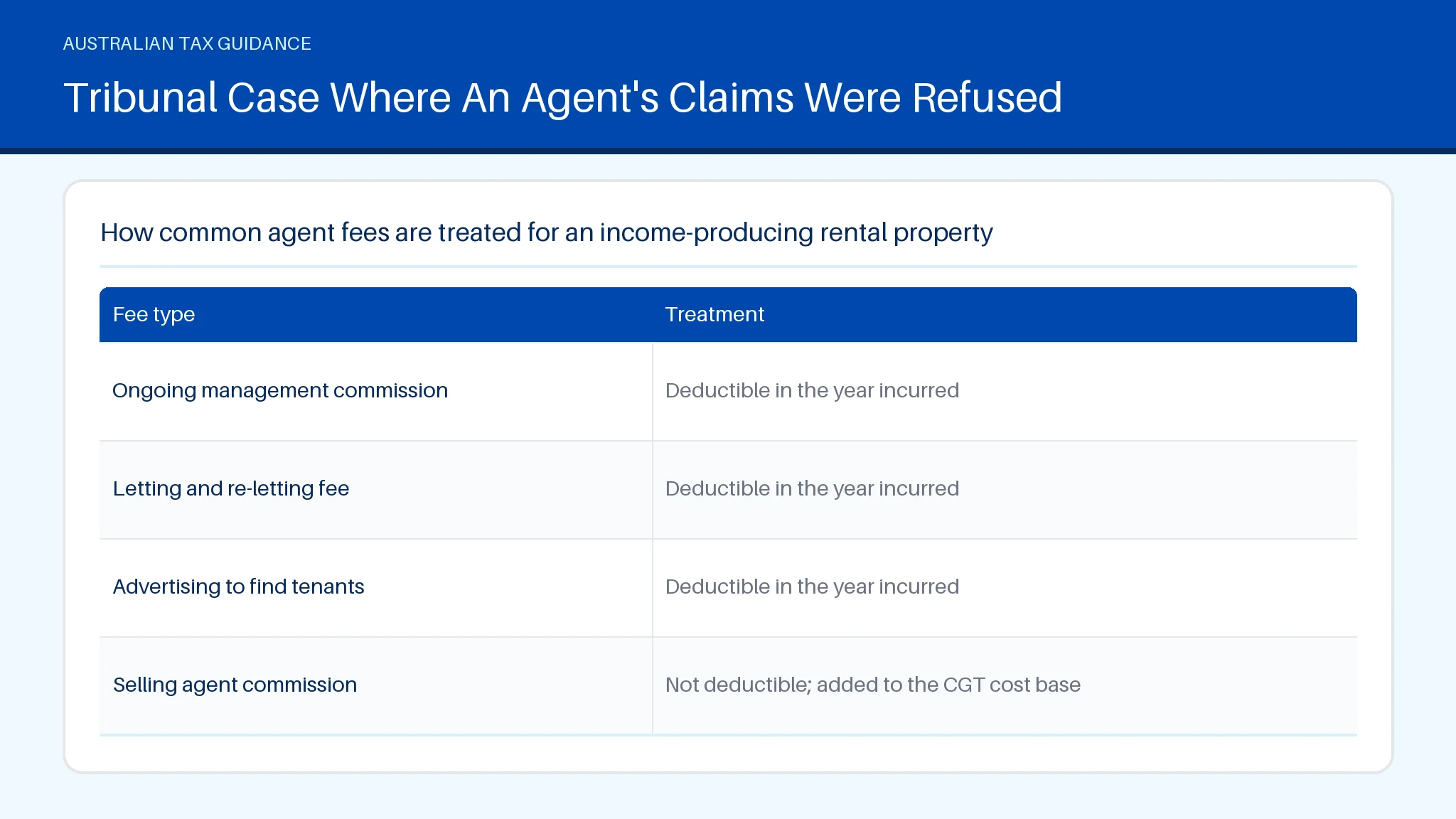
Property management and agent fees are deductible to the owner of a property that is rented or genuinely available for rent. The ATO treats ongoing management commission, letting and re-letting fees, advertising for tenants and statement fees as rental expenses claimable in the year they are incurred. Fees connected to acquiring or disposing of the property are not deductible; they form part of the capital gains tax cost base. This distinction is the single most common error in tax deductions for real estate agents advising their own landlord clients.
| Fee type | Treatment |
|---|---|
| Ongoing management commission | Deductible in the year incurred |
| Letting and re-letting fee | Deductible in the year incurred |
| Advertising to find tenants | Deductible in the year incurred |
| Selling agent commission | Not deductible; added to the CGT cost base |
Letting fees and commission charges become claimable from the date the property is first advertised at a market rent and genuinely available to tenants. If a property is held off the market for private use, or advertised at an unrealistic rent, the ATO can apportion or refuse the claim for that period. Timing matters too: a letting fee covering a lease that spans two income years is still claimed when incurred, not spread across the lease.
Fees that relate to an unsuccessful listing remain deductible if the property stayed available for rent. Agents quoting phone numbers such as 1300661508 on a statement should still itemise each charge, because a registered tax agent needs the breakdown to apportion correctly.
Everyday work expenses for agents include the running costs of selling property. The ATO accepts a claim for the work-related portion of each expense where you paid it and kept evidence.
- Car travel between offices, listings, inspections and settlements, using the cents per kilometre or logbook method.
- Mobile phone and internet, apportioned to work use over a representative four-week period.
- Marketing you personally fund, including flyers, signboards and paid social posts.
- Licence renewals, professional association fees and continuing professional development.
- Home office expenses for admin done after hours, claimed under the fixed rate or actual cost method.
A home office claim does not extend to rent, mortgage interest or rates for an employee agent. Occupancy costs are generally limited to a home-based business expense, which is a separate rule. You can browse each rule in the Australian deductions library.
Rental property owners claim three broad groups of annual costs: holding costs such as interest, council rates, insurance and body corporate fees; ongoing service costs including management commission, cleaning, gardening and pest control; and repairs that restore the property to its former condition. Improvements are capital and are claimed over time instead.
An accountant or registered tax agent will usually ask for the annual agent statement, loan interest summary and a depreciation schedule before finalising the figures, since those three documents carry most of the claim. Landlords chasing a service line such as 1300650286 should still keep the underlying invoices. The same evidence standard applies across real estate agent tax deductions australia wide.
Deductions matter to agents because commission income is irregular and largely self-funded on the expense side. An agent who spends heavily on marketing in a quiet quarter can face a tax bill calculated on gross commission unless those costs are captured and claimed. Getting the daily costs right is usually worth more than hunting for unusual claims.
Daily costs that commonly qualify include:
- Parking and tolls incurred travelling between client sites, though not the cost of getting from home to your regular office.
- Client refreshments at an inspection, which are entertainment and generally not claimable, so check before assuming.
- Branded clothing carrying a permanently affixed employer logo, plus its laundry.
- Laptops, tablets, cameras and signage, where items over the immediate write-off threshold are claimed through depreciation across effective life.
- Home office running costs for evening admin, under whichever method produces the better supported result.
The decision most agents get wrong is method choice for the car. The cents per kilometre method is capped at 5,000 business kilometres per car per year, so high-mileage agents are often better off with a logbook. This is a core part of australian tax deductions planning and drives real estate agent tax deductions australia outcomes more than any other single choice.
Digital records satisfy the ATO as long as they are true and clear copies showing the supplier, amount, date, nature of the goods and date of the document. A photographed receipt stored in an app is acceptable evidence for a deductible cost, and you do not need to keep the paper original.
The practical advantage of capturing costs as they happen is apportionment. A deductible percentage applied to a phone plan or a car trip is only defensible if the underlying usage was recorded at the time. Retrospective estimates are the weakest form of support. Use a tax deduction calculator that shows every formula to test whether a partly deductible cost is worth the paperwork before you claim it as fully deductible.
A short review before lodgement catches most problems. Work through these items in order.
- Income statement, plus any commission or bonus paid outside your regular pay cycle.
- Car logbook covering a continuous 12 weeks, or your kilometre diary if using the cents per kilometre method.
- Receipts for every item you are claiming, given written evidence is required once total work claims exceed $300.
- A depreciation schedule for laptops, cameras and signage still declining in value.
- Travel diary entries for any overnight trip, including a property inspection away from your usual area.
- Agent and management statements if you also own a rental, since the question of whether are real estate agent fees tax deductible depends on which property they relate to.
Anything unsupported by a record is better left out than estimated. Reviewing australian tax deductions against your own bank feed is the quickest way to spot gaps.
Tribunal decisions consistently refuse agent claims that lack contemporaneous records rather than claims that are inherently ineligible. Reported cases have denied car expenses where a logbook was reconstructed after an audit notice, clothing where the garments carried no employer logo and were suitable for general wear, and home office amounts estimated as a round percentage with no diary support.
The pattern answers the practical question of what can a real estate agent claim on tax: you can claim what you can prove. It also explains why owners asking are real estate agent fees tax deductible for rental property get a conditional answer from the ATO, since the fee must attach to a property producing assessable income during the period claimed.
This guide is general information about Australian tax rules, not personal tax advice. Your own eligibility depends on your employment arrangement, whether you operate through a company or trust, and how each cost splits between work and private use. Rates and thresholds also change between income years, so confirm current figures against ATO guidance before you lodge.
Deductit publishes the rule and the calculation behind each deduction so you can check the working; it does not assess your circumstances or lodge on your behalf. Questions such as are real estate agent fees tax deductible for rental property, what can a real estate agent claim on tax, or whether a jacket with a logo qualifies, are best resolved with a registered practitioner. You can set up a deduction workspace to organise the evidence first.
Eligibility turns on paying the cost, connecting it to income and holding records. Calculation depends on apportioning private use and spreading capital items over effective life. Records must show supplier, amount, date and nature of each item. Deductit sets out the ATO rule and formula behind each claim as general information only.
What is the biggest mistake a real estate agent can make?
The biggest mistake is claiming an estimate instead of a recorded amount. Agents lose otherwise valid car, phone and home office claims because the apportionment was worked out after the fact. A second frequent error is claiming commission paid on a property purchase or sale as an annual expense, when it belongs in the capital gains tax cost base.
What are the most overlooked tax deductions in Australia?
Overlooked deductions cluster around small recurring costs. Common misses include licence and professional association renewals, continuing professional development, the work portion of a phone plan, income protection premiums paid personally, interest on a loan used to buy work equipment, and the decline in value of a laptop or camera bought in an earlier year and still in use.
What items are 100% deductible?
Items that are fully deductible are those used entirely for earning income with no private component. Examples include an employer-branded uniform with a permanently affixed logo, a signboard, professional indemnity premiums, licence renewal fees and fees charged by a registered tax agent for preparing your return.
Can I claim up to $300 without receipts?
You can claim up to $300 of work-related expenses without written evidence, but only if you actually incurred the costs and can explain how you worked out the amount. The concession is a records exception, not an automatic entitlement, and car, travel allowance and meal allowance claims sit outside it.
What is 100% tax-deductible in Australia?
Fully deductible costs in Australia are those incurred wholly in earning assessable income, such as trading stock, employee wages, business insurance and management fees on a fully tenanted rental. Where a cost has a private or capital element, only the income-producing portion is claimable, and capital items are claimed through depreciation. If you are weighing up a sale of your agency, the treatment of goodwill, plant and any small business CGT concessions should be checked before you sign, since they change the after-tax result substantially.
You may also find these related guides helpful: find.