A stamp duty calculator for used cars estimates the one-off transfer duty your state or territory charges when a second-hand vehicle is registered in your name. You enter the purchase price or market value, the fuel type or engine details where relevant, and the state of registration. The calculator applies that jurisdiction's rate scale and returns a dollar figure you can add to your on-road costs.
This guide is for private buyers and small business owners who want to know what the transfer will actually cost before they hand over a deposit. It covers how each state works the duty out, why two buyers paying the same price in different states can face very different bills, and what the figure means at tax time if the car is used for work.
Three points shape every estimate. First, duty is a state tax, so there is no national rate and no national exemption list. Second, revenue offices generally assess duty on the dutiable value, which is the higher of what you paid and what the vehicle is worth, so a mates-rates purchase does not automatically produce a small duty bill. Third, the duty figure sits alongside a transfer fee and any registration transfer costs, which are set separately.
A stamp duty calculator for used cars will not tell you whether the cost is deductible. That depends on how the car is used, and the answer usually runs through depreciation rather than an outright claim. If you drive for work, the car expenses tax deduction guide explains how the ATO treats vehicle costs, and the Deductit tax deduction calculators show the working behind each method.
Key takeaways
- Vehicle stamp duty is a state and territory tax on transferring a car into your name, so the rate you pay depends on where the vehicle is registered, not where you bought it.
- Most jurisdictions work duty out on the higher of the purchase price or the market value of the car, which matters when you buy a used car cheaply from family or at auction.
- A stamp duty calculator for used cars gives you an estimate only. Transfer fees, registration and plate charges are separate line items you still need to budget for.
- Duty is usually payable when you lodge the transfer of registration, commonly within 14 days of the sale, and late lodgement can attract penalties from the state revenue office.
- Stamp duty on a car used for work or business is generally not an immediate deduction. The ATO treats it as part of the vehicle's cost for depreciation purposes, so keep the receipt with your other vehicle records.
Work Out the Duty Payable on Your Vehicle Purchase
Duty payable on a vehicle purchase comes down to three inputs: the dutiable value, the rate scale in the state of registration, and any concession or exemption you qualify for. Change the state and the same car can shift by hundreds of dollars.
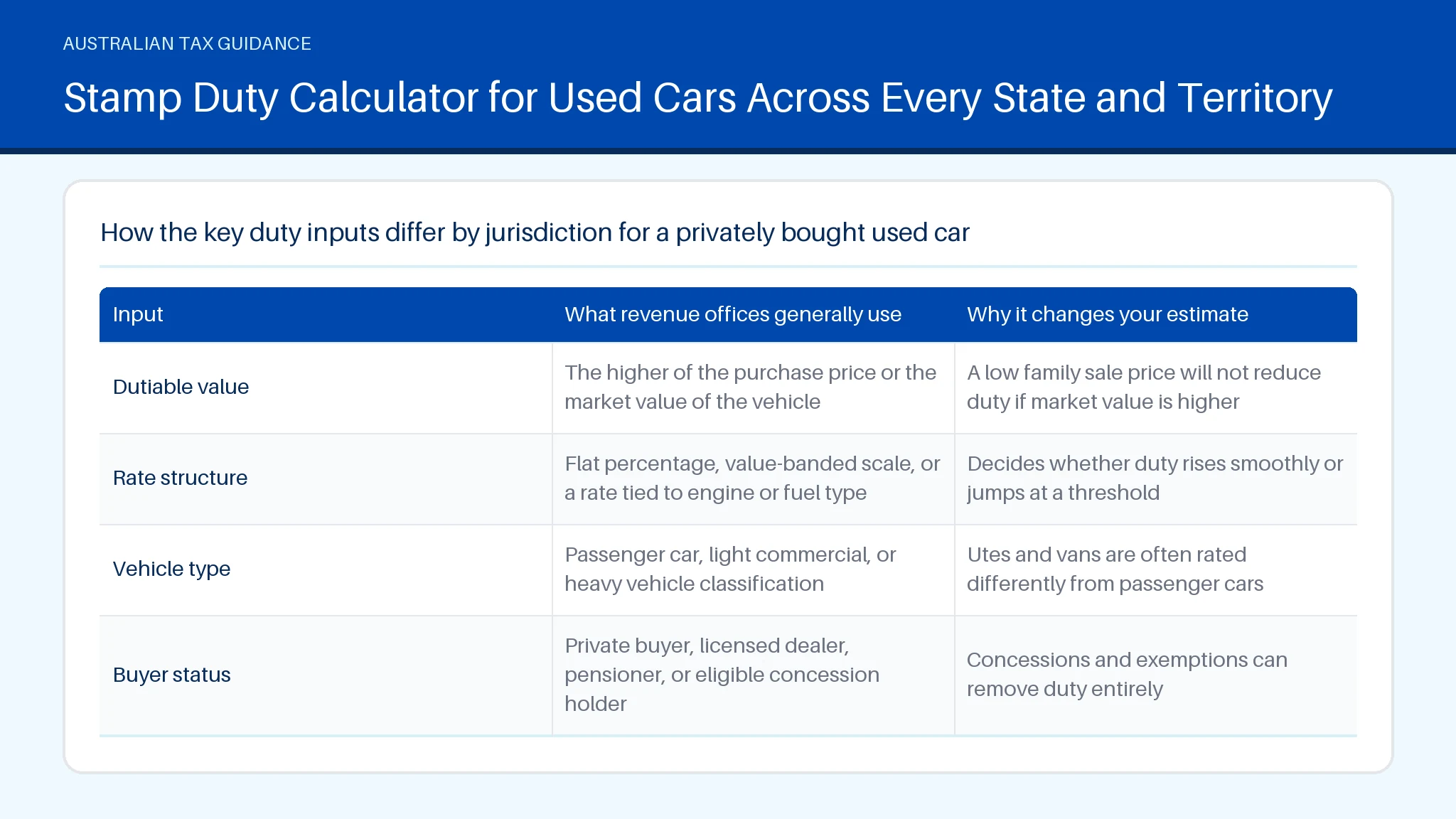
The table below compares how the main inputs differ, so you can see which figure a stamp duty calculator for used cars is actually asking you for.
| Input | What revenue offices generally use | Why it changes your estimate |
|---|---|---|
| Dutiable value | The higher of the purchase price or the market value of the vehicle | A low family sale price will not reduce duty if market value is higher |
| Rate structure | Flat percentage, value-banded scale, or a rate tied to engine or fuel type | Decides whether duty rises smoothly or jumps at a threshold |
| Vehicle type | Passenger car, light commercial, or heavy vehicle classification | Utes and vans are often rated differently from passenger cars |
| Buyer status | Private buyer, licensed dealer, pensioner, or eligible concession holder | Concessions and exemptions can remove duty entirely |
Work from the figure on the contract or receipt, then check the state revenue office's own calculator before you commit to a price.
Stamp Duty Calculator for Used Cars: Current Year Rates
Current year rates for a stamp duty calculator for used cars always come from the state or territory revenue office, not from the ATO. Each jurisdiction publishes its own scale and updates it in its budget cycle, so a figure quoted in an older article may no longer apply.
Rate scales fall into three broad shapes. Some states charge a flat percentage of dutiable value. Others use value bands, where the rate steps up once the price passes a threshold such as $45,000. A few set the rate by engine capacity, cylinder count or whether the vehicle is a passenger car or light commercial.
Two practical consequences follow. A car priced just above a band threshold can attract noticeably more duty than one priced just below it, which is worth knowing during negotiation. And electric or low-emission vehicles are treated differently in several jurisdictions, so the fuel type field on a calculator is not cosmetic. Confirm the current scale on the relevant revenue office page before you rely on an estimate.
What Duty and Transfer Fees Cost on a $40,000 Petrol Car
On a $40,000 petrol car, duty and transfer fees are two separate charges that arrive together. Duty is the percentage or banded amount calculated on the $40,000 dutiable value. The transfer fee is a fixed administrative charge for changing the registered operator, and it does not scale with price.
Where a stamp duty calculator for used cars gives you one number, your actual outlay at the service centre usually includes:
- motor vehicle duty on the dutiable value;
- a transfer of registration fee;
- any balance of registration or new plate charges if registration has lapsed;
- a late transfer penalty if you lodge outside the required window.
Budget for all four. Buyers frequently set aside duty alone and then find the total at the counter is higher. If the car is for a business, keep every receipt filed with your other vehicle paperwork, because the duty component forms part of the asset's cost rather than a standalone expense.
How Vehicle Stamp Duty Is Calculated in South Australia
South Australia calculates vehicle stamp duty on the dutiable value of the car using a banded scale, with separate treatment for commercial and non-commercial vehicles. Revenue SA publishes the current bands, and the duty rises in steps as value increases rather than at one flat rate.
Vehicle stamp duty in Australia is a state and territory tax charged when a motor vehicle is registered or transferred into a new owner's name. It is calculated on dutiable value, which revenue offices generally take as the greater of the purchase price and the market value of the vehicle. That is why a stamp duty calculator QLD buyers use will ask for a price but may still be overridden by a valuation if the sale was not at arm's length.
Stamp duty on a car is generally not immediately deductible. Where the vehicle is used to produce income, the ATO treats duty as part of the cost of the depreciating asset, so it is recovered through decline in value over the car's effective life rather than claimed in the year you buy. You can see how that interacts with claim methods in the guidance on business motor car expenses and the broader Deductit deduction library.
Duty is payable when the transfer of registration is lodged, which in most jurisdictions is within 14 days of the sale. Exemptions vary by state. In Victoria, exemptions and concessions apply to categories such as transfers between spouses or domestic partners, vehicles passing under a deceased estate, and certain primary producer and incapacitated person vehicles, with eligibility set out by the State Revenue Office. Check the exemption list for your own state before assuming you qualify.
How Vehicle Stamp Duty Is Calculated in New South Wales
New South Wales calculates motor vehicle duty using a two-tier rate on dutiable value, with a higher rate applying to the portion of value above the published threshold. Revenue NSW sets the threshold and the rates, and duty is collected when the transfer of registration is processed by Transport for NSW.
Three details change the result in practice. Duty is assessed on the greater of the price paid and the market value, so a nominal sale price will not reduce the bill. The calculation applies to the vehicle only, not to extras invoiced separately such as an aftermarket accessory fitted later. And new registrations and transfers use the same scale, so a used car does not attract a discounted rate simply because it is second-hand.
The arithmetic is the same whether you use a stamp duty calculator QLD residents reach for or the NSW equivalent, but the thresholds behind it are not interchangeable.
How Vehicle Stamp Duty Is Calculated in Tasmania
Tasmania calculates vehicle duty on a banded scale tied to the dutiable value of the vehicle, with the rate per $100 of value increasing as the value rises. The State Revenue Office of Tasmania publishes the bands, and heavy vehicles and some commercial classes sit outside the standard passenger car treatment.
The banded structure means marginal pricing matters. A vehicle valued just over a band boundary moves the whole calculation into a higher rate per $100, which can be worth a few hundred dollars on a mid-priced car.
As elsewhere, duty is assessed on the greater of the consideration paid and the market value. If you buy privately well below market, expect the revenue office to use its own valuation source rather than the figure on your receipt, and keep documentation that explains any genuine reason the car was worth less, such as accident damage or mechanical faults.
Estimating Duty on a Tasmanian Car Purchase
Estimating duty on a Tasmanian car purchase starts with settling on a defensible dutiable value, because every other step follows from it. Take the contract price, compare it with a market guide figure for the same make, model, year and condition, and use the higher of the two.
From there, work through a short sequence:
- confirm the vehicle class, since light commercial and heavy vehicles are rated separately;
- apply the current rate per $100 of value for the band your figure falls into;
- add the transfer of registration fee and any registration balance;
- check whether a concession or exemption applies before you pay.
Round the result up when you budget. Minor differences in recorded odometer readings or options lists can shift a valuation, and it is easier to absorb a small surplus than to find extra cash at the service centre. For business buyers, record the final duty amount against the vehicle in your Deductit workspace so it sits with the purchase documents.
Stamp Duty Calculator for Used Cars Across Every State and Territory
Stamp duty on a car is a one-off state or territory tax charged on the value of a motor vehicle when it is first registered or transferred to a new owner. More broadly, stamp duty is a tax on certain transactions and documents, applied by state and territory revenue offices rather than by the Commonwealth, which is why vehicle duty has no single national rate.
The cheapest car stamp duty depends on the price band you are buying in, not on one state being permanently lowest. Jurisdictions that apply a flat percentage tend to be cheaper at higher values, while those with low opening bands are cheaper on inexpensive cars. Some territories also apply reduced or nil rates to low-emission and electric vehicles, which can make them the cheapest option for that specific category. Compare the actual scale against your actual purchase price rather than relying on a general ranking.
You do pay stamp duty on a used car. Duty attaches to the transfer of registration, not to the newness of the vehicle, so a second-hand purchase from a private seller, a dealer or an auction is all dutiable unless a specific exemption applies.
Stamp duty is paid at the point you lodge the transfer of registration, usually within 14 days of the sale date. Private buyers typically pay at a service centre or online when lodging the transfer. Licensed dealers often collect and remit duty as part of the on-road costs quoted in the contract, so check the breakdown before assuming it is still outstanding. Late lodgement can attract a penalty on top of the duty itself.
When Motor Vehicle Duty Is Exempt or Not Payable
Motor vehicle duty is not payable where a specific exemption in the relevant state or territory legislation applies to the transfer. The categories are narrow and documented, and you generally have to claim them with supporting evidence rather than receive them automatically.
Commonly recognised exemption and concession categories include:
- transfers between spouses or domestic partners;
- vehicles transferred under a will or on intestacy from a deceased estate;
- transfers resulting from a family law property settlement;
- certain vehicles for eligible primary producers;
- specified concessions for pensioners and some incapacitated persons;
- repossessions and transfers to or from a licensed dealer for resale.
Each revenue office sets its own eligibility tests, evidence requirements and application forms, and the categories above are not uniform across the country. Confirm the current rules with the revenue office for the state where the vehicle will be registered, and keep the approval or exemption notice with your purchase records.
Summary
Eligibility for duty turns on where the vehicle is registered and whether a state exemption applies. Calculation runs on dutiable value, the greater of price paid and market value, against that jurisdiction's rate scale. Records matter because duty forms part of a work vehicle's cost for depreciation rather than an immediate claim. A stamp duty calculator for used cars gives you a budgeting estimate, not a tax position. Deductit shows the formulas behind vehicle deduction methods so you can find the deduction rules that apply and review your own figures against them.
You may also find these related guides helpful: Car Stamp Duty Calculator QLD: Estimate Vehicle Duty, Pay Calculator Australia: Work Out Your Take Home Pay, ATO Number: Which Line to Call for Your Tax Query, Log Book Method: How to Claim Your Car Deduction, ABN Registration: How to Apply, Costs and Who Qualifies, Balancing Account ATO: What It Means for Your Return, and BAS Explained: What to Report, Lodge and When.
Frequently asked questions
How much is stamp duty on a second hand car in South Australia?
Stamp duty on a second-hand car in South Australia is calculated on the dutiable value of the vehicle using Revenue SA's banded scale, with different treatment for commercial and non-commercial vehicles. A mid-priced used car attracts duty in the low hundreds to around a thousand dollars, but the exact amount depends on the current band your value falls into. Check the Revenue SA scale for the figure that applies on the day you transfer.
Do you pay stamp duty on second-hand cars in Australia?
You pay stamp duty on second-hand cars everywhere in Australia unless a documented exemption applies. Duty is triggered by the transfer of registration into your name, so it makes no difference whether the car is new, demonstrator or twenty years old. Private sales, dealer sales and auction purchases are all dutiable, and the revenue office assesses the greater of the purchase price and market value.
How much is stamp duty on a second hand car in QLD?
Stamp duty on a second-hand car in Queensland is calculated on dutiable value at a rate per $100 that depends on the vehicle's engine type, with hybrid and electric vehicles on a lower rate than multi-cylinder petrol vehicles. That engine-based structure makes the Queensland result unusual: two cars at the same price can attract different duty. Queensland Revenue Office publishes the current rate per $100 for each category.
How much is stamp duty on a second hand car in Victoria?
Stamp duty on a second-hand car in Victoria is calculated on dutiable value using rate bands that differ for new and used passenger vehicles, with a separate lower rate for primary producer and some commercial vehicles. Values above the luxury car threshold attract a higher rate on the whole value, not just the excess, which creates a noticeable step in the bill. Confirm the current bands with the State Revenue Office Victoria.
How do VicRoads calculate stamp duty?
VicRoads applies the duty rate set by the State Revenue Office to the vehicle's dutiable value when you lodge a transfer, collecting the amount as part of the transfer transaction. The difference between stamp duty and transfer duty is largely terminology: stamp duty is the historical name, transfer duty is the modern statutory term for the same tax on a dutiable transaction, and some jurisdictions use motor vehicle duty for vehicles specifically. If the car is for work, record the duty with the purchase documents and see how vehicle costs are claimed through the logbook method guide or start a record in Deductit's getting started steps.