An ATO late lodgement penalty is a fine the Australian Taxation Office can apply when you lodge a tax return, business activity statement or other required document after its due date. The Australian Taxation Office calls it the Failure to lodge on time penalty, or FTL penalty, and it is calculated in penalty units for each 28 day block that a document stays overdue rather than as a percentage of the tax you owe.
This guide is for individuals, sole traders and small business operators who have missed a deadline or are worried about one approaching. It explains who can receive an ATO late lodgement penalty, how the amount is worked out, when the ATO will waive or reduce it, and what records help you either avoid the penalty or support a remission request. For the wider picture on lodgement, rates and record keeping, start with our Australian tax guides hub.
Key takeaways
- The ATO applies a Failure to lodge on time (FTL) penalty when a return, activity statement or annual report is lodged after its due date, calculated in penalty units for each 28 day period the document is late.
- Penalty size scales with entity size: the ATO multiplies the base amount for medium entities and large entities measured by assessable income or GST turnover.
- A penalty is usually not applied where you are due a refund and have no other obligations outstanding, but lodging late can still stall your refund and your debt reporting.
- The ATO can remit a penalty in full or in part where circumstances outside your control caused the delay, and safe harbour can protect you where a registered agent lodged late.
- Keeping income statements, receipts and a lodgement diary in one place makes both on time lodgement and any later remission request far easier to support.
What Is an ATO Late Lodgement Penalty?
An ATO late lodgement penalty is an administrative penalty imposed under tax law when a taxpayer does not meet a statutory lodgement obligation by the due date. The ATO applies it to income tax returns, business activity statements, PAYG withholding annual reports, fringe benefits tax returns, taxable payments annual reports and similar documents. Anyone with lodgement obligations can receive one, including employees who lodge a simple return, sole traders, partnerships, trusts, companies and self managed super funds.
The size of the penalty depends on the entity's size, which the ATO sets by assessable income or GST turnover. The ATO can also waive or reduce the penalty where the delay was outside your control, and it states that it generally does not apply a penalty for a late tax return where no tax is payable or a refund is due and nothing else is outstanding.
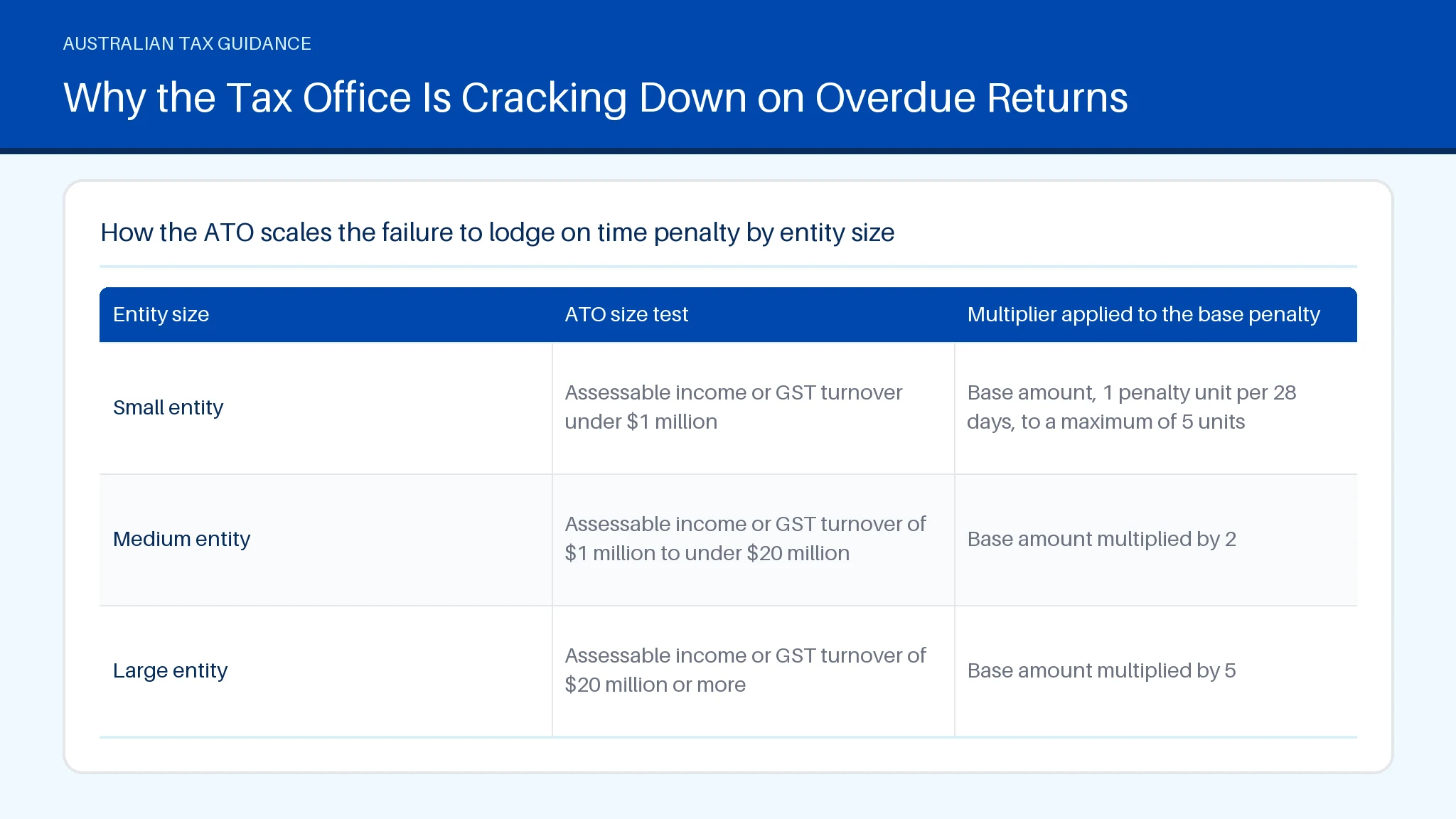
| Entity size | ATO size test | Multiplier applied to the base penalty |
|---|---|---|
| Small entity | Assessable income or GST turnover under $1 million | Base amount, 1 penalty unit per 28 days, to a maximum of 5 units |
| Medium entity | Assessable income or GST turnover of $1 million to under $20 million | Base amount multiplied by 2 |
| Large entity | Assessable income or GST turnover of $20 million or more | Base amount multiplied by 5 |
Can a Registered Tax Agent Reduce Your Fine?
A registered tax agent cannot cancel a penalty, but engaging one before the due date usually changes your deadline and gives you a stronger path to remission. Agents lodge under the ATO's agent lodgement program, which generally allows later due dates than the 31 October date that applies when you lodge your tax return yourself, provided you are on the agent's client list before that date.
An agent can also lodge a remission request that sets out your circumstances, confirm which obligations are outstanding, and reconstruct the records behind your work related and business deductions so the return is complete rather than rushed. Entity size still matters: where assessable income or GST turnover pushes you into the medium or large category, the base FTL amount is multiplied before any remission is considered.
Maximum Fine Now Facing Taxpayers Before the October Cut-Off
The maximum Failure to lodge penalty for a small entity is five penalty units for a single document, reached once that document is more than 140 days overdue. The Australian Taxation Office caps the FTL charge there, so the amount stops growing even if the return remains unlodged, but general interest charge continues to accrue on any tax you owe.
Missing the 31 October self lodgement date rarely produces the largest cost on its own. The bigger risks are compounding penalties across several documents, loss of access to agent concessions, and a default assessment that ignores the deductions you are entitled to claim. Sustained non-compliance can also lead the ATO to refer a return for prosecution, where court imposed fines are considerably higher than the standard ATO late lodgement penalty.
Safe Harbour Protection When Your Agent Lodges Late
Safe harbour protects a taxpayer from administrative fines where a registered agent caused the Failure to lodge, provided the taxpayer gave the agent all the relevant information in time. The taxation office will not apply the penalty if you can show you supplied your records before the due date and the delay sat with the agent, not with you.
Safe harbour has real limits. It covers the late lodgement penalty and false or misleading statement penalties, not the general interest charge on an outstanding assessment, and it does not cover an unregistered adviser or a bookkeeper preparing a GST activity statement outside agent registration. Keep dated emails, portal messages and file transfers showing when your information was handed over, because a documented handover is the evidence that separates a protected non-lodgement from an unprotected one.
How the Failure to Lodge on Time Charge Applies
The Failure to lodge charge applies automatically once a required document passes its due date, and it runs per document rather than per taxpayer. A business with four quarterly GST activity statements outstanding faces four separate penalty calculations, not one. Common triggers include a change of address that stops ATO mail reaching you, a business that keeps reporting after it stops trading, and a taxpayer who assumes nothing is due because no tax is payable.
The ATO usually issues a warning by phone or in writing before it raises the charge for individuals and small businesses, and it may remit the amount where you lodge promptly after that contact. If you cannot lodge on time, the practical sequence is to ask for a deferral before the date, lodge as soon as you can, then ask the ATO to remit the amount with reasons. ATO penalties for late lodgement are easier to argue down when the return itself is already in.
Penalty Unit Value and How the Total Is Calculated
One penalty unit is $330 from 1 July 2023, so a small entity accrues $330 for each 28 day period a document is late, to a maximum of $1,650. A medium entity doubles that figure and a large entity multiplies it by five, which is how a single missed deadline can reach $8,250 for the largest taxpayers.
The calculation is separate from interest. The general interest charge applies to unpaid tax, compounds daily and keeps running while the debt is unpaid, so lodging without paying still reduces ATO penalties for late lodgement but does not stop interest. If you are due a refund instead, no interest applies and the usual cost of lodging late is a delayed payment rather than a fine. Our pay calculator helps you estimate whether withholding has already covered the year's tax.
Australian Lodgement Due Dates You Need to Diarise
The core individual deadline is 31 October for a self prepared income tax return covering the year to 30 June. Quarterly activity statements fall due on 28 October, 28 February, 28 April and 28 July, and the annual PAYG withholding payment summary report is due 14 August.
Diarise two dates rather than one: the lodgement date and the payment date, since they differ for most activity statements. Businesses should also note the 28 day deadline that follows each quarter end and keep a standing reminder for superannuation guarantee, which carries its own consequences. Companies can map their reporting cycle with our small business tax guide, and individuals checking which deductions are substantiated before lodging can work through the deduction calculators. An early lodgement often means an earlier refund, with nothing unpaid left hanging over the year.
Why the Tax Office Is Cracking Down on Overdue Returns
The ATO is pursuing overdue returns because unlodged documents are now easier to detect and harder to justify. Single Touch Payroll reports wages in real time, banks and platforms report income directly, and prefilled data means the Australian taxation system already knows roughly what most people should declare before they lodge.
The ATO has also resumed firmer debt and lodgement action after the pandemic pause, including disclosing eligible business tax debts to credit reporting bureaus. For businesses, late now carries commercial consequences beyond ATO penalties: lenders and suppliers can see a reported debt, and an unlodged return blocks finance applications. A missed deadline that once attracted a quiet reminder is more likely to produce fines and follow up contact today.
How the FTL Penalty Is Triggered and Escalates
An FTL penalty is triggered the day after a document's due date passes without lodgement, then escalates in 28 day steps. One unit accrues immediately, a second at 29 days, and so on until the small entity cap of five units at 141 days. The FTL penalty stops growing at that point, but the obligation does not disappear.
Escalation beyond the FTL penalty takes a different form. The ATO may issue a default assessment based on estimated income, apply a 75 per cent administrative penalty on that assessment, or refer the matter for prosecution. Each outstanding document carries its own FTL penalty, so three late activity statements and one late return generate four separate FTL penalty calculations. Lodging every outstanding document at once is usually the fastest way to stop the FTL penalty clock, and it gives you a clean base from which to request remission of each FTL penalty already raised. Our deduction review workspace helps you assemble the figures those lodgements need.
Summary
Anyone with a lodgement obligation can receive an ATO late lodgement penalty, the amount is set by penalty units and entity size, and the ATO can remit it where the delay was outside your control. Deductit's ATO sourced deduction library and calculators help you organise records before you lodge, without giving personal tax advice.
You may also find these related guides helpful: Superannuation Calculator: Estimate Your Retirement Balance, Balancing Account ATO: What It Means for Your Return, BAS Explained: What to Report, Lodge and When, ATO Number: Which Line to Call for Your Tax Query, Self Managed Super Fund: Rules, Costs and Trustee Duties, Logbook Method: Claim Real Car Costs at Tax Time, Log Book Method: How to Claim Your Car Deduction, and Pay Calculator Australia: Work Out Your Take Home Pay.
Frequently asked questions
How much does the ATO charge for late lodgement?
The ATO charges one penalty unit of $330 for each 28 day period a document is late, to a maximum of five units, or $1,650, for a small entity. Medium entities pay double that and large entities pay five times, based on assessable income or GST turnover. The charge applies separately to each late document.
What is the penalty for submitting my tax return late?
Submitting your tax return late attracts the Failure to lodge on time penalty, starting at $330 and rising every 28 days to $1,650 for an individual or small entity. In practice the ATO often issues a warning first and may remit the amount if you lodge promptly, and it generally does not apply the penalty where you are due a refund and have no other obligations outstanding.
What happens if you pay the ATO late?
Paying the ATO late triggers the general interest charge rather than the lodgement penalty. Interest compounds daily on the unpaid balance from the due date until the debt is cleared, and the ATO can offset future refunds against it. A payment plan stops recovery action but does not stop interest accruing, so paying what you can sooner reduces the total.
Can I request remission of an ATO penalty for late lodgement?
You can request remission of an ATO penalty at any time, in writing or by phone, and there is no fee. Explain what caused the delay, such as illness, a natural disaster, a bereavement or an agent error, and attach supporting documents. The ATO decides case by case, and a request is far stronger once the outstanding document is lodged.
What can you do if your tax return is late?
Lodge the outstanding return as soon as possible, even if you cannot pay the resulting bill. Download your prefill data and income statements, reconstruct receipts for anything you intend to claim, then lodge through myTax or a registered agent. Our step by step myTax walkthrough covers the mechanics, and you can set up a records routine for next year in the Deductit workspace so the same deadline does not catch you twice.
Part of Australian Tax Guides