The Small Business Superannuation Clearing House (SBSCH) closed permanently from 1 July 2026 as part of the Payday Super reform. You can no longer use it to make payments or download records. The quarterly due date still applies. The Australian Taxation Office (ATO) says super guarantee contributions for the quarter ending 30 June 2026 remain due on 28 July 2026. If you paid SBSCH superannuation by the ATO deadline in past quarters, you now need a different payment method to meet that date.
This guide is for small business employers, bookkeepers and sole traders with staff who used the SBSCH. For later payments, the ATO lists other electronic options such as payroll software, a super fund's online system, a commercial clearing house, and EFT or BPAY direct to the fund, and if you use a commercial clearing house, the ATO counts super as paid on the date the fund receives it, not the date you pay the clearing house.
For a refresher on how employer contributions reach a member's account, start with our guide to how superannuation works in Australia.
The closure changes when a payment counts as made, as well as where you send it. The ATO's SuperStream guidance says a payment through the SBSCH met your obligation on the date the clearing house accepted it, as long as the super fund did not reject it. A commercial clearing house works differently. The ATO counts the contribution as paid on the date the super fund receives it, not the date the clearing house receives your money.
The difference matters most close to the due date. With a commercial clearing house, your payment has to be processed and reach every fund by the due date. The ATO tells employers to check with their clearing house so they allow enough processing time before the quarterly due dates. The acceptance-date rule that linked SBSCH superannuation and the ATO deadline does not apply to any payment you make now.
To meet SuperStream requirements, the ATO lists these electronic options: your payroll system, a super fund's online system, a super clearing house, EFT or BPAY direct to the fund, or a messaging portal. The ATO suggests checking your existing payroll software first, because it may already include super functions. Your accountant or bookkeeper can also help you use one of these options.
Keep these three questions separate:
- Eligibility: which payment methods you can use now that the SBSCH has closed.
- Calculation: how much super guarantee you owe each employee for the quarter.
- Records: what evidence shows each contribution reached the fund on time. The SBSCH can no longer be used to download records, so keep your own copies.
This guide covers payment methods, timing and records, based on current ATO guidance. For the wider year-end calendar, including lodgement dates, see our guide to end of financial year dates and ATO deadlines.
Key takeaways
- The ATO closed the Small Business Superannuation Clearing House (SBSCH) permanently from 1 July 2026 as part of the Payday Super reform. It can no longer take payments or provide record downloads.
- The ATO says super guarantee contributions for the quarter ending 30 June 2026 are still due on 28 July 2026.
- Through the SBSCH, your obligation was met on the date it accepted the payment, as long as the fund did not reject it. Through a commercial clearing house, a contribution only counts as paid when the fund receives it.
- The ATO lists other payment options: payroll software with super functions, a super fund's online system, a commercial clearing house, or EFT or BPAY direct to the fund messaging portal.
- Keep your own proof of payment, because you can no longer download SBSCH records.
What You Need Before Paying SBSCH Superannuation by the ATO Deadline
To pay on time, you need a working payment method, correct employee details and enough lead time. Since 1 July 2026 the ATO's own clearing house is no longer one of those methods. Have these ready before the quarter's due date:
- Contribution figures for each employee for the quarter, checked against your payroll records.
- The fund and member details for each employee. A rejected payment can undo an on-time payment.
- A SuperStream-compliant way to pay. Set it up and test it before the due date, not on it.
- Your past SBSCH payment history, saved from your own files. The ATO says you can no longer download records from the SBSCH.
- Each provider's processing times, so you know how many business days a payment takes to reach the fund.
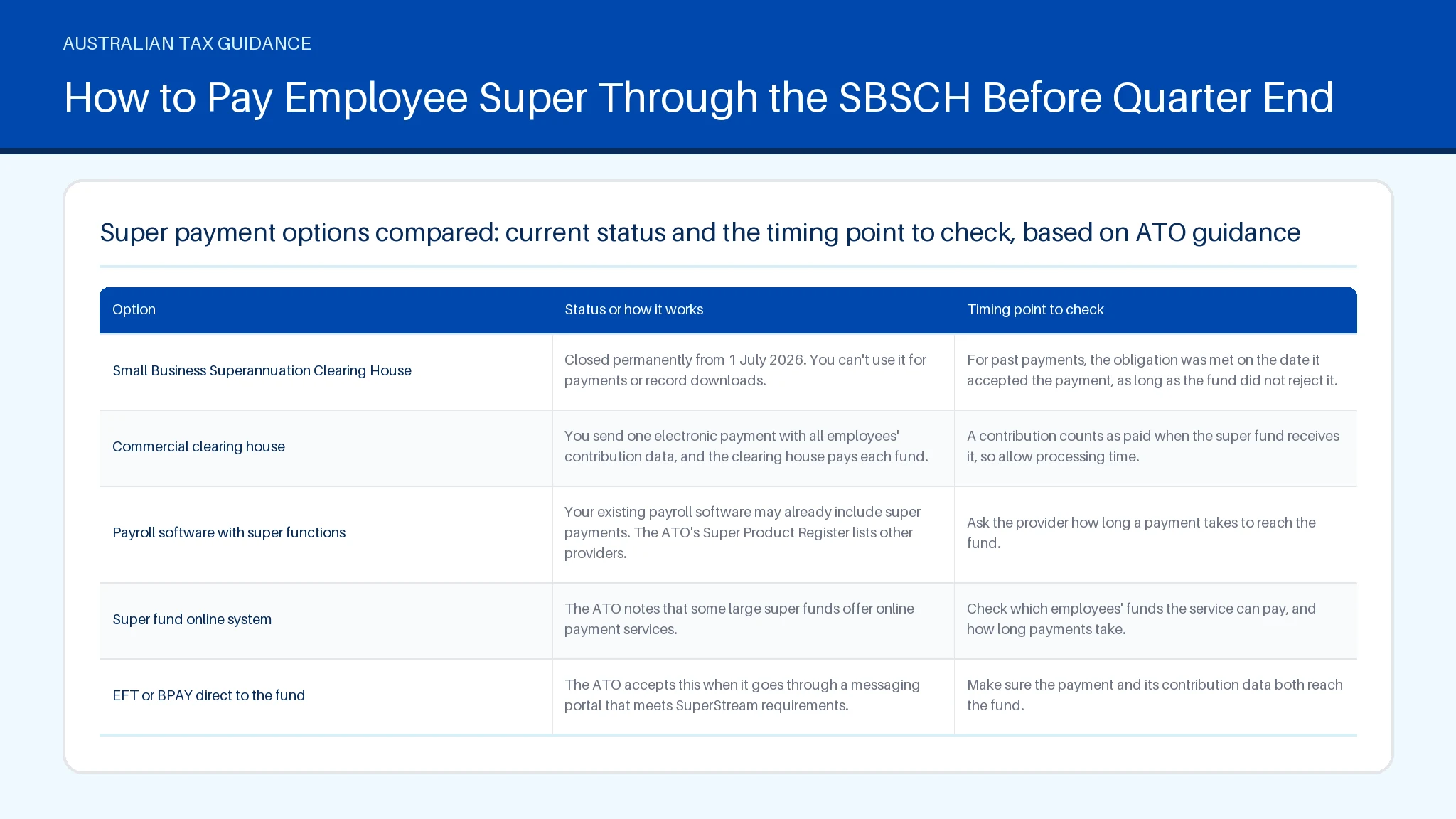
| Option | Status or how it works | Timing point to check |
|---|---|---|
| Small Business Superannuation Clearing House | Closed permanently from 1 July 2026. You can't use it for payments or record downloads. | For past payments, the obligation was met on the date it accepted the payment, as long as the fund did not reject it. |
| Commercial clearing house | You send one electronic payment with all employees' contribution data, and the clearing house pays each fund. | A contribution counts as paid when the super fund receives it, so allow processing time. |
| Payroll software with super functions | Your existing payroll software may already include super payments. The ATO's Super Product Register lists other providers. | Ask the provider how long a payment takes to reach the fund. |
| Super fund online system | The ATO notes that some large super funds offer online payment services. | Check which employees' funds the service can pay, and how long payments take. |
| EFT or BPAY direct to the fund | The ATO accepts this when it goes through a messaging portal that meets SuperStream requirements. | Make sure the payment and its contribution data both reach the fund. |
The ATO also notes that your accountant or bookkeeper can help you set up any of these options.
How to Pay Employee Super Through the SBSCH Before Quarter End
Employee super can no longer be paid through the SBSCH. It stopped accepting payments from 1 July 2026. Contributions for the June 2026 quarter that were not paid through it before it closed must go through another method by 28 July 2026. The steps below follow the old SBSCH routine but are adapted for the options the ATO now lists:
- Choose your payment method early. First check whether your existing payroll software already has super functions. If it doesn't, look at the ATO's Super Product Register, a large fund's online payment service, or a commercial clearing house.
- Enter or import each employee's contribution data. A clearing house takes one electronic payment covering all employees and then pays each fund.
- Pay well before the due date. Paying SBSCH superannuation on the ATO deadline itself used to work because acceptance counted as payment. With a commercial clearing house, the fund has to receive the money by the due date.
- Check holiday and maintenance schedules. In December 2025, payments that reached the ATO's clearing house after its cut-off were not processed until 2 January 2026, ahead of the 28 January 2026 quarterly due date. Ask your new provider whether it has similar pauses.
- Confirm receipt and save the evidence. Keep the confirmation that each fund received the payment, with the date.
SBSCH Mistakes That Cause Late or Missed Super Payments
Most late payments around the closure come from assumptions about timing, not from employers refusing to pay. A common mistake is relying on the old SBSCH superannuation ATO deadline routine, because the ATO says the SBSCH closed permanently from 1 July 2026, and with a commercial clearing house a contribution counts as paid on the date the super fund receives it, not on the date the clearing house receives it from you.
- Assuming the acceptance-date rule still applies. The rule that acceptance counts as payment applied only to the SBSCH. With a commercial clearing house, the ATO counts the date the fund receives the contribution.
- Overlooking fund rejections. Even with the SBSCH, the obligation was only met if the fund did not reject the payment. Wrong fund or member details can turn an on-time payment into a late one.
- Losing payment history. You can no longer download SBSCH records. If you didn't save them, rebuild your evidence from payroll reports, bank statements and fund confirmations. Our guide to what the ATO expects from your records explains good record-keeping habits.
- Setting up the new method in the due-date week. Registering, testing and importing data all take time. Do them before the quarter ends.
- Ignoring planned maintenance. Clearing houses and portals can pause processing over holidays.
If a payment is late, read about how ATO penalty risks are worked out. For how employer contributions are claimed at tax time, see our page on business super contribution deduction rules.
Summary
Paying SBSCH superannuation by the ATO deadline is no longer possible, because the ATO closed the clearing house permanently from 1 July 2026. Contributions for the quarter ending 30 June 2026 are still due on 28 July 2026.
Payment options: payroll software with super functions, a fund's online system, a commercial clearing house, or EFT or BPAY through a SuperStream messaging portal.
Timing: a commercial clearing house payment counts only when the fund receives it, so build in processing time.
Records: keep your own proof that each fund received each payment.
To review the related tax rules, you can browse the Deductit deduction library, run figures through the Deductit tax calculators, and keep notes in your Deductit workspace. Deductit does not pay super, give personal tax advice or lodge returns.
You may also find these related guides helpful: Aus Financial Year: What to Know, ATO Late Lodgement Penalty: What to Know, Carry-Forward Concessional Contributions: Rules and Timing, and How to Lodge BAS Online: Steps, Labels and Due Dates.
Frequently asked questions
What are the due dates for superannuation payments in Australia?
Super guarantee contributions are due quarterly. The two most recent due dates in ATO guidance are 28 January 2026 and 28 July 2026. The 28 July 2026 date covers contributions for the quarter ending 30 June 2026, which the ATO confirms is still due even though the SBSCH has closed.
The date you pay isn't always the date that counts. If you use a commercial clearing house, the fund must receive the contribution by the due date. Allow extra time for processing and public holidays.
What is super clearing house?
A super clearing house is a service that pays super to your employees' funds for you. You send it one electronic payment along with all your employees' contribution data, and it pays each fund.
The ATO lists clearing houses as one way to meet SuperStream requirements. The others are payroll systems, super fund online systems, and EFT or BPAY direct to the fund through a messaging portal.
What is the small business superannuation clearing house?
The Small Business Superannuation Clearing House (SBSCH) was the ATO's own clearing house for small business employers. One feature set it apart: your super obligation was met on the date the SBSCH accepted your payment, as long as the fund did not reject it.
The ATO closed it permanently from 1 July 2026. You can no longer use it to make payments or download records.
Why is it shutting down?
The SBSCH closed because the ATO shut it down permanently from 1 July 2026 as part of the Payday Super reform. Employers who used it need another way to pay.
The ATO suggests first checking whether your existing payroll software has super functions. If it doesn't, you can search its Super Product Register for providers, use a large super fund's online payment service if one is available, or use a commercial clearing house.