Tax deduction record keeping is the practice of capturing and storing written evidence for every expense you claim, so that each claim on your tax return can be traced back to a real payment made to earn your income. It matters for employees, sole traders and investors alike, because the Australian Taxation Office treats the absence of records as a reason to reduce or disallow a claim, even when the spending genuinely happened.
This guide covers three separate questions that are easy to blur together: whether an expense is deductible, how you calculate the claimable portion, and what evidence you need to keep. Each has its own rules. Our pillar guide to tax return deadlines, deductions and records sets out the lodgment side; this page stays with the records themselves.
Strong tax deduction record keeping also makes the return faster to prepare, because you are reading your own notes rather than reconstructing a year from bank statements and memory.
Key takeaways
- Good tax deduction record keeping means holding written evidence that shows what you bought, who you bought it from, the amount, the date and the work or business purpose.
- The ATO generally asks you to keep records for five years from the date you lodge the return in which you make the claim, and longer for assets involved in capital gains or depreciation.
- If your total work-related expenses are $300 or less, you can claim without receipts, but you still need to show how you worked the amount out and that you actually spent the money.
- Car claims need either a valid logbook covering 12 continuous weeks or a reliable record of work kilometres for the cents per kilometre method, not a round estimate written in June.
- Records can be digital, including photos of paper receipts, as long as the image is clear, complete and kept for the full retention period.
What Counts as a Tax Deduction in Australia
A tax deduction is an expense you incurred in earning assessable income, which you subtract from that income before tax is calculated. The ATO applies five practical record keeping principles: keep all records that explain your transactions, keep them in English or in a form that can be readily converted, keep them for the required retention period, do not alter or destroy them early, and be able to show the records if asked. Those principles sit behind the categories below, and they are why tax deduction record keeping is a year-round habit rather than a June task.
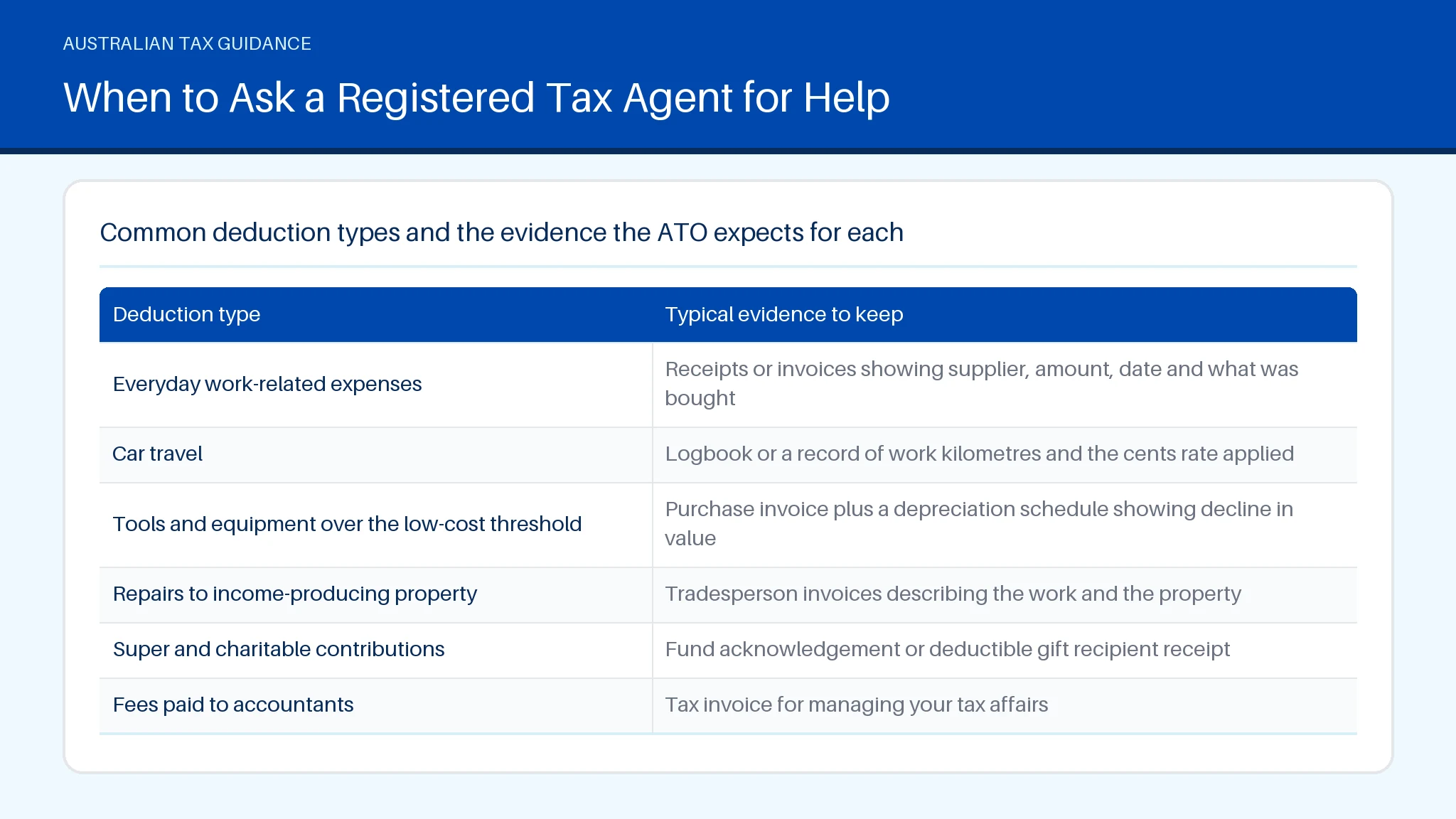
| Deduction type | Typical evidence to keep |
|---|---|
| Everyday work-related expenses | Receipts or invoices showing supplier, amount, date and what was bought |
| Car travel | Logbook or a record of work kilometres and the cents rate applied |
| Tools and equipment over the low-cost threshold | Purchase invoice plus a depreciation schedule showing decline in value |
| Repairs to income-producing property | Tradesperson invoices describing the work and the property |
| Super and charitable contributions | Fund acknowledgement or deductible gift recipient receipt |
| Fees paid to accountants | Tax invoice for managing your tax affairs |
Our deduction library lists the related expenses that apply to each category in more detail.
How to Organise Receipts Before Tax Time Arrives
Receipts are easiest to manage when you sort them at the moment of purchase rather than at tax time. Set up one folder per income year and one subfolder per claim type, then file each receipt the day it arrives. Thermal paper fades within months, so photograph paper receipts immediately; the ATO accepts a clear digital image of an original.
Write the work purpose on the record itself. A hardware receipt tells the ATO what you bought but not why, and the connection to earning your income is the part a reviewer cannot guess. A short note such as "replacement safety boots, site work" closes that gap.
For part-business items, record the split and the method you used to reach it, including the cents of GST where relevant. Keeping that working makes the eligible portion defensible when you prepare your tax return, and it turns a pile of receipts into a usable summary. Our deduction finder can help you label expenses by category as you go.
Car Expense Claim Errors That Trigger ATO Scrutiny
Car claims draw ATO attention because many are estimated rather than recorded. The deductions you can claim for a car cover work travel between sites, to alternative workplaces and for carrying bulky tools you cannot leave at work; ordinary home-to-work driving is private, regardless of how far you drive or how early your shift starts.
The errors the ATO flags most often follow a pattern:
- Claiming the full cents per kilometre cap without any record of trips taken.
- Keeping a logbook that covers fewer than 12 continuous weeks or omits odometer readings.
- Reusing an expired logbook beyond its five-year life without checking the pattern still holds.
- Claiming car running costs that an employer already reimbursed through wages or an allowance.
- Claiming both methods for the same vehicle in the same year.
A trip diary is the practical fix for irregular work travel, and sound tax deduction record keeping here protects the related expenses you claim alongside the car, such as parking and tolls. See the logbook method guide for how the percentage is worked out.
Substantiating Work Travel and Vehicle Running Costs
Substantiation for travel means showing both the cost and the work reason. For overnight trips, the Australian Taxation Office expects receipts for accommodation, fares and meals, plus a travel diary if you are away from home for six or more nights in a row. The diary records the dates, places, times and nature of each activity.
Running costs follow the method you choose. Under the cents per kilometre approach you need a reasonable record of work kilometres, such as a diary of trips, rather than invoices for fuel. Under the logbook approach you keep fuel, servicing, insurance and registration records, plus the decline in value of the car as a depreciating asset.
Check whether any travel expenses were reimbursed before you claim; reimbursed amounts are not eligible. Work out the likely effect on your refund with our tax calculators before you finalise the work-related expenses on your tax return.
Digital Tools for Capturing Expenses as You Spend
Capturing expenses at the point of sale removes the biggest cause of lost claims, which is simply forgetting what a payment was for. The Australian Taxation Office accepts digital records, so a photographed receipt stored with a short note meets the same standard as the paper original, provided the image shows the supplier, amount, date and goods.
Home office expenses show why timing matters. The fixed rate method requires a record of the actual hours you worked from home across the whole year, not an estimate, and the actual cost method requires receipts for each item plus a four-week representative record of use. Either way, the record has to be made as the year runs. Our page on working from home expenses covers the two calculation methods.
Phone and internet expenses are the other common trap. Claiming 100% of phone and internet expenses is only correct where there is genuinely no private use, which is rare for a personal service. Most people need a representative four-week usage record to support a work-use percentage, and then apply that percentage to the bills for the year.
Claiming expenses without keeping records is possible only in the narrow cases the ATO allows, such as small total work-related expenses, laundry below the set threshold, or award overtime meal allowances. Outside those cases, an undocumented claim can be reduced in full. Running a short monthly review in your deduction workspace keeps the evidence and the expenses in step.
Is Your Expense Actually Deductible for Your Occupation
Deductibility depends on your occupation and your actual duties, not on what colleagues claim. The ATO publishes occupation and industry guides setting out which items are deductible for each role, and the same purchase can be deductible for one worker and private for another. Sunscreen for an outdoor crew is a clear example; the same product bought by an office worker is not deductible.
Three tests decide the outcome. You must have spent the money yourself without reimbursement, the expense must directly relate to earning your income, and you must hold records. Where an item is partly private, only the work portion is deductible, including items you write down over time as a depreciating asset or claim at a cents per kilometre rate.
Compliance here is cheaper than correction. Overstated claims can attract penalties and interest, so check the rule for your role in our work expenses category before you lodge your tax return.
When to Ask a Registered Tax Agent for Help
Ask a registered tax agent for help when the facts are genuinely unclear rather than merely fiddly. Common triggers include running a business from home, holding an investment property, selling an asset during the year, receiving foreign income, or working across several employers with different allowances. A registered agent can give personal advice and lodge on your behalf; only agents on the Tax Practitioners Board register may charge for that work.
Bring your documentation with you. An agent charges for the time spent reconstructing records, so arriving with sorted work-related expenses, your cents per kilometre or logbook figures and a clean summary of related expenses keeps the accounting fee down. Fees for managing your tax affairs are themselves deductible in the following year.
Agent involvement does not transfer responsibility for accuracy, and penalties still apply to the taxpayer under Australian taxation law, so review the return before it is lodged. Our guide to choosing a registered agent explains what to ask.
Your 30 June Checklist for Accurate Deduction Claims
Finish the income year with a short, repeatable review. Work through the list below in the last week of June, while the detail is still fresh.
- Download the full year of statements and tag every payment that is related to earning your income.
- Photograph any paper receipts still in wallets, glove boxes or toolboxes.
- Total your work-related expenses by category and check each one against the ATO rule for your occupation.
- Close off your hours-at-home record and your car kilometres, then confirm your cents per kilometre or logbook figures.
- Confirm super and donation acknowledgements have arrived, since both need documentation before you claim.
- Note any reimbursements so you do not claim amounts an employer already paid.
- Check asset purchases for the year and record their cost, date and purpose.
Store the pack in one place, then compare it with the prefilled data when you prepare your tax return. If the review raises questions about an unusual item, that is the point to involve accountants, who can confirm the correct taxation treatment. Business owners can start the same review from our company deductions hub.
Summary
Eligibility depends on your duties and the income you earn, calculation depends on the method you choose and the work-use portion you can show, and records must prove both for the ATO's retention period. Deductit sets out those rules with ATO sources so you can organise your own evidence; start in the deduction checklist.
You may also find these related guides helpful: Self Managed Super Fund: Rules, Costs and Trustee Duties, Balancing Account ATO: What It Means for Your Return, Pay Calculator Australia: Work Out Your Take Home Pay, and Superannuation Calculator: Estimate Your Retirement Balance.
Frequently asked questions
What records need to be kept for 7 years in Australia?
Records connected to assets you may sell, such as property, shares or business equipment, need to be kept for five years after the capital gains event, which often means holding them well beyond seven years in practice. Purchase contracts, improvement invoices, depreciation schedules and selling costs all belong in that file, because the cost base you calculate at sale depends on them.
How long should ATO records be kept?
The ATO's general rule is five years from the date you lodge the return containing the claim, not five years from the purchase date. If the ATO reviews or amends your return, or you are in a dispute, keep the records until that matter is finalised and then for the remaining period.
What are the five rules for record keeping in Australia?
The five principles are straightforward: keep records that explain every transaction, keep them in English or readily convertible form, retain them for the required period, keep them unaltered and intact, and produce them if the ATO asks. Meeting all five is what makes a claim substantiated.
What records need to be kept for 7 years?
Asset and capital gains records sit in the longest retention group, along with depreciation schedules, superannuation documents and records relating to a business you have sold or closed. Donation receipts are the common exception people ask about: you need a receipt from a deductible gift recipient, although bucket collections for approved organisations can be claimed up to $10 in total without one.
Do I need to keep 7 years of bank statements?
Bank statements supporting a claim fall under the same five-year rule as the claim itself, and longer where they evidence an asset's cost base. Home-based business running expenses are a good example, since the statements often carry the only proof of utilities and internet charges. If you are unsure which period applies, ask the ATO or a registered agent before you delete anything, and keep a review record of what you hold.
Part of Tax return steps from records and pre-fill to your refund