ATO penalty risks are the administrative penalties and interest the Australian Taxation Office can apply when a return, activity statement or other approved form is lodged late, or when a statement in it is wrong. They are not criminal fines in most cases. They are calculated amounts, applied under the tax administration law, that can be reduced or cancelled when the facts justify it.
This guide is for individual taxpayers, sole traders, small business owners and the people who keep their records. It separates the three questions that actually decide your exposure: whether a penalty applies at all, how large it is, and what evidence can reduce it. Those three questions behave differently, and treating them as one is the most common reason a penalty notice surprises someone.
Two things matter before anything else. First, lodging late and paying late are separate problems with separate consequences. The failure to lodge penalty is driven by the calendar; general interest charge is driven by the unpaid balance. Second, the ATO generally does not apply an FTL penalty where lodging the return produces a refund or a nil result, so an overdue return is often cheaper to fix than people fear.
The rest of the risk comes from accuracy. If a figure in your return is wrong and tax was underpaid as a result, the ATO can impose a shortfall penalty. The size of that penalty depends on how the error happened, not on how large it is. Careless arithmetic, a position adopted without checking the law, and a deliberate omission sit at three very different points on the scale.
Across this guide you will find how the base penalty amount is set, what makes a position reasonably arguable, where significant global entities face far heavier exposure, and how to request remission. For context on lodgment mechanics and deadlines, the Australian Tax Guides hub covers the surrounding obligations in more detail.
Key takeaways
- ATO penalty risks fall into three broad groups: failing to lodge on time, making a false or misleading statement, and taking a tax position that is not reasonably arguable.
- The failure to lodge (FTL) penalty builds at one penalty unit for each 28 days (or part) a document is late, capped at five units for an individual or small entity, with multipliers for medium and large entities.
- Shortfall penalties are worked out as a base penalty amount, usually a percentage of the extra tax owed, set by the behaviour the ATO identifies: lack of reasonable care, recklessness or intentional disregard.
- Records are the practical defence. Written evidence of how a figure was worked out, and of the advice or law relied on, supports both a reasonably arguable position and a request for remission.
- Penalties can be reduced for voluntary disclosure and remitted in full or part where the ATO accepts the circumstances, but general interest charge on the underpaid tax is treated separately.
Why the ATO Applies Penalties to Taxpayers
The ATO applies penalties to encourage people to lodge on time and to take reasonable care with what they report, because the tax system relies on self-assessment. Penalties are not designed to raise revenue; they are designed to make the careful taxpayer no worse off than the careless one. That framing matters, because it explains why behaviour, not the dollar size of an error, drives most of the penalty rules.
Understanding which category your ATO penalty risks sit in tells you what to do next. A timing failure is fixed by lodging. An accuracy failure is fixed by amending and disclosing. A payment failure is handled through a payment arrangement and interest remission.
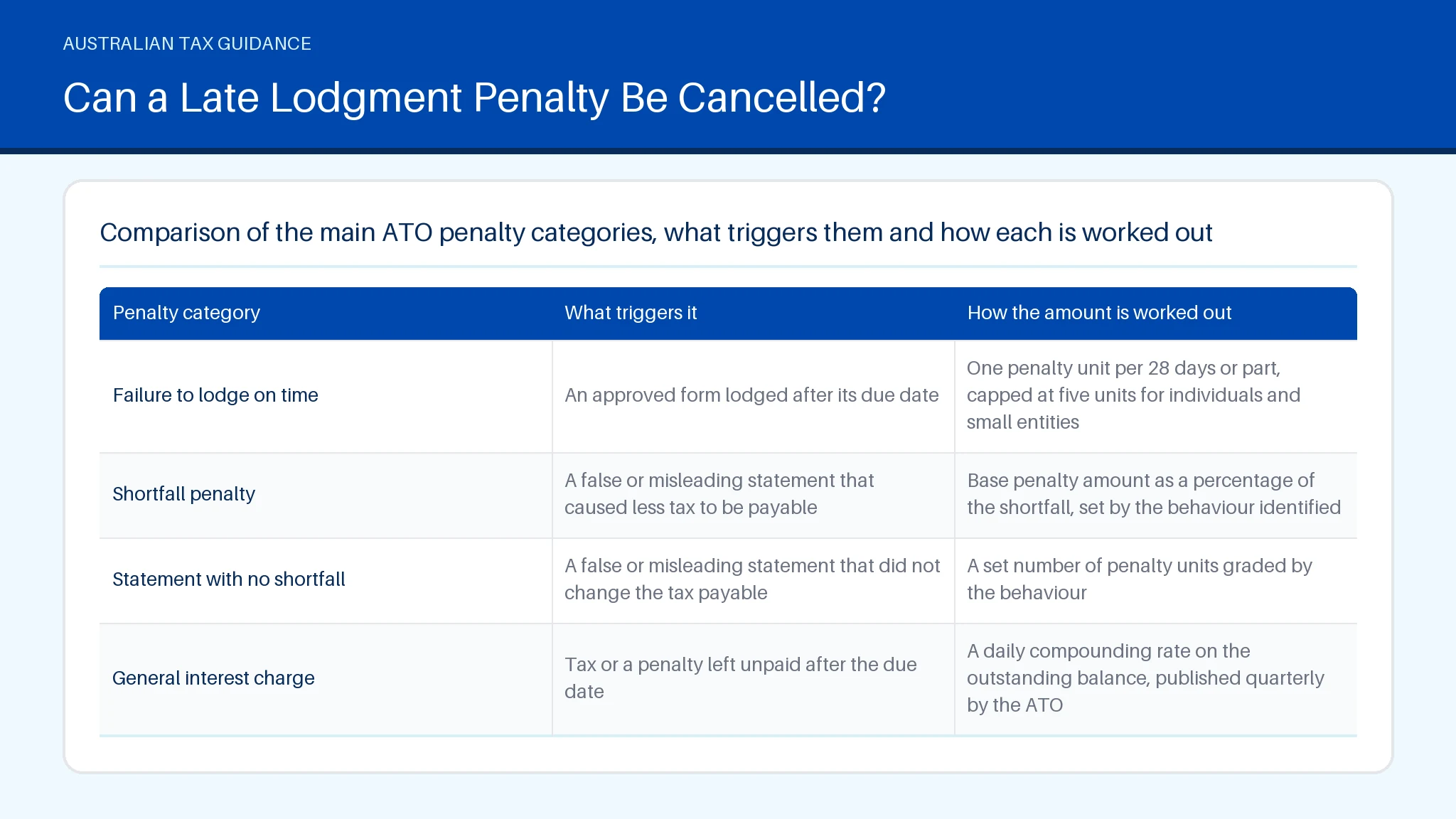
| Penalty category | What triggers it | How the amount is worked out |
|---|---|---|
| Failure to lodge on time | An approved form lodged after its due date | One penalty unit per 28 days or part, capped at five units for individuals and small entities |
| Shortfall penalty | A false or misleading statement that caused less tax to be payable | Base penalty amount as a percentage of the shortfall, set by the behaviour identified |
| Statement with no shortfall | A false or misleading statement that did not change the tax payable | A set number of penalty units graded by the behaviour |
| General interest charge | Tax or a penalty left unpaid after the due date | A daily compounding rate on the outstanding balance, published quarterly by the ATO |
The ATO publishes the current penalty unit value and the GIC rate, and both change over time, so always confirm the figure that applies to your period before estimating an amount.
What Counts as a Reasonably Arguable Tax Position
A reasonably arguable position is one where, on the facts and the law as they stood when you lodged, the argument for your treatment is about as likely to be correct as it is to be wrong. The ATO's test is not whether your view is more likely than not to win. It is whether a reasonable person, properly informed, could conclude the position was as likely as not correct.
That standard is higher than simple good faith and lower than certainty. A hopeful reading of a single sentence in a guidance page does not reach it. A position supported by the words of the provision, a public ruling, or a court or tribunal decision on comparable facts usually does.
The distinction carries real money. For taxpayers subject to the reasonably arguable requirement, a shortfall from a position that fails the test attracts a base penalty of 25 per cent of the shortfall, even where the taxpayer was otherwise careful. Showing the position was reasonably arguable removes that penalty entirely, which is why the analysis is worth documenting at the time rather than reconstructing it after an audit letter arrives.
Practical evidence of a reasonably arguable position includes a dated file note naming the provision relied on, copies of the rulings or decisions considered, and a short explanation of why competing interpretations were rejected. Where you relied on written advice from a registered agent, keep the advice itself, not just the conclusion. If you are unsure whether a claim is even available before you get to the arguability question, the Deductit deduction library sets out the eligibility rules the ATO applies to common expense categories.
How the ATO Calculates the Size of a Penalty
The ATO calculates a penalty in two steps: it works out a base amount, then adjusts it up or down. For shortfall penalties the base amount is a percentage of the extra tax that would have been avoided. For lodgment and no-shortfall penalties the base amount is a fixed number of penalty units multiplied by the unit value in force at the time of the failure.
The adjustments are where behaviour after the event counts. The base amount increases by 20 per cent where the taxpayer took steps to prevent the ATO finding the shortfall, or where there is a previous shortfall penalty for the same kind of conduct. It decreases by 20 per cent where a voluntary disclosure is made after the ATO tells you an examination is starting, and by 80 per cent where the disclosure is made before you are notified.
These ATO penalty risks compound with general interest charge, which runs on the underpaid tax from the original due date, not from the date the amendment is processed. A small shortfall discovered several years later can therefore cost more in interest than in penalty. Working out the tax effect first, using the current Australian tax rates and brackets, gives you a realistic figure before you contact the ATO.
Grounds for Getting a Tax Penalty Remitted
A penalty can be remitted in whole or in part where the ATO accepts that applying it in full would be unreasonable in the circumstances. Remission is a discretion, so the request has to give the decision maker facts to work with rather than an appeal to fairness.
Grounds the ATO commonly accepts include serious illness or a death in the immediate family around the due date, a natural disaster affecting your records or premises, a documented failure by a third party you reasonably relied on, and a first lodgment failure by an otherwise compliant taxpayer. Records destroyed in a flood or fire, with evidence of the event, carry more weight than a general statement that the year was difficult.
What rarely succeeds on its own is being busy, losing access to a login, or disagreeing with the underlying law. A pending objection is a separate process from remission, although you can pursue both.
A useful request does four things: names the penalty and the notice it appeared on, states the period affected, sets out the facts in date order with supporting documents attached, and explains what you have changed so the failure does not repeat. If an audit or review is already underway, make the request through the officer handling it, because they hold the file and the context. Keeping your substantiation organised in your Deductit workspace makes that chronology far quicker to assemble.
ATO Penalty Risks for Significant Global Entities
Significant global entities face penalty amounts that are an order of magnitude larger than those applying to ordinary taxpayers. An SGE is broadly a member of a group with annual global income of A$1 billion or more, and once that threshold is crossed, the administrative penalty for late lodgment of an approved form is multiplied by 500. That turns a routine timing slip into a six-figure exposure, which is why SGE groups treat lodgment calendars as a governance control rather than a compliance chore.
The multiplier applies to the FTL penalty and to several statement-related penalties. SGEs also have extra obligations attached to general purpose financial statements and country-by-country reporting, each with its own due date, so the number of ways to be late is larger than for a domestic company.
Superannuation guarantee carries its own regime for every employer, regardless of size. Where an employer does not pay the full superannuation guarantee by the quarterly due date, it must lodge a superannuation guarantee charge statement. The Part 7 penalty applies for not lodging that statement on time and can be up to 200 per cent of the superannuation guarantee charge itself, reducible where the employer lodges before the ATO begins compliance action. Lodging the statement, even when the shortfall cannot be paid immediately, is what preserves access to that reduction; not lodging it leaves the maximum penalty in place.
Two practical points follow for any entity. Lodging an approved form on time protects you even when payment has to wait, and the obligations attached to employing staff and running an entity sit alongside income tax lodgment, not inside it. The small business and company deductions hub covers the expense side of those obligations, and how to lodge a tax return in myTax walks through the individual lodgment path.
False or Misleading Statements With No Tax Shortfall
Some ATO penalty risks arise with no money at stake: a false or misleading statement can attract a penalty even when no extra tax results. The law treats the accuracy of what you tell the ATO as an obligation in its own right, because wrong information distorts assessments, refunds and compliance decisions whether or not it changes the bottom line.
Where there is no shortfall, the penalty is expressed in penalty units rather than as a percentage. The number of units reflects the behaviour: a smaller number where the statement resulted from a failure to take reasonable care, more where it was reckless, and the highest where the ATO finds intentional disregard of the law. A statement is not false or misleading merely because a figure later changes; it has to be wrong when made.
These ATO penalties most often arise from reporting errors in activity statements, incorrect labels on an entity return, overstated losses that were never used, and claims reversed before they affected an assessment. Safe harbour can apply where you gave a registered agent all the relevant information and the error was the agent's, which is one reason to keep what you sent and when. Reviewing figures before lodgment, including through the Deductit review step, catches most of these errors while they are still costless to fix.
Penalties for Not Issuing a Tax Invoice on Request
A supplier registered for GST must give a recipient a tax invoice within 28 days of being asked for one, and failing to do so is a penalised obligation under the tax administration law. The penalty is set in penalty units rather than as a share of the transaction, so a small sale and a large one attract the same amount.
Administrative penalties across the system are expressed this way. A penalty unit is a dollar figure fixed by legislation and indexed periodically, so the same number of units costs more after each increase. The relevant value is the one in force when the failure occurred, which means an old failure is measured against the older, lower figure. The ATO publishes the current and historical penalty unit values, and those are the figures to use when estimating any unit-based penalty.
The practical risk sits with the recipient as much as the supplier. Without a valid tax invoice, a business generally cannot claim a GST credit for a purchase above the low-value threshold, so a missing invoice costs the buyer the credit and exposes the supplier to the penalty. Chasing the document promptly protects both sides.
Keep requests in writing with a date, because the 28 day clock runs from the request. If you are reconstructing records for an earlier period, note which purchases lack a compliant invoice before you lodge rather than after, and check the substantiation rules for the expense in the deduction finder so you know what evidence the claim actually requires.
Can a Late Lodgment Penalty Be Cancelled?
A late lodgment penalty can be cancelled, and in practice many are. The ATO has a general discretion to remit the FTL penalty, and it also applies a softer approach in defined situations rather than waiting for a request.
Three patterns lead to cancellation most often, and they cover a large share of everyday ATO penalty risks. The first is where lodging the overdue return produces a refund or a nil result, in which case the ATO generally does not apply the penalty at all. The second is a first failure by a taxpayer with an otherwise clean lodgment history, where a warning is often issued instead. The third is a documented circumstance outside your control, such as illness, bereavement or a declared natural disaster.
The sequence matters. Lodge the outstanding document first, then ask for remission. A request made while the form is still outstanding has little to work with, because the failure is continuing and the penalty is still accruing at one unit per 28 days.
If the penalty has already been paid, you can still ask for it to be remitted and refunded. Set out the dates, attach evidence, and say plainly what you are asking for.
How the Base Penalty Amount Is Set
The base penalty amount for a tax shortfall is a percentage of the shortfall, set by the behaviour that caused it. The ATO works through the conduct first and the dollars second, which is why two taxpayers with identical errors can face very different penalties.
The scale has four recognised levels:
- Failure to take reasonable care: 25 per cent of the shortfall, where you did not do what a reasonable person in your position would have done.
- No reasonably arguable position: 25 per cent, where the requirement applies and the position adopted was not as likely as not correct.
- Recklessness: 50 per cent, where there was a real risk of a shortfall that you disregarded.
- Intentional disregard: 75 per cent, where the law was known and deliberately ignored.
Each level is then adjusted by the increases and reductions described earlier, including the 80 per cent reduction for a voluntary disclosure made before notification of an examination. A taxpayer who finds a 50 per cent recklessness error and discloses it early can bring the effective rate down to 10 per cent of the shortfall.
Reasonable care is assessed against your circumstances, not an expert standard. Using a calculation method the ATO publishes, keeping the inputs, and checking figures against your own records are the ordinary steps that evidence it. The Deductit calculators show the formula behind each result, which gives you a working to keep with the claim.
Summary
ATO penalty risks turn on three separate questions. Eligibility for a penalty depends on whether a form was late, whether a statement was wrong, and whether tax was underpaid as a result. Calculation depends on penalty units for timing and unit-based failures, and on a behaviour-based percentage of the shortfall for accuracy failures, with increases for concealment and reductions of up to 80 per cent for early voluntary disclosure. Records decide the rest: a dated note of the law relied on, the inputs behind each figure, and evidence of any circumstance outside your control. Deductit sets out ATO deduction rules and shows the formula behind each calculation so you can keep a working with your records. It does not provide personal tax advice or lodge returns on your behalf. Check current rates and thresholds against ATO guidance for your period, or speak with a registered tax agent about your own position.
You may also find these related guides helpful: Logbook Method: Claim Real Car Costs at Tax Time, ATO Number: Which Line to Call for Your Tax Query, Balancing Account ATO: What It Means for Your Return, BAS Explained: What to Report, Lodge and When, End of Financial Year 2025: Dates and ATO Deadlines, Log Book Method: How to Claim Your Car Deduction, PAYG Calc: Turn Gross Pay Into Take-Home Pay Estimates, and Tax Return Australia: Deadlines, Deductions and Records.
Frequently asked questions
Can you go to jail for owing ATO money?
Imprisonment for owing the ATO money is not a realistic outcome for an ordinary tax debt. Administrative penalties and general interest charge are civil amounts recovered as a debt, and the ATO's usual escalation is a payment arrangement, then garnishee notices, director penalty notices or legal recovery action. Criminal prosecution is reserved for conduct such as tax fraud, deliberately falsified documents or persistent failure to lodge after repeated formal notices, and those are prosecuted as offences rather than collected as penalties. Owing money while engaging with the ATO is a payment problem. Lying about what you owe is a different problem. The practical risk for most people with a debt is compounding interest, a default assessment if returns stay outstanding, and the effect of a reported business tax debt on credit.
What will trigger an ATO audit?
An ATO audit is usually triggered by a mismatch between what you reported and what the ATO already knows. Prefilled data from employers, banks, share registries, health funds, state revenue offices and digital platforms is matched against your return, so an omitted interest amount or a missing capital gain stands out immediately. Other common triggers are deduction claims well outside the benchmark range for your occupation or industry, business ratios that sit away from small business benchmarks, repeated late lodgment, large or unusual refunds, cash-heavy operations with low reported margins, and a tip-off. An audit is not an accusation. Being able to produce the records behind each figure, in the form the ATO expects, is what turns a review into a short conversation.
How to get out of an ATO fine?
Getting out of an ATO fine starts with lodging or amending whatever is outstanding, then asking in writing for the penalty to be remitted. State the penalty type and the notice it appeared on, the period, the facts in date order, and attach evidence such as a medical certificate, a death certificate, a disaster declaration or correspondence showing a third party's failure. Explain what has changed so the failure will not repeat. If you accept the facts but dispute the law, lodge an objection instead; if you dispute the amount of a shortfall penalty, you can argue the behaviour was lower on the scale, or that your position was reasonably arguable. Remission requests are decided on the circumstances, so there is no fixed entitlement, and interest is considered separately from penalty.
What happens if you don't pay the ATO?
If you do not pay the ATO, the debt attracts general interest charge that compounds daily until it is cleared. The ATO will contact you, and unpaid business tax debts above the reporting threshold can be disclosed to credit reporting bureaus where the business is not engaging. Beyond that, the ATO can issue a garnishee notice to your bank or a third party who owes you money, issue director penalty notices making directors personally liable for unpaid PAYG withholding, GST and superannuation guarantee charge, offset refunds against the debt, and take court action. Payment arrangements are available and can be set up online for smaller amounts, and interest-only remission is sometimes granted where you keep to the plan. Contacting the ATO before the due date keeps the most options open.
What is the ATO 6 year rule?
The ATO six year rule lets you keep treating a former home as your main residence for up to six years after you move out and rent it, so a sale within that time can still be free of capital gains tax, as long as you claim no other main residence for that period and are an Australian resident when you sell. It is separate from record keeping, where you generally keep records for five years from the date you lodge, and from the amendment period, which generally lets the ATO change an assessment within two years for simple individual affairs and four years otherwise, with no limit where fraud or evasion is involved. The Deductit get started page explains what to gather before you begin.
Part of Australian Tax Guides