Bank interest counts as income in Australia. It goes in your tax return for the income year it was paid or credited to you. The myTax instructions list interest from accounts and term deposits with Australian financial institutions, interest the ATO paid or credited to you, and interest on children's accounts you opened or ran with your own money. You also have to report interest from bank accounts you hold overseas.
This guide is for individuals, joint account holders, parents who manage children's savings and small company owners. It answers the common search question, is bank interest taxable. It then covers what your annual statement shows, how the tax is worked out, which records to keep and where the figures go.
What you need before you start:
- the annual interest statement for every account in your name or held jointly, including term deposits
- any notice of assessment or statement of account showing interest paid to you on early payments, overpayments or a delayed refund
- statements for any bank accounts you hold in other countries
- a note of whose money is in any children's account you operate
Once the answer to is bank interest taxable is clear, the work is reporting the correct gross figures. The sections below explain how.
Key takeaways
- Interest paid or credited to you by an Australian bank goes in your tax return for the income year you receive it. This includes savings accounts and term deposits.
- Banks report the interest they pay, and myTax pre-fills those figures. You still need to check them and add anything missing, such as interest from overseas accounts.
- If your bank does not hold your tax file number, it withholds tax at the highest marginal rate. You claim that amount back as a credit when you lodge.
- For a joint account, myTax asks for the number of account holders, the total gross interest and the total TFN amounts withheld.
- You can claim expenses you incur in earning interest income, so keep the records that support them.
What Your Bank's Annual Interest Statement Shows
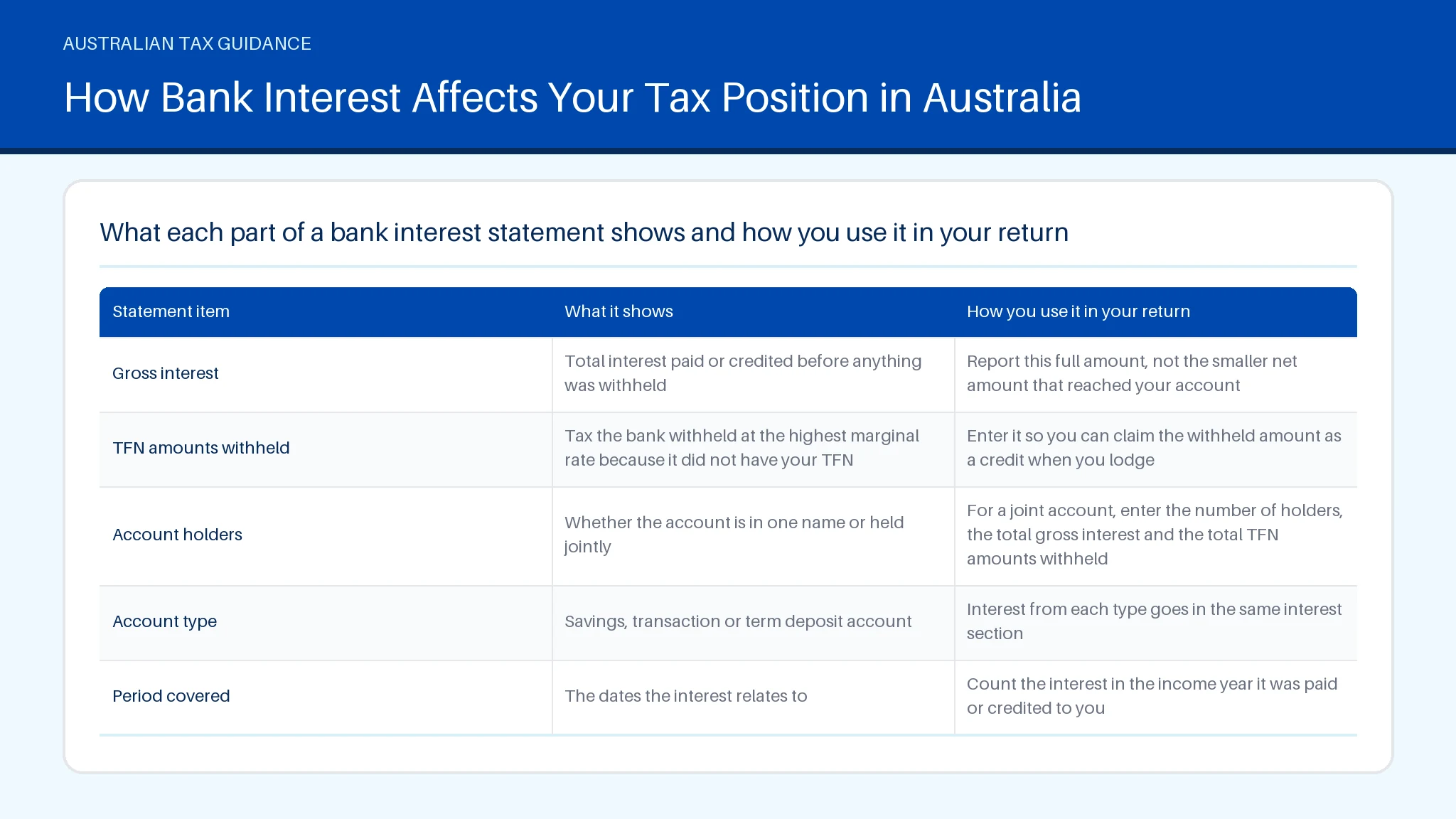
Your bank's annual interest statement shows the gross interest paid or credited to each account, any tax withheld and who holds the account. The Australian Taxation Office gets the same information because banks and other investment bodies report the interest they pay to account holders. If your question was is bank interest taxable, this statement turns the answer into a number. The gross figure is assessable income, and the ATO pre-fills your return with the amount the bank reported.
| Statement item | What it shows | How you use it in your return |
|---|---|---|
| Gross interest | Total interest paid or credited before anything was withheld | Report this full amount, not the smaller net amount that reached your account |
| TFN amounts withheld | Tax the bank withheld at the highest marginal rate because it did not have your TFN | Enter it so you can claim the withheld amount as a credit when you lodge |
| Account holders | Whether the account is in one name or held jointly | For a joint account, enter the number of holders, the total gross interest and the total TFN amounts withheld |
| Account type | Savings, transaction or term deposit account | Interest from each type goes in the same interest section |
| Period covered | The dates the interest relates to | Count the interest in the income year it was paid or credited to you |
Check that the statement period matches the income year you are lodging for. Then add any account that has not pre-filled.
Legal Ways to Reduce Tax on Savings Interest
The legal ways to reduce tax on savings interest are claiming what you are entitled to and stopping withholding from tying up your cash. The answer to is bank interest taxable does not change, so interest you earn still has to be reported.
- Give your bank your TFN. Without it, the bank withholds tax at the highest marginal rate. You get that money back as a credit when you lodge, but you can't use it until then. Under the ATO's bank account guidance, children under 16 don't need to provide a TFN for an account in their own name that earns less than $420 in interest each income year. Our guide to getting a tax file number explains how to apply.
- Claim the costs of earning the interest. Expenses you incur in earning interest income can be deductible. The rules are set out on our investment interest and account-keeping fees page, and the Deductit deduction calculators can help you estimate a claim.
- Keep records of whose money is in a child's account. The interest is yours to report if you opened or ran the account with your own funds, or used the funds as if they were yours.
- Report joint savings accounts as joint. Enter the number of holders with the totals. Don't report the whole amount as if it were yours alone.
Worked Example: Calculating the Tax Owed on Bank Interest
Is bank interest taxable? Yes. The ATO's 2026 gross interest instructions tell you to declare interest received or credited to you from any source in Australia, including accounts and term deposits. For example, if you bank prize money, you usually leave the prize out of your return but include the interest it earns (ATO).
- Check the pre-fill. Banks report the interest they pay to the ATO, and myTax pre-fills it. Check each amount and add any interest that has not pre-filled (myTax 2026).
- Joint accounts. Show the number of account holders, the total gross interest and the total TFN amounts withheld.
- No TFN held. Your bank withholds tax at the highest marginal rate. You claim a credit for that amount when you lodge.
- Costs. You can claim a deduction for expenses incurred in earning interest income.
- Overseas accounts. Interest from bank accounts in other countries must also go in your Australian tax return, or you may face additional charges.
How much tax you end up owing depends on your whole return, so work through these steps with your own bank statements.
How Bank Interest Affects Your Tax Position in Australia
Interest paid or credited to you from any source in Australia goes in your return. The ATO's 2026 interest instructions include interest on accounts and term deposits with Australian financial institutions, and on children's accounts you opened or operated with your own funds. For individual brackets, see our guide to tax rates in Australia for 2025-26 and 2026-27.
- Pre-filled figures are a starting point. Banks report interest, which pre-fills your return. Check it against statements and add missing accounts.
- The interest counts, not the deposit. Banked prize money usually stays off your return, but the interest it earns goes on. Expenses incurred in earning interest can be claimed as a tax deduction.
- Withholding is a credit. A bank without your TFN withholds tax at the highest marginal rate, and you claim a credit for it when you lodge.
- Overseas interest counts. Report interest from accounts in other countries, even if that country does not require it. Additional charges may apply otherwise.
- Non-residents are treated differently. Withholding tax deducted from their interest is a final tax and is not declared as income. Without an overseas address, tax is withheld at 47%.
How Company Interest Income Is Taxed at the Corporate Rate
Interest income is the amount a bank or other financial institution pays or credits to an account holder for money held on deposit. Whoever is entitled to the interest reports it. When a company holds the account, the interest belongs to the company, not to its directors or shareholders. Banks and other investment bodies report the interest they pay to account holders and investors to the ATO, so statements should match the tax return. Our small business tax deductions hub covers related company claims.
Individuals report interest differently. In myTax, select the Australian interest option at Personalise return. Then select Add/Edit at the Interest banner and add any account that has not pre-filled. On the paper individual return, interest goes at question 10, Gross interest.
Some interest does not end up in your taxable income:
- For non-residents, the ATO treats withholding tax deducted from interest as a final tax. That interest is left out of taxable income, and you select your country of residence in myTax when you report it.
- The money you deposit is not interest. If you bank prize money, for example, you usually don't include the prize itself in your return, but you do include the interest it earns.
- Interest on a child's account may not belong in a parent's return. It does belong there if the parent opened or ran the account with their own funds.
Sample Interest Income Summary: What Each Part Means
Your bank's interest summary has a few lines, and the ATO's myTax interest instructions explain where each one goes.
- Account holders. For a joint account, enter the number of holders, the total gross interest and the total TFN amounts withheld.
- Gross interest. Enter the total interest paid or credited, not the amount left after withholding.
- TFN amounts withheld. A bank without your TFN withholds tax at the highest marginal rate, and you can claim a credit for it when you lodge.
The Australian Taxation Office's myTax instructions say the interest you declare can come from more than one statement, covering accounts and term deposits with Australian financial institutions, interest the ATO paid or credited to you, and interest on children's accounts you opened or operated with your own funds. Check for these assessable items:
- interest the tax office paid you on early payments, overpayments or delayed refunds
- interest from bank accounts held overseas
- pre-filled interest from a child's account, checked against TD 2017/11 to see whose funds it holds
Summary
The answer to is bank interest taxable in Australia is yes for residents. The ATO says interest paid or credited by an Australian bank, and interest earned on overseas accounts, must be reported in your tax return. Check pre-filled figures against your statements, report gross interest and any TFN withholding, and keep your statements and notices. You can then plan your next steps in your Deductit workspace.
You may also find these related guides helpful: Aus Financial Year: What to Know, BAS Requirements: Who Must Report, Deadlines and How to File, Tax Return Australia: Deadlines, Deductions and Records, HECS Loan Balance: How to Check It and What Changes It, How to Lodge BAS Online: Steps, Labels and Due Dates, Log Book Method: How to Claim Your Car Deduction, and Pay Calculator Australia: Work Out Your Take Home Pay.
Frequently asked questions
Where to add interest in tax return?
Interest goes in the Interest section of myTax, or at question 10, Gross interest, on the paper individual return. In myTax, select the option for Australian interest or other income from investments or property at Personalise return. Then select Add/Edit at the Interest banner and add any account that has not pre-filled. For a joint account, enter the number of holders, the total gross interest and the total TFN amounts withheld. Our guide on how to lodge a tax return in myTax covers the rest of the return.
How much tax do I have to pay on interest?
The ATO says you include interest paid or credited to you from Australian sources in your tax return. The tax on it is therefore worked out with the rest of your assessment, not charged separately. You can claim a deduction for expenses you incurred in earning that interest. If your bank doesn't have your TFN, the ATO says the bank withholds tax at the highest marginal tax rate. You can claim a credit for that amount when you lodge.
How much tax do you pay on your bank interest?
The answer depends on your residency and whether your bank has your TFN. If you're an Australian resident, you declare the gross interest paid or credited to you in your tax return. You can also claim expenses you incurred in earning it. If your bank doesn't have your TFN, the ATO says the bank withholds tax at the highest marginal tax rate, and you can claim a credit for that amount when you lodge. For non-residents, withholding tax deducted is a final tax, and the interest isn't included in taxable income.
How much tax will I pay on 5000 savings interest?
There is no single dollar figure. The ATO treats the $5,000 as interest you include in your tax return, so the tax depends on your whole return. You can claim a deduction for expenses you incurred in earning that interest. If your bank didn't have your TFN, it withholds tax at the highest marginal rate, and you can claim a credit for that amount when you lodge. Banks report interest to the ATO, so check the pre-filled amount against your statements. For non-residents, the withholding tax is a final tax.
Which interest income is exempt from tax?
Interest income mostly stays out of your taxable income in two cases: it belongs to someone else, or it is paid to a non-resident under final withholding. Interest paid to a non-resident with final withholding tax deducted is not included in taxable income. Interest on a child's account is the parent's to declare only if the parent opened or ran the account with their own funds, or used the funds as if they were theirs. The deposit itself, such as banked prize money, is not usually income, but the interest it earns is.