The log book method lets you claim the work-related share of what your car actually costs you to run. You record every work trip for a continuous 12 week period, work out the percentage of total kilometres those trips represent, then apply that percentage to your real expenses for the year: fuel, insurance, registration, servicing, interest and the car's decline in value.
It suits people whose driving is heavy, expensive, or both. If you cover well over 5,000 work kilometres a year, drive a ute or van, or run a car with high finance and servicing costs, the percentage approach usually produces a larger and better supported claim than a flat per kilometre rate. It asks more of you in return: twelve weeks of disciplined trip records, and a paper trail that survives questions later.
This guide walks through what each trip entry needs, how the percentage is calculated and applied, how long your records stay current, what to keep for each car, and where the method falls down in practice. Before you start, check the broader eligibility rules for who can claim car expenses on tax, since the log book method only matters once the trips themselves qualify.
Key takeaways
- The log book method claims a work-related percentage of your actual car running costs, so your records, not a flat rate, set the size of the claim.
- The ATO requires a continuous 12 week record of trips, plus opening and closing odometer readings for the period and for the full income year.
- A completed logbook stays valid for five income years if your pattern of use does not change materially, so year one does the heavy lifting.
- You need receipts or invoices for fuel, insurance, registration, servicing and repairs, plus a depreciation calculation for the car itself.
- Each car needs its own record, and the 12 week periods for two cars must overlap if you want to use the method for both.
What Information Goes Into Each Trip Record
Every trip entry needs five pieces of information: the date, the start and finish odometer readings, the kilometres travelled, and the reason for the trip. A valid reason names the work purpose in plain terms, such as "depot to client site, Parramatta", not just "work". Vague entries are the single most common reason a claim falls apart under review.
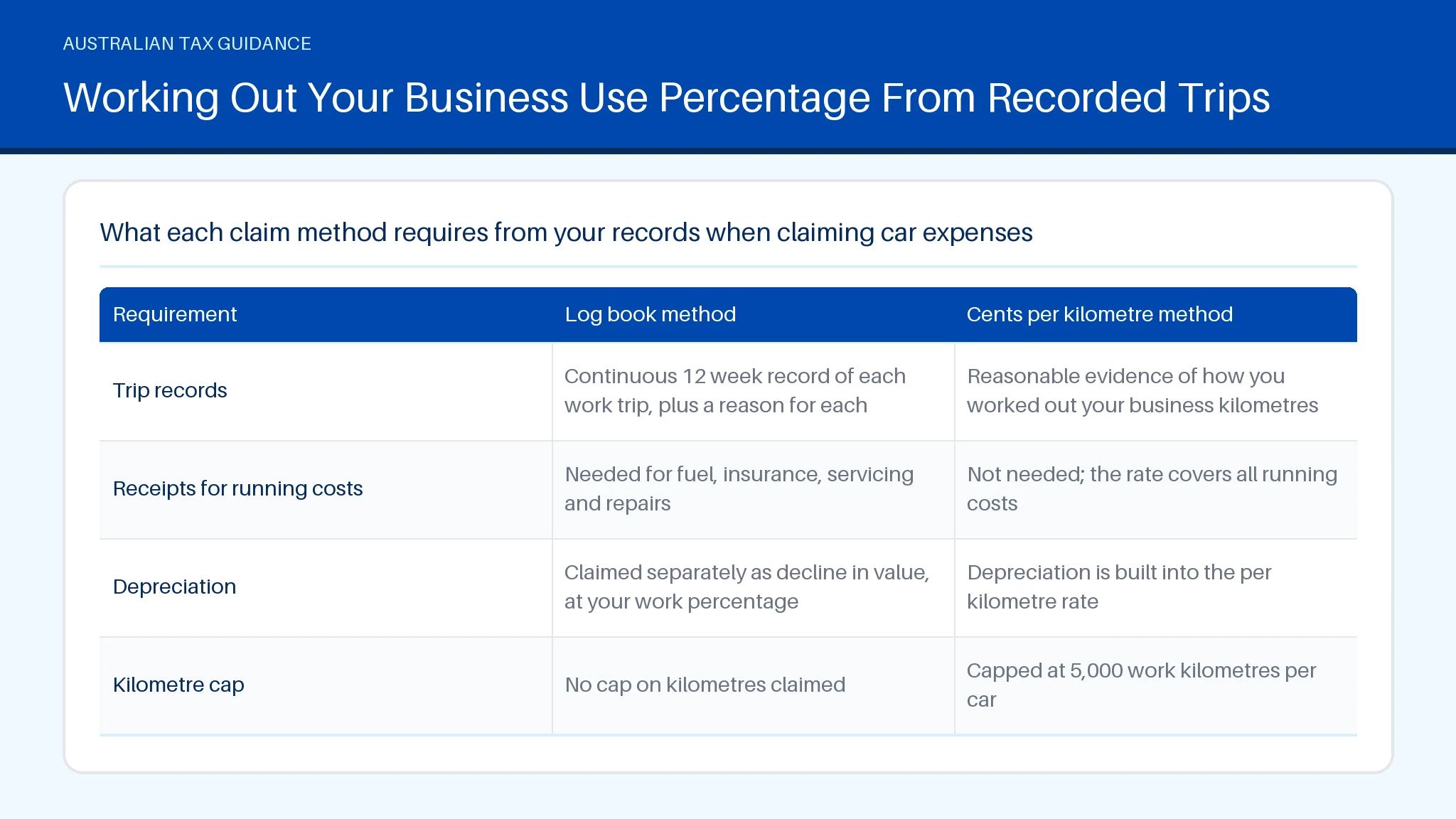
Before you commit to the log book method, it helps to see what each approach asks of you. The ATO sets different record standards for the two options, and the per kilometre method trades a smaller ceiling for far lighter paperwork.
| Requirement | Log book method | Cents per kilometre method |
|---|---|---|
| Trip records | Continuous 12 week record of each work trip, plus a reason for each | Reasonable evidence of how you worked out your business kilometres |
| Receipts for running costs | Needed for fuel, insurance, servicing and repairs | Not needed; the rate covers all running costs |
| Depreciation | Claimed separately as decline in value, at your work percentage | Depreciation is built into the per kilometre rate |
| Kilometre cap | No cap on kilometres claimed | Capped at 5,000 work kilometres per car |
A simple spreadsheet or printed vehicle log book template with those five columns is enough to stay compliant.
How to Calculate Your Car Deduction From Logbook Records
A logbook you completed in an earlier year can still support this year's claim. The ATO treats a valid logbook as current for five income years, so in years two to five you do not repeat the 12 week record. You still need the odometer reading at the start and end of each of those years, because the total kilometres change even when the percentage does not.
The calculation runs in three steps. First, divide your work kilometres from the logbook by total kilometres in the same logbook period to get your percentage. Second, add up your actual costs for the full year. Third, multiply. A deduction of 68 per cent against $7,400 of running costs produces a claim of $5,032.
Two practical points change the result. If your pattern of use shifts, a new role or a house move, the old percentage no longer reflects reality and you need a fresh logbook. And you must calculate the claim per car, not across your household. Our tax calculators can help you sanity check the arithmetic, and the logbook method guide covers the five year validity rules in more detail. Each deduction you claim should trace back to the logbook that supports it.
Log Book Method vs Cents Per Kilometre: Choosing Your Claim
Your car expenses claim comes down to one comparison: the work percentage of your real costs, or a flat rate per kilometre up to 5,000 kilometres. You can switch between methods from year to year, and you can use different methods for different cars, so the choice is a yearly calculation rather than a permanent commitment.
The per kilometre method wins on effort. It needs no receipts and no 12 week record, only a reasonable basis for the kilometres you claim. Its ceiling is the catch: once you pass 5,000 work kilometres, every extra kilometre is unclaimable under that method. The kilometre method also bundles depreciation into the rate, which matters if you drive a newer or more expensive car.
The log book method has no kilometre ceiling and lets you claim the work share of finance interest and decline in value on top of running expenses. It is the stronger option when your annual expenses are high relative to distance, such as a heavily insured vehicle driven mostly on short work trips. Note that utes, vans and trucks outside the ATO definition of a car follow separate rules for other business vehicles when claiming car expenses.
ATO Car Logbook Requirements for the 2026 Income Year
Year one is the demanding year. The ATO requires your first logbook to cover a continuous 12 week period that is representative of your usual driving, and that period must begin in the income year you are claiming for. It can run past 30 June into the next year, which is useful if you only realise in May that you want to use the logbook method.
For a valid car logbook, the ATO expects you to record the period's start and end dates, the odometer reading at each end, the total kilometres travelled, and your work percentage, alongside the individual trip entries. You also record the odometer reading on 1 July and 30 June so the full year total is documented.
Two details other guides tend to skip. Twelve weeks of holidays or sick leave is not representative, so starting in a quiet month can understate your percentage for five years. And if you own the car part way through the year, the ATO expects odometer readings from the date you acquired it. Deductit's deduction library sets out the record conditions that sit behind each car claim.
Recording Trips With a Digital Logbook App
A digital logbook satisfies the ATO as readily as a paper one, provided the entries carry the same detail and you can produce them in English if asked. GPS based tools capture start and finish points automatically, which removes the usual failure point: trips that were driven but never written down.
The trade-off is accuracy of purpose. An app can log that you travelled 24 kilometres on a Tuesday, but only you can classify it as work or private, and a compliant logbook needs that classification trip by trip. Most reviews that unwind a claim do so because business kilometres were assumed rather than recorded. Set aside a few minutes each week to label the trips while you still remember them.
Also export and store a copy. An account you lose access to is not a record you can produce in four years. Keeping a dated export alongside your receipts in your Deductit workspace means the logbook survives a change of phone or provider.
Receipts, Odometer Readings and the Paperwork Behind the Kilometres
Kilometres only tell half the story. The logbook method sets the percentage; receipts set the dollar amount it applies to. The ATO expects written evidence for fuel, oil, insurance, registration, servicing, tyres, interest and lease payments, and you can use a reasonable estimate for fuel and oil based on odometer readings if you have kept the readings but not every receipt.
Four odometer readings matter each year: the start and end of the logbook period, and the readings at the start and end of the income year. Those four numbers let you prove the total distance travelled and reconcile it against the logbook. Photograph the dash rather than relying on memory, and note the date in the image.
Keep receipts and readings together for the same year so the two sides reconcile easily. If you are assembling the paperwork for the first time, the records review checklist shows what the ATO expects you to hold.
Working Out Your Business Use Percentage From Recorded Trips
Your percentage is work kilometres divided by total kilometres across the logbook period, expressed as a percentage and carried through to the whole income year. If you drove 4,100 kilometres in twelve weeks and 2,870 of those were for work, your percentage is 70 per cent.
Applying your percentage to total car expenses is the step where claims go wrong. Add your actual costs first, then multiply once. Expenses that are wholly work related, such as parking at a client site or a toll on a work trip, are claimed in full and sit outside the percentage calculation. Costs that are purely capital, such as the purchase price, are never claimed directly; you claim decline in value instead.
Worked example: total car expenses of $9,200 plus $2,400 of depreciation gives $11,600. At 70 per cent, the claim is $8,120. A spreadsheet or printed template with one column per expense category makes the addition auditable. The kilometre method needs none of this, which is exactly its appeal, but it caps what you can claim. Deductit's deduction finder helps you check which expenses belong in the total.
Running a Separate Log Book Method Record for Each Car
Each car needs its own logbook, its own odometer readings and its own percentage. If you want to use the logbook method for two cars in the same income year, the ATO requires the 12 week periods to run over the same dates, so the two records describe the same stretch of your working life.
Keep the expense paperwork separate too. Registration, insurance, servicing and repairs all attach to a specific vehicle, and depreciation is calculated per car on its own cost and effective life. Mixing vehicle expenses into one pile makes it impossible to establish which car the claim relates to and makes the records less compliant.
You can also mix methods: logbook for the car that does the long trips, per kilometre method for the second car that covers a few hundred business kilometres. A valid record for one car does not support a claim on another, no matter how far either travelled. Businesses running several vehicles can review the rules at small business tax deductions.
Summary
The log book method rewards accurate records: twelve continuous weeks of trips sets a percentage, five years of odometer readings and receipts support the dollars, and each car stands alone. Deductit's calculators and deduction library help you organise those records and check which costs belong in the total. For your own circumstances, speak with a registered tax agent. You can start a record set at get started.
You may also find these related guides helpful: Balancing Account ATO: What It Means for Your Return, Working From Home Tax Deductions Australia, ABN Registration: How to Apply, Costs and Who Qualifies, ATO Number: Which Line to Call for Your Tax Query, and BAS Explained: What to Report, Lodge and When.
You may also find these related guides helpful: Pay Calculator Australia: Work Out Your Take Home Pay.
Frequently asked questions
What records do I need to keep if the ATO audits me?
For a tax review, keep your completed logbook, the four odometer readings for the year, and written evidence for every expense in your claim: fuel, insurance, registration, servicing, repairs, interest and the depreciation calculation. The ATO requires you to keep these records for five years from the date you lodge the return that uses them, and for a logbook, five years from the latest year it supports.
What to record in your logbook?
Record the date of each trip, the odometer reading at the start and the end, the kilometres covered, and the reason for the journey in enough detail to identify the work purpose. For the period as a whole, record the start and end dates, the opening and closing odometer readings, total kilometres and the resulting percentage.
What are business kilometres?
Business kilometres are the kilometres you drive in the course of earning your income: travel between two separate workplaces, trips to clients or suppliers, and carrying bulky tools you cannot leave at work. Ordinary home to work commuting is private, as are personal errands on the way. The distinction decides your percentage, so classify each trip honestly in your deduction records as you go. It is not too late to start a logbook part way through the year, provided the 12 weeks begin before 30 June.