
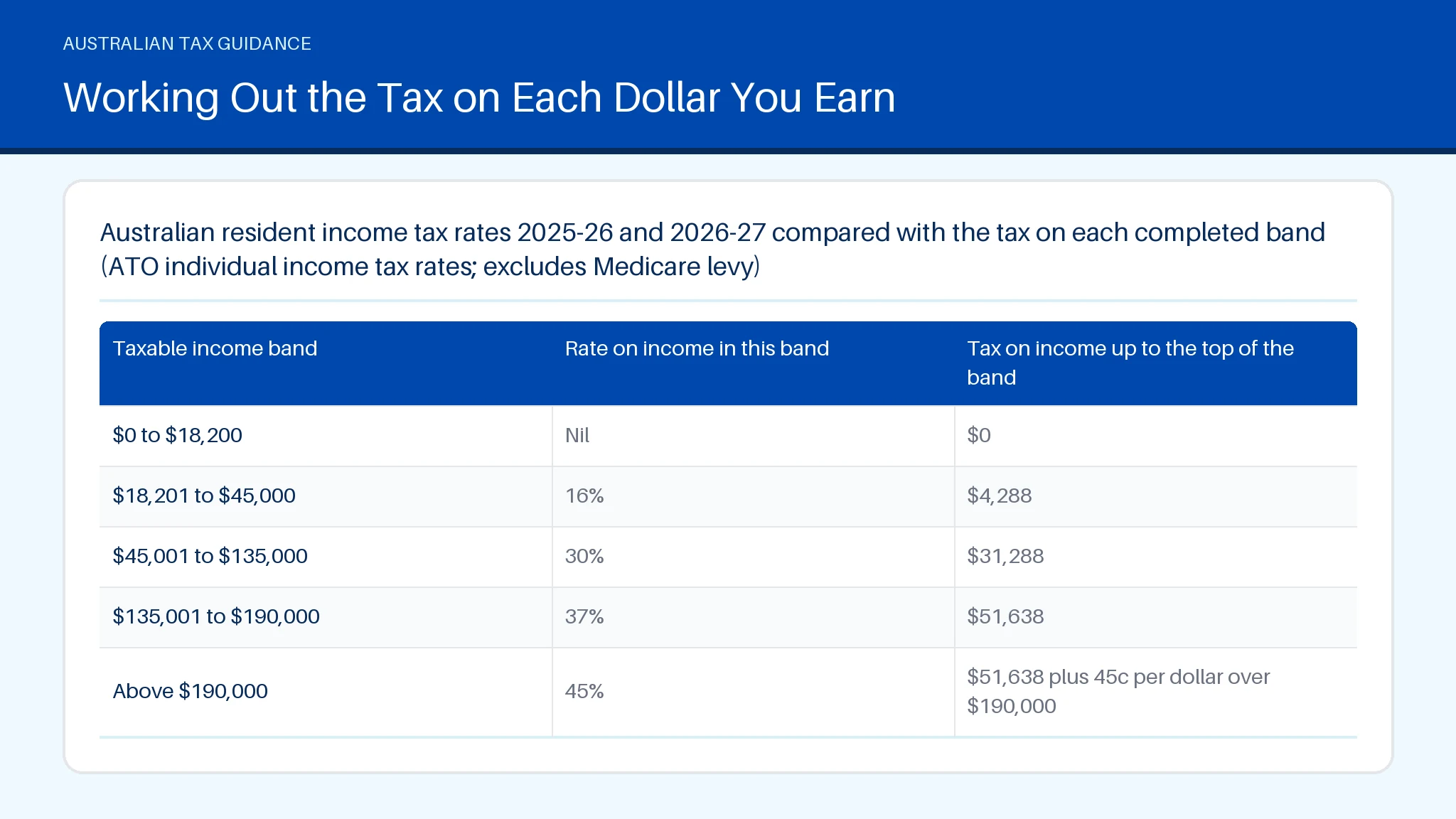
Australian resident individuals pay income tax at graduated rates: nothing on the first $18,200 of taxable income, 16% from $18,201 to $45,000, 30% from $45,001 to $135,000, 37% from $135,001 to $190,000, and 45% on every dollar above $190,000. The ATO publishes these rates as the individual income tax rates for Australian residents, and they apply for the 2024-25 and 2025-26 income years. For 2026-27 the 16% rate falls to 15%, as legislated in March 2025, and the other rates and thresholds stay the same.
This guide is for employees, sole traders and investors who want to work out what they will actually pay rather than just read a bracket list. It separates three things that often get blurred together: whether a rate applies to you at all (residency and eligibility), how the calculation runs dollar by dollar, and what records the ATO expects you to keep to support the taxable income figure you report.
Two points matter before you start. First, the headline tax rates for residents do not include the 2% Medicare levy, the Medicare levy surcharge for higher earners without appropriate private hospital cover, or compulsory study and training loan repayments. Second, the low income tax offset reduces tax payable after the brackets are applied, which is why someone earning $30,000 pays far less than 16% of their income above the threshold.
Work through the sections in order if you are estimating a full-year position, or jump to the marginal rate section if you only need to know what your next pay rise or deduction is worth.
Key takeaways
- Australian resident rates are progressive: the ATO applies a tax-free threshold of $18,200, then 16% (15% from 1 July 2026), 30%, 37% and 45% to each slice of taxable income above it.
- The rate on your last dollar earned is your marginal rate, but the average rate you actually pay across your whole income is always lower.
- Foreign residents for tax purposes get no tax-free threshold and pay 30% from the first dollar, according to the ATO's foreign resident rates.
- The published rates exclude the 2% Medicare levy, the Medicare levy surcharge, the low income tax offset and any study loan repayment, so your real tax payable differs from a bracket-only estimate.
- Deductions reduce taxable income before the rates apply, so a valid work expense saves tax at your marginal rate, not at a flat amount.
Resident Tax Rates for 2025-26 and 2026-27 Explained
Resident rates for 2025-26 and 2026-27 differ in one band: the 16% rate on income from $18,201 to $45,000 falls to 15% from 1 July 2026, so the table shows both years. The ATO applies the rate to the portion of taxable income inside each band, never to the whole amount.
| Taxable income band | Rate 2025-26 | Rate 2026-27 | Tax up to the top of the band, 2025-26 | Tax up to the top of the band, 2026-27 |
|---|---|---|---|---|
| $0 to $18,200 | Nil | Nil | $0 | $0 |
| $18,201 to $45,000 | 16% | 15% | $4,288 | $4,020 |
| $45,001 to $135,000 | 30% | 30% | $31,288 | $31,020 |
| $135,001 to $190,000 | 37% | 37% | $51,638 | $51,370 |
| Above $190,000 | 45% | 45% | $51,638 plus 45c per dollar over $190,000 | $51,370 plus 45c per dollar over $190,000 |
The practical value of the two tax columns is that you can check any payroll or software estimate in about ten seconds. Because the 2025-26 rates are unchanged from the prior year, a jump in your tax payable usually points to higher income, a lost offset, or a levy or loan repayment rather than a rate change. To test a figure against your own pay cycle, use the Australian pay calculator.
How Australia's Income Tax Brackets Actually Work
Australia's brackets work as a stack of slices, not a single rate that switches over. Moving into the 37% band does not re-tax the income below $135,000; only the dollars above that line attract 37%. This is why a pay rise never leaves you worse off on income tax alone, although it can reduce income-tested offsets and family payments.
The order of operations also matters. The ATO calculates assessable income, subtracts allowable deductions to reach taxable income, applies the tax rates to that taxable figure, then subtracts offsets and adds levies. A $1,000 deduction therefore reduces the top slice of your income first, which is why deductions are worth more to higher earners.
If a bracket result looks wrong on your notice of assessment, the ATO takes general individual enquiries on its main line. Check the correct number in our guide to ATO phone lines before calling.
What Your Marginal Rate Means at Each Income Band
Your marginal rate is the rate that applies to your next dollar of income and to your next dollar of deductions. On $60,000 of taxable income the marginal rate is 30%, so a $500 deductible work expense reduces tax payable by $150, plus $10 from the 2% Medicare levy. On $200,000 the same expense is worth $225 plus levy.
This is the most useful number for planning, because it tells you the value of tax deductions Australia allows before you spend anything. It also frames decisions like salary sacrifice, where contributions taxed at 15% inside super are compared against your marginal rate on the same income.
Watch the transition points. Income between $45,001 and $135,000 sits at 30%, so most full-time workers face the same marginal rate across a wide range. To confirm which claims sit behind a deduction at your marginal rate, browse the deduction library.
Resident Versus Non-Resident Tax Rates Compared
Foreign residents for tax purposes pay a flat 30% on the first $135,000 of Australian-sourced taxable income, then 37% to $190,000 and 45% above that, with no tax-free threshold. They are also generally not liable for the Medicare levy, which is the main offset to the higher starting rate. Residency for tax purposes is decided by the ATO's residency tests, not by your visa or citizenship.
The gap is largest at low incomes. On $30,000, a resident pays 16% (15% from 2026-27) only on the amount above $18,200, while a foreign resident pays 30% on the whole $30,000. Working holiday makers are taxed under a separate schedule again, starting at 15%.
Historical comparisons still circulate: 2022 tax rates used a $45,001 to $120,000 band at 32.5% and a 37% band from $120,001, so older calculators produce the wrong answer for current years. If your residency changed mid-year, part-year thresholds apply, and the myTax lodgment walkthrough shows where that is declared.
Marginal Rate Versus Average Rate on Your Income
Your average rate is total tax payable divided by taxable income, and it is always lower than your marginal rate under a progressive system. Someone on $135,000 has a 30% marginal rate but pays $31,288 in income tax in 2025-26, an average rate of about 23.2% before the Medicare levy.
The difference explains a common complaint. People describe themselves as being "in the 37% bracket" and assume more than a third of their pay disappears, when the actual average rate at $150,000 is roughly 24.5% before levies. Comparing the two rates also shows why a mid-year bonus is withheld heavily: payroll applies the marginal treatment to that pay period.
Use the average rate when you are budgeting annual cash flow, and the marginal rate when you are deciding whether to make an extra super contribution, prepay an expense, or take on extra work. Older figures such as 2022 rates give different averages, and the 2026-27 rates above are the ones to use for current-year planning with a tax and pay calculator.
Low Income Tax Offset: Who Qualifies and How Much
The low income tax offset gives eligible residents up to $700 off tax payable, and the ATO applies it automatically when you lodge. The full $700 applies to taxable income of $37,500 or less. Between $37,501 and $45,000 the offset reduces by 5 cents per dollar, and from $45,001 to $66,667 it reduces by 1.5 cents per dollar, phasing out completely above $66,667.
Two limitations catch people out. The offset is non-refundable, so it can reduce income tax to nil but cannot generate a refund on its own or offset the Medicare levy. It also cannot be claimed as a deduction or applied during the year by your employer, which is why a small refund often appears at lodgment.
Because the offset applies after the 2025-26 rates are calculated, an extra deduction and the offset can interact: reducing taxable income below $66,667 may restore part of the offset. The 2025-26 rates combined with this offset mean an income of $22,500 or less generally results in no income tax payable.
Estimating Your Annual Tax Bill and Weekly Take Home Pay
A reliable annual estimate needs four steps: total your assessable income, subtract deductions, apply the brackets, then add the 2% Medicare levy and subtract any offsets. On $112,000 of taxable income in 2025-26 the income tax is $24,388, the Medicare levy adds $2,240, and total tax payable is about $26,628, leaving roughly $85,372 or $1,641 a week before super and any study loan repayment.
Weekly take-home pay rarely matches that figure exactly. Payroll withholds on each pay period using the ATO tax tables, so overtime, bonuses, unpaid leave and mid-year pay rises all create timing differences that square up at lodgment.
Also add a compulsory study loan repayment if you have one, since it is calculated on repayment income rather than taxable income. The 2025-26 rates apply the same way in every state, but check whether the 2026-27 rates apply to part of the period you are modelling, and use the take-home pay calculator for fortnightly and monthly cycles.
Working Out the Tax on Each Dollar You Earn
Tax on each dollar is worked out band by band, and doing it manually once makes every payroll figure easier to check. On $70,000 of taxable income in 2025-26: the first $18,200 attracts nothing; the next $26,800 at 16% is $4,288; the remaining $25,000 at 30% is $7,500. Income tax is $11,788, which the ATO's tax tables confirm as $4,288 plus 30c for each dollar over $45,000.
Then layer on the extras. The Medicare levy adds $1,400 at 2%, so total tax payable is $13,188 unless a levy reduction or exemption applies at lower incomes.
The same arithmetic tells you what a deduction returns. At $70,000, a $300 claim for tools cuts tax by $90 plus $6 of levy. Because the 30% rate is unchanged across 2024-25, 2025-26 and 2026-27, the marginal saving on an identical claim has not moved. The deduction finder shows which claims match your occupation before you calculate the saving.
Checking Withholding Against Current Tax Rates Before Lodging
Check withholding before you lodge by comparing the total tax withheld on your income statement against tax calculated from the brackets on your final taxable income. A large gap usually has a specific cause: a second job where the tax-free threshold was claimed twice, an unclaimed threshold, a mid-year salary change, or taxable income from interest, dividends or a side business that had no tax withheld at all.
Common mistakes worth avoiding: using an old calculator built on rates from before the bands changed, forgetting that the Medicare levy surcharge applies on income for surcharge purposes rather than taxable income, and treating a deduction as a dollar-for-dollar refund.
Keep written evidence for every deduction that reduced your taxable income, generally for five years from lodgment under ATO record-keeping rules. Sole traders and company directors can review the business side in the small business deductions hub, and the 2025-26 figures above give you the benchmark to test any estimate before you review your claims.
Summary
Eligibility for the resident rates depends on the ATO's residency tests, not your visa, and foreign residents pay 30% from the first dollar with no tax-free threshold. Calculation runs in a fixed order: assessable income, less deductions, brackets applied slice by slice, then levies added and offsets such as the low income tax offset subtracted. Record-keeping supports the taxable income figure, with written evidence generally kept five years. Deductit publishes ATO-sourced deduction rules and calculators so you can check your own numbers; it does not give personal tax advice or lodge returns.
You may also find these related guides helpful: Pay Calculator Australia: Work Out Your Take Home Pay, What Is the Medicare Levy? Rates, Rules and Surcharge, BAS Explained: What to Report, Lodge and When, Medicare Levy Exemption: Who Qualifies and How to Claim, Medicare Levy Surcharge: Who Pays and How It Adds Up, Salary Calculator: Gross and Take Home Pay in Australia, and Contractor Pay Calculator: Rate to Salary in Australia.
Frequently asked questions
What are the tax brackets in Australia?
Australian resident tax brackets for 2025-26 are $0 to $18,200 at nil, $18,201 to $45,000 at 16% (15% from 1 July 2026), $45,001 to $135,000 at 30%, $135,001 to $190,000 at 37%, and above $190,000 at 45%. The ATO applies each rate only to the income inside that band, so the rate on your last dollar is higher than the average rate across your whole income. These figures exclude the 2% Medicare levy.
What are the tax brackets for 2026?
The 2026-27 brackets keep the 2025-26 thresholds with a lower first rate: nil to $18,200, then 15%, 30%, 37% and 45% at the thresholds of $45,000, $135,000 and $190,000. The 16% rate became 15% from 1 July 2026, so an estimate built on 2025-26 rates will overstate 2026-27 tax by up to $268. The Medicare levy thresholds and study loan repayment rates are indexed annually and should be checked on the ATO website before you rely on a figure.
What are the ATO tax rates for 2026?
ATO rates for the 2026 income year start at 16% once taxable income passes the $18,200 tax-free threshold. Taxable income is assessable income, including salary, government payments, business income, interest, dividends, rent, capital gains and foreign income, minus allowable deductions. Australian residents for tax purposes are assessed on worldwide income, while foreign residents are assessed only on Australian-sourced income at the higher foreign resident rates.
How much tax do I pay if I earn $100,000 in Australia?
On $100,000 of taxable income in 2025-26 the income tax is $20,788, calculated as $4,288 on the first $45,000 plus 30% of the remaining $55,000. The 2% Medicare levy adds $2,000, so total tax payable is about $22,788 and your marginal rate is 30%. A study loan repayment or the Medicare levy surcharge would increase that figure.
How much tax will I pay on a salary of $112,000 in Australia?
On a $112,000 salary in 2025-26 the income tax is $24,388, made up of $4,288 on the first $45,000 and 30% of the $67,000 above it, plus a $2,240 Medicare levy for total tax payable of roughly $26,628. Take-home pay is about $85,372 a year, or $1,641 a week, before compulsory super and any HELP repayment. Every deductible dollar at this income saves 32 cents including levy, so keeping records of work expenses through the Deductit workspace changes the result. The ATO provides free general help with income tax through its website and phone lines, and a registered practitioner can advise on your personal circumstances.