A TFN is a unique nine-digit personal reference number the Australian Taxation Office issues to individuals, companies, trusts, partnerships and super funds so income and tax paid can be matched to the right taxpayer. It is free, it lasts for life, and it is yours alone even if you change your name, change jobs, move interstate or leave Australia for several years.
This guide is written for anyone who has to deal with that number for the first time or sort out a problem with it: a school student starting a first casual job, a new migrant or working holiday maker, a sole trader registering a business, a director setting up a company, or someone who simply cannot find the number anymore. It sets out who has to quote one, who is exempt, what happens to your pay if you do not quote it, how to apply through each available pathway, how long the ATO takes, and what records to keep so you never have to hunt for the number again.
Two points tend to surprise people. First, quoting your number is voluntary in a legal sense; the consequence of not quoting it is a withholding rate, not a penalty. Second, a business entity's number is separate from the personal number of the person who runs it, which is why company and trust registrations ask for both.
The rates and rules below are attributed to the ATO. Once your tax affairs are in order, our pay calculator for Australian employees and our library of what you can claim on tax show how withholding and deductions interact across a full income year.
Key takeaways
- A TFN is a free, lifetime personal reference number issued by the Australian Taxation Office, and you keep the same number through job changes, name changes and moves overseas.
- Quoting your number is not compulsory, but an employer, bank or super fund that does not have it must withhold tax at the top rate plus the Medicare levy under the ATO's no-TFN rules.
- Individuals apply online through myGov with an identity check, at a participating Australia Post outlet, at an ATO shopfront, or by paper form if none of those pathways suit.
- The ATO asks you to allow up to 28 days for processing, and lodging a return or starting a job before the number arrives is still possible, just with more paperwork.
- A company, trust or partnership needs its own business number separate from the director's or trustee's personal one, and that registration usually happens alongside an ABN application.
Who Is Exempt From Quoting a Tax File Number?
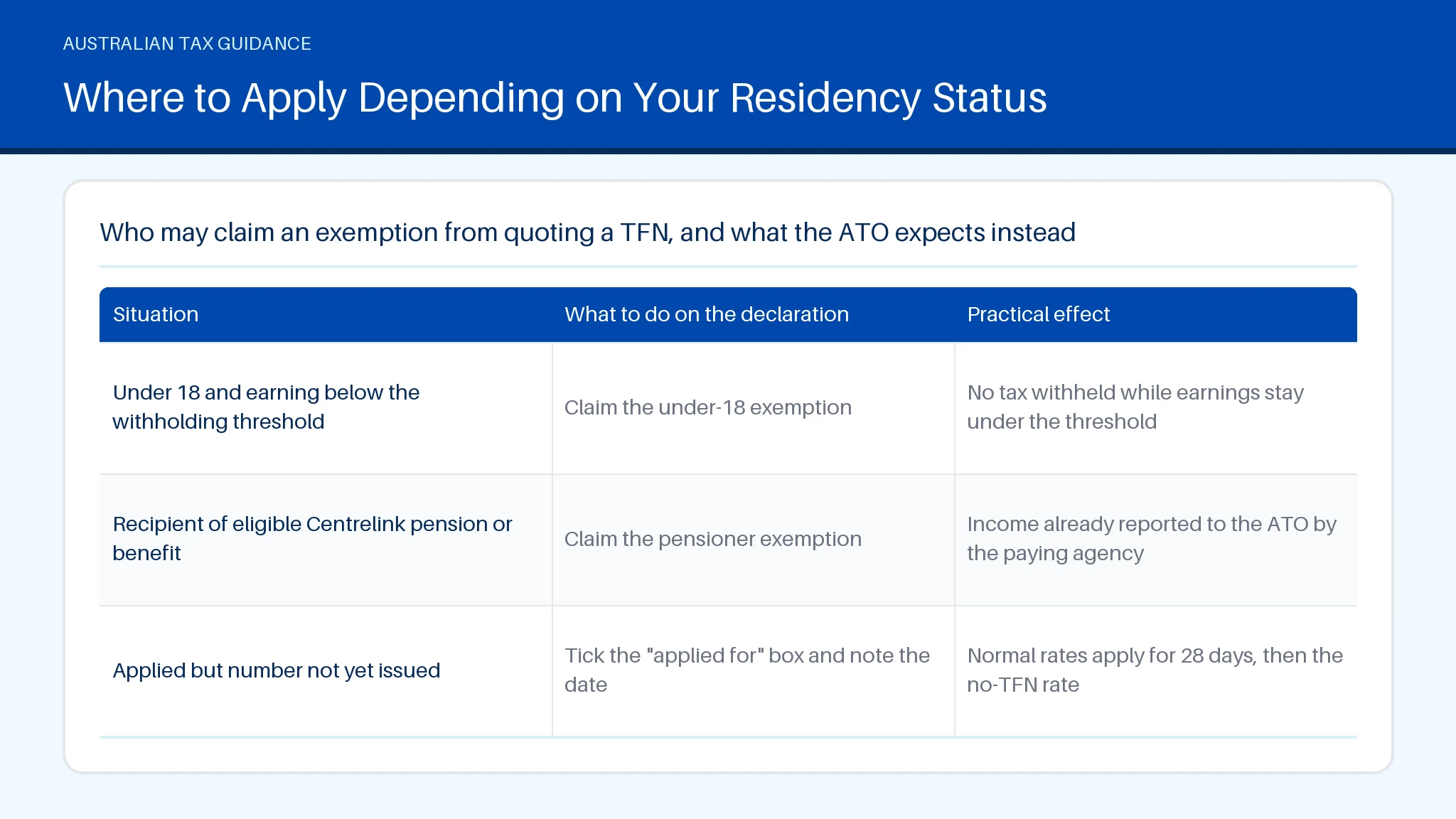
Exemptions from quoting a number apply mainly to people whose income is already below the tax-free threshold or already reported to the ATO another way. According to the ATO, a payee can claim an exemption on a tax file number declaration if they are under 18 and earning below the weekly threshold at which tax is withheld, or if they receive certain Centrelink pensions and benefits. Applicants and payees who have applied but have not yet received their number can also tick that box and keep the normal withholding rate for 28 days.
| Situation | What to do on the declaration | Practical effect |
|---|---|---|
| Under 18 and earning below the withholding threshold | Claim the under-18 exemption | No tax withheld while earnings stay under the threshold |
| Recipient of eligible Centrelink pension or benefit | Claim the pensioner exemption | Income already reported to the ATO by the paying agency |
| Applied but number not yet issued | Tick the "applied for" box and note the date | Normal rates apply for 28 days, then the no-TFN rate |
Why Applying for Your TFN Early Pays Off
Applying early protects your cash flow. The ATO allows a 28-day grace period after you tell a payer you have applied, and once that window closes the payer must switch to the no-TFN withholding rate. Getting the application in before your first pay day keeps your take-home pay at the normal rate rather than forcing you to wait until you lodge a return to recover the difference.
Early application also smooths the things that depend on the number: opening an interest-bearing bank account without resident withholding on the interest, giving your super fund the number so it can accept personal contributions and search for lost accounts, applying for a HELP loan, and claiming the tax-free threshold on your first job. If you are starting a business at the same time, the ABN registration guide covers the registrations you can bundle into one sitting. To see what the difference in withholding actually looks like on your wage, run the figures through our take-home pay calculator.
Lodging a Paper Tax File Number Application by Post
The paper pathway exists for people who cannot complete an identity check online or in person. The ATO publishes separate application forms for Australian residents, for foreign passport holders and permanent migrants, and for people applying from outside Australia, and each form lists the proof-of-identity documents it will accept. You order or download the right form, complete it in full, attach certified copies of your identity documents rather than originals where the form allows it, and post it to the address printed on the form.
Paper lodgement is the slowest option, so build the full processing window into your plans. Three practical habits avoid rework: use your legal name exactly as it appears on your identity documents, give a postal address that will still be yours in a month, and keep a photocopy or scan of the completed form so you can answer questions if the ATO follows up. Incomplete identity evidence is the most common reason a posted application stalls.
Completing the Tax File Number Declaration for Your Employer
A tax file number declaration tells a new employer how to withhold from your pay. You complete it when you start a job, and most employers now collect it digitally through ATO online services in myGov, where your details prefill and the form goes straight to the ATO. You give your number, confirm your residency status for tax purposes, say whether you are claiming the tax-free threshold, and declare any study and training support loan. Your employer keeps the declaration and reports the details through Single Touch Payroll.
A few related questions come up at the same moment. Payers who may legitimately ask for your number include employers, banks and other investment bodies paying interest or dividends, super funds, Centrelink and Services Australia, higher education providers administering HELP loans, and the ATO itself. A bank can ask, and you can decline, but the ATO's resident withholding rules then apply to the interest it pays you. If you need a number and do not have one, you apply through myGov with an identity check, at a participating Australia Post outlet, at an ATO shopfront, or by paper form. A company, trust or partnership applies for its own entity number, normally at the same time as its ABN, and that entity number never replaces the director's or trustee's personal one.
If you cannot find your number, check a payment summary or income statement, an old notice of assessment, your super fund correspondence, or ATO online services in myGov before calling the ATO, which will ask identity questions rather than read the number out to an unverified caller. Keep a copy of every declaration you sign with your Deductit workspace records so the detail is there next time a payroll team asks.
What Happens After You Lodge Your Application
After you lodge, the ATO verifies your identity, creates your tax record and posts the number to the address on the application. The ATO asks you to allow up to 28 days and not to lodge a second application in that time, because duplicate applications slow the process down rather than speed it up.
While you wait, tell each payer you need a TFN and have applied for one, and note the application date on the declaration so the 28-day rule applies. Watch the post rather than expecting an email, since the ATO notifies by mail. If the deadline passes with nothing arriving, contact the ATO before reapplying. Once the number arrives, give it to your employer, your bank and your super fund, then store it with your other tax paperwork in your records workspace ready for the end-of-year review step.
Withholding Rates Applied When a Payee Quotes No TFN
Payers must withhold at a penalty rate when a payee does not quote a number and no exemption applies. The ATO directs employers to withhold from payments to a resident employee at 47 per cent, being the top marginal rate plus the Medicare levy, with no tax-free threshold and no offsets. For foreign resident employees, the ATO rate is 45 per cent. Investment bodies apply the same approach to interest, dividends and unit trust distributions under the resident withholding rules.
The money is not lost. Amounts withheld are credited against your assessment when you lodge, so you recover any excess as part of your refund, but you carry the shortfall in every pay until then. The mechanics of rates and tax tables are set out in our PAYG withholding guide.
How Long Does It Take to Receive Your Number?
Allow up to 28 days from the day the ATO receives a complete application. The identity check is the variable that matters most: applications verified online through myGov or in person at Australia Post or an ATO shopfront tend to move faster than posted paper forms, because the documents have already been sighted and matched.
Delays usually have one of a few causes. Names that differ between your passport, visa and application, a missing document, a post office box that cannot receive mail, or a duplicate application lodged out of impatience all add time. If you are already working, tell payroll the date you applied so the 28-day grace period runs from the right day. Plan around the full window rather than the best case, particularly if your first pay day or a loan application falls inside that month.
Where to Apply Depending on Your Residency Status
Your residency and visa status decide which application pathway is open to you. Australian citizens with a passport can apply online through myGov with a digital identity, and Australian residents without that option can apply at a participating Australia Post outlet, at an ATO shopfront or by paper form. Migrants and temporary visitors with work rights, including working holiday makers and permanent migrants, can apply online once their visa is active because the ATO can verify status with the Department of Home Affairs.
People living outside Australia who have Australian income, such as rent or dividends, use the ATO's separate application for foreign residents and send certified copies of identity documents. Residency also drives your tax rates and your Medicare levy position, so if your status changed mid-year, read our Medicare levy explainer alongside this guide.
What a Tax File Number Is Used For
Your number is the ATO's key for matching reported income to your record. It appears in Single Touch Payroll reports from your employer, in interest and dividend data from banks and share registries, in super fund reporting, in Centrelink and Services Australia records, and in HELP loan accounts. That data matching is also why prefill works when you lodge.
You use the number when you lodge a return, apply for an ABN, register for GST, claim government payments, take out a study loan or make personal super contributions. Keep it private: the ATO advises giving it only to payers and agencies entitled to ask, never over email or social media. If you are using it to register a business structure, our small business deductions hub and deduction finder show what the entity can claim once it is trading.
Summary
Eligibility for a TFN is broad: any individual or entity with Australian tax obligations can apply, and specific exemptions from quoting one cover under-18s below the withholding threshold and eligible Centrelink recipients. The calculation consequence is simple, since payers withhold at 47 per cent for residents and 45 per cent for foreign residents when no number is quoted, per ATO rules. Record keeping means storing your number securely, keeping copies of declarations, and allowing 28 days for processing. Deductit's calculators and deduction library help you work through the figures, without providing personal tax advice.
You may also find these related guides helpful: Pay Calculator Australia: Work Out Your Take Home Pay, Balancing Account ATO: What It Means for Your Return, Superannuation in Australia: How Your Super Works, ATO Number: Which Line to Call for Your Tax Query, BAS Explained: What to Report, Lodge and When, and Medicare Levy Exemption: Who Qualifies and How to Claim.
Frequently asked questions
How do I find my TFN number?
Your number appears on your income statement or payment summary, on any notice of assessment from the ATO, on super fund statements, and in ATO online services through your myGov account, which is the quickest place to look. Your registered tax agent will also hold it on file. If none of those sources work, phone the ATO and expect identity questions about your income, bank details or past returns before any information is released; the ATO will not read the number out to an unverified caller. Avoid lodging a fresh application, because a duplicate record causes more delay than it solves.
What does TFN stand for?
TFN stands for tax file number. The abbreviation is used across ATO forms, payroll systems, bank account applications and super fund paperwork, and it always refers to the same nine-digit reference number rather than to any other tax registration. It is not the same thing as an ABN, which identifies a business to the public and is covered in our ABN registration guide.
What does TFN mean?
The term means your personal or entity tax reference number held by the Australian Taxation Office. It is the identifier the ATO uses to match the income your employer, bank, super fund and Centrelink report against the return you lodge, which is what makes prefilled data possible at tax time. Day to day, you need it in Australia whenever you start a job, lodge a return, open an interest-bearing account or deal with a study loan.
What is a TFN in Australia?
In Australia it is a free, lifetime number issued by the ATO, whose job is to collect tax, administer the GST and superannuation systems, run the Australian Business Register and match reported income data. You keep the same number permanently, including through name changes and periods overseas. A business entity such as a company or trust holds its own number because it lodges its own return, which is why a new business needs one even when the director already has a personal number. A 14 year old does not have to have one, but they will need one to claim the tax-free threshold or to avoid resident withholding on bank interest, and there is no minimum age to apply.
Can I get my TFN immediately?
Immediate issue is not available. The ATO asks you to allow up to 28 days for a complete application, and an identity check verified online through myGov or in person is generally the fastest route. In the meantime, tell each payer you have applied and record the date so normal withholding rates continue for the 28-day grace period. If you are setting up tax records for the first time, the Deductit get started steps and the Australian tax calculators help you plan for the pay and deduction side while you wait.