Your HECS loan balance is the total amount of Higher Education Loan Program (HELP) debt the Australian Taxation Office currently records against your tax file number, including any tuition fees your provider has reported but before amounts you have paid during the current financial year are applied. You can see it by signing in to myGov, linking the ATO service and opening the loan accounts section, or through the ATO app.
This guide is for anyone who studied under HECS-HELP or another HELP loan and needs to understand what the number on screen actually represents: when it updates, why it can look wrong, how indexation and the one-off 20% reduction changed it, and how much you can still borrow under the combined HELP loan limit.
The broader rules on who can defer fees, how to apply and how repayments fit into your tax return sit in our pillar guide, HECS Explained: Eligibility, Applying and Repayments. This page stays focused on the balance itself.
What you need before you start. Gather these items and the whole process takes a few minutes:
- A myGov account with the ATO linked, or your Commonwealth Higher Education Student Support Number (CHESSN) and myHELPbalance login if you are not using myGov.
- Your tax file number and a recent notice of assessment.
- Your most recent Commonwealth Assistance Notice from each provider, issued after each census date.
- Your current payslip or income estimate, so you can compare your HECS loan balance against what your repayments will do to it this year.
If you want to see how repayments affect your take-home pay at the same time, the Deductit pay calculator models tax, Medicare levy and HELP withholding together.
Key takeaways
- Your HECS loan balance is held by the ATO, not your university, and the figure shown in myGov is a point-in-time account balance rather than a payout figure.
- HELP debts carry no interest. The ATO applies indexation on 1 June each year, and since 2023-24 indexation is set at the lower of the Consumer Price Index or the Wage Price Index.
- Compulsory repayments only start once your repayment income passes the annual threshold, and they are worked out on a marginal basis from 2025-26 onward, not as a flat percentage of your whole income.
- The ATO has applied a one-off 20% reduction to student loan balances, calculated on the balance as it stood at 1 June 2025 before indexation.
- Keep your own records: indexation notices, Commonwealth Assistance Notices and notices of assessment explain movements your online balance does not itemise.
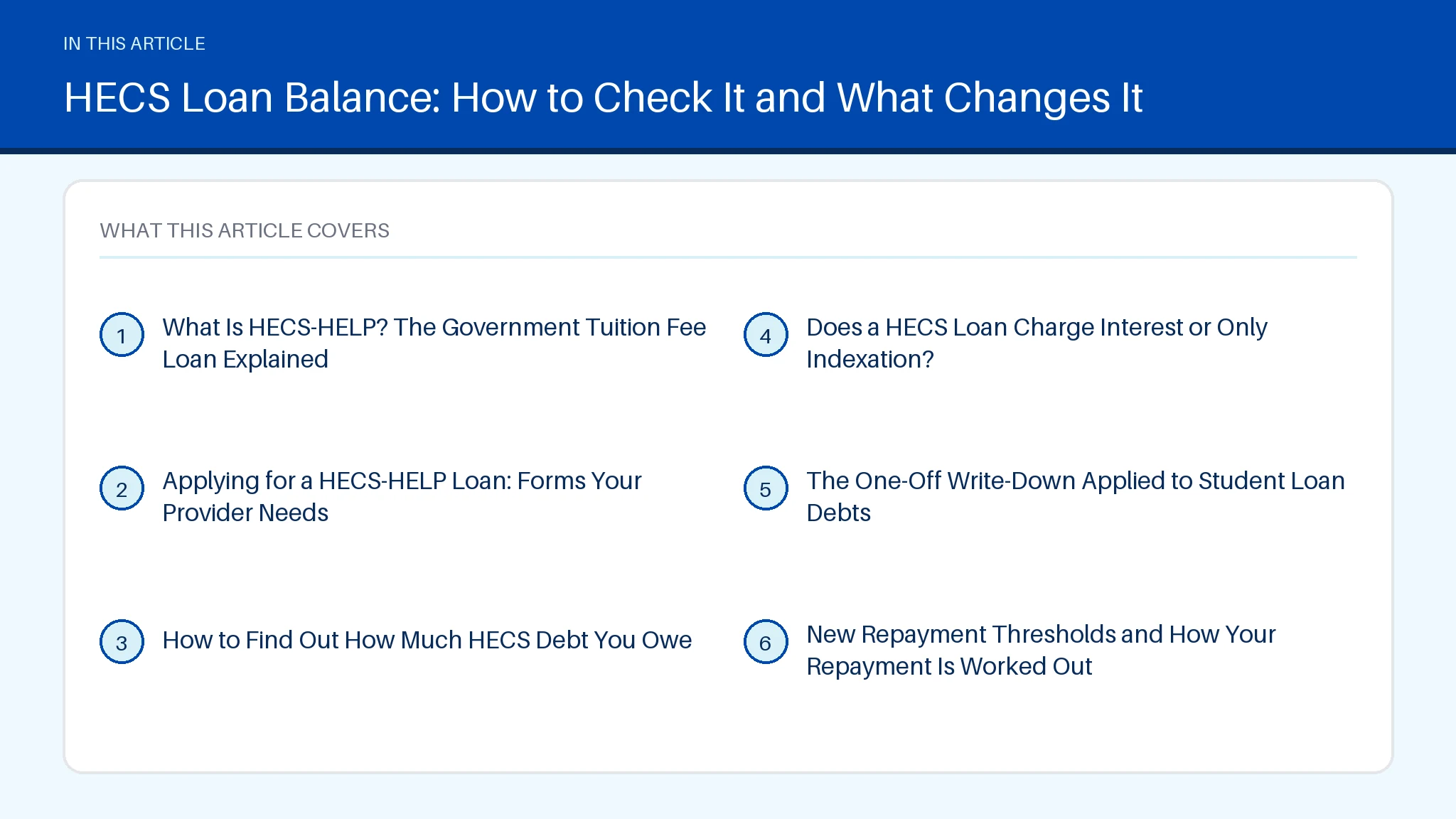
What Is HECS-HELP? The Government Tuition Fee Loan Explained
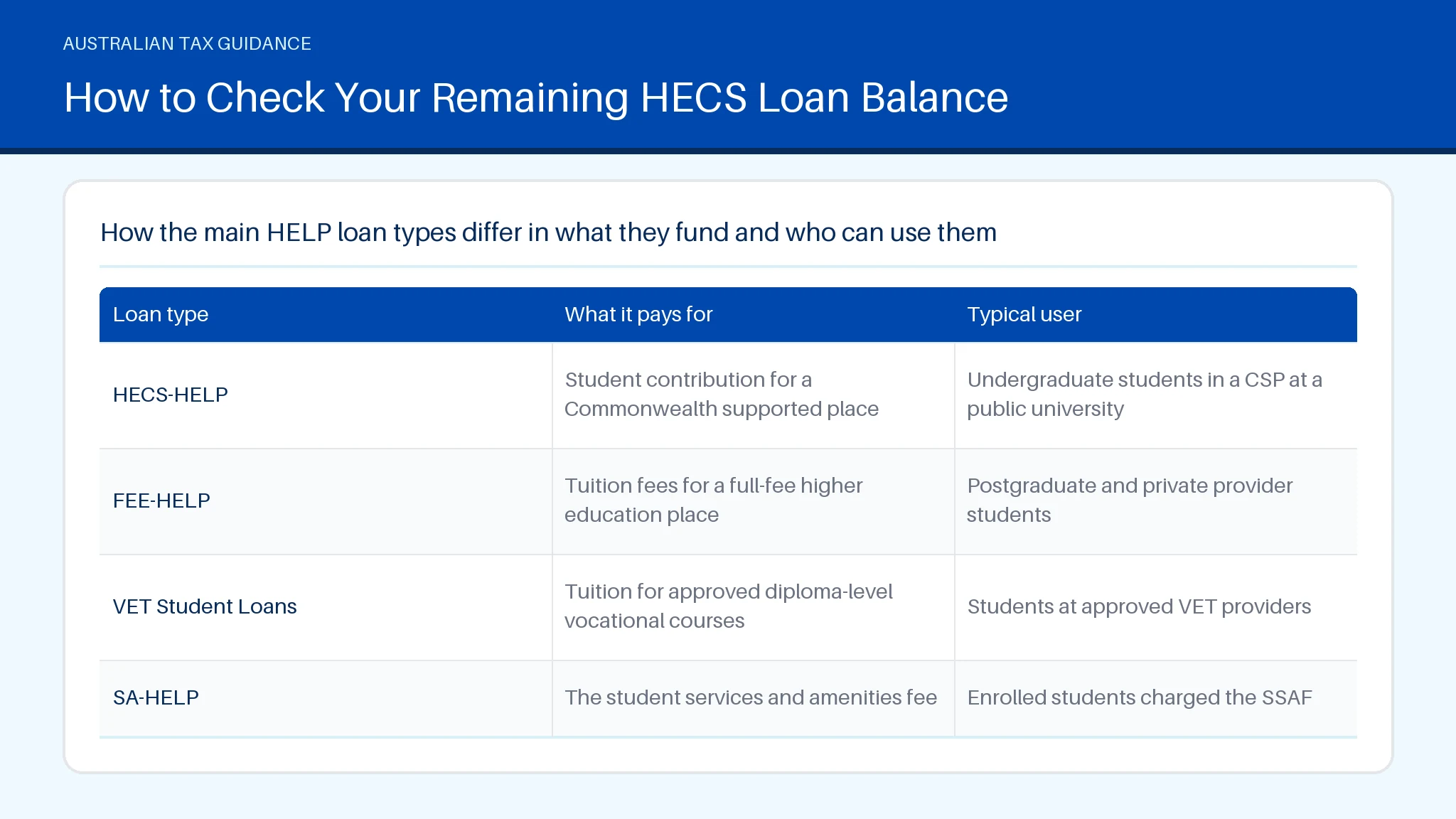
HECS-HELP is a Commonwealth loan that pays the student contribution amount for Commonwealth supported places at approved higher education providers. The government pays your provider at census date, and the amount becomes a debt you repay through the tax system once your income is high enough. It is one of several loans that roll into a single HELP debt, which is why your HECS loan balance may include study you did under more than one scheme.
| Loan type | What it pays for | Typical user |
|---|---|---|
| HECS-HELP | Student contribution for a Commonwealth supported place | Undergraduate students in a CSP at a public university |
| FEE-HELP | Tuition fees for a full-fee higher education place | Postgraduate and private provider students |
| VET Student Loans | Tuition for approved diploma-level vocational courses | Students at approved VET providers |
| SA-HELP | The student services and amenities fee | Enrolled students charged the SSAF |
All of these accumulate into the one account the ATO reports, and all count towards the combined HELP loan limit. Eligibility, citizenship and residency rules for each are set out in the HECS eligibility guide.
Applying for a HECS-HELP Loan: Forms Your Provider Needs
Your provider, not the ATO, processes your HECS-HELP application. You complete an electronic Commonwealth Assistance Form (eCAF) through your institution's student portal, and it must be submitted on or before the census date for each study period. Miss that date and you owe the fees upfront for those units.
Three things have to be right on the form or your HECS loan balance will not reflect what you expected:
- Your tax file number, or a Certificate of Application for a TFN. Without it the provider cannot accept the request for a loan.
- Your citizenship or visa status, which determines whether you can access HECS-HELP at all.
- The units you are claiming assistance for in that study period.
After census date your provider issues a Commonwealth Assistance Notice confirming the amount loaned. Check it against your enrolment within 14 days, because corrections are easier before the amount is reported to the ATO. If you do not yet have a tax file number, see our guide on who needs a TFN and how to apply.
How to Find Out How Much HECS Debt You Owe
The ATO is the only authoritative source for how much HECS debt you owe. Sign in to myGov, select the ATO service, then open Tax, Accounts, Loan accounts. The screen shows your account balance, the date it was last updated, and a transaction history listing each amount your provider reported, each indexation entry, each voluntary payment and each compulsory repayment credited after a return was assessed.
Two practical points the balance screen does not spell out. First, compulsory repayments withheld from your pay during the year are not credited to your HECS loan balance until your tax return for that year is assessed, so mid-year the figure looks higher than your real position. Second, fees for a study period you are enrolled in now will not appear until after census date and provider reporting.
Step-by-step instructions for each access channel, including the ATO app and myHELPbalance, are covered in Check My HECS Debt: myGov, ATO App and myHELPbalance.
Does a HECS Loan Charge Interest or Only Indexation?
A HELP debt charges no interest. The ATO applies indexation instead, which maintains the real value of the debt rather than earning a return for the lender. Indexation is applied on 1 June each year to the portion of your debt that has been outstanding for 11 months or more.
Since the 2023-24 indexation year, the rate is the lower of the Consumer Price Index and the Wage Price Index, a change made retrospectively so earlier high indexation figures were recalculated and credited. That matters for two decisions. A voluntary payment made before 1 June reduces the balance that gets indexed, while the same payment made on 2 June does not. And because indexation tracks inflation rather than a commercial rate, paying a HELP debt down early carries a different trade-off to clearing other borrowings, where deductible interest may be in play. HELP repayments are never a tax deduction.
The One-Off Write-Down Applied to Student Loan Debts
The Australian Government legislated a one-off 20% reduction to HELP and other student loan debts, and the ATO applied it automatically to accounts. The reduction was calculated on the balance as it stood at 1 June 2025, before the 2025 indexation amount was applied, so the credit is worked out on the larger pre-indexation figure.
Three practical consequences follow:
- You did not need to apply. The ATO credited eligible accounts and the adjustment appears as a transaction line in your loan account history.
- If you had already cleared your debt in full before the reduction was applied, there was no balance left for the credit to reduce.
- A voluntary payment made shortly before the write-down reduced the balance the 20% was calculated on, which is why some people saw a smaller credit than they expected.
Eligibility detail for the reduction is handled in our HECS debt checking guide.
New Repayment Thresholds and How Your Repayment Is Worked Out
Compulsory repayments start when your repayment income exceeds the minimum threshold for that financial year, and from 2025-26 the amount is worked out on a marginal basis. Rather than applying one flat percentage to your entire income, the formula charges a rate only on the income above each threshold band, so crossing a threshold no longer creates a sharp jump in the amount payable.
Repayment income is broader than salary. The ATO calculates it as your taxable income plus reportable fringe benefits, reportable employer super contributions, total net investment losses and any exempt foreign employment income. A salary-sacrifice arrangement therefore does not remove the sacrificed amount from the repayment calculation, as explained in our salary sacrifice guide.
For current-year rates, bands and a worked estimate, use the HECS repayment calculator and thresholds page.
Where to View Your HECS Loan Account Statement Online
Your full loan account statement sits in ATO online services, reached through myGov under Tax, Accounts, Loan accounts, where you can expand the transaction list and download it. The statement is the document to use when something does not add up, because it dates every entry.
Read it in this order:
- Opening balance for the period and the date it was struck.
- Loan amounts reported by each provider, which should match your Commonwealth Assistance Notices.
- Indexation applied on 1 June, shown as a separate line.
- Compulsory repayments credited after each notice of assessment, and any voluntary payments.
If a provider amount looks wrong, raise it with the provider rather than the ATO, since the provider reports the figure. If a compulsory repayment is missing, check the assessment date on the relevant tax return, because credits follow assessment, not lodgement.
How to Check Your Remaining HECS Loan Balance
Checking what is left on your HELP loan takes three routes, and they answer different questions. Use the one that matches what you actually need to know.
- myGov linked to the ATO. Shows the outstanding debt, transaction history and indexation entries. This is the figure to use when deciding on a voluntary payment.
- The ATO app. Shows the same account balance on a phone, with no desktop login needed. Useful for a quick check, less useful for reading a full statement.
- myHELPbalance. Shows how much you can still borrow under the combined HELP loan limit, not what you owe. Access uses your CHESSN and does not require myGov.
Before you act on any figure, check the last-updated date on the screen. Compulsory repayments withheld through PAYG do not reduce the displayed debt until the ATO assesses your return, and amounts for a current study period will not appear until after census date. If you intend to make a voluntary payment to reduce indexation, allow several business days for a BPAY or card payment to be received and processed before 1 June. The ATO applies indexation to the balance it holds on that date, not to the balance after a payment that is still in transit. More guidance sits across our Australian tax guides.
Working Out How Much You Can Still Borrow Under the Cap
Your available HELP balance is the combined HELP loan limit for the current year minus the HELP amounts you have already borrowed, plus any amounts restored by repayments you have made. HECS-HELP, FEE-HELP, VET FEE-HELP and VET Student Loans all count towards the one limit, which is why a student who used FEE-HELP for a postgraduate course has less room left for further study.
Two features change the arithmetic. The limit is a renewable balance for most loan types, so repayments you make top your available balance back up for future study, subject to the annual limit in force. And HECS-HELP amounts for Commonwealth supported places also draw on that same pool.
Check the figure in myHELPbalance before enrolling in a further course, because a shortfall means paying the difference upfront at census date. Our calculators can help you plan around that cash-flow timing.
Summary
Eligibility for HECS-HELP is decided by your provider at census date, the amount owing is held and indexed by the ATO, and your HECS loan balance moves only when a provider reports fees, indexation is applied on 1 June, or a payment is credited. Keep your Commonwealth Assistance Notices, indexation notices and notices of assessment so you can reconcile the account yourself. Deductit publishes calculators and plain-English guidance; it does not give personal tax advice or lodge returns. To see your figures in context, start in the Deductit workspace.
You may also find these related guides helpful: ATO Number: Which Line to Call for Your Tax Query, Balancing Account ATO: What It Means for Your Return, BAS Explained: What to Report, Lodge and When, and What Is the Medicare Levy? Rates, Rules and Surcharge.
Frequently asked questions
How much HECS do I pay on $70,000?
On a repayment income of $70,000 you pay a compulsory HELP repayment worked out on the income above the minimum threshold, not on the full $70,000. From 2025-26 the ATO applies marginal rates to each band of income above the threshold, so the repayment is a modest share of the excess rather than a flat percentage of your salary. Because repayment income adds reportable fringe benefits, reportable employer super contributions and net investment losses to taxable income, your figure can sit higher than your salary suggests. Run your own numbers through the current-year rates and thresholds page.
Is the government taking 20% off HECS?
Yes. A one-off 20% reduction to HELP and other student loan debts has been legislated and applied automatically by the ATO, calculated on balances as at 1 June 2025 before that year's indexation. It is a single adjustment rather than an ongoing 20% discount on future repayments, and it appears as a credit line in your loan account transaction history. If you had no balance left at that date, there was nothing for the credit to apply to.
Will HECS debt be wiped?
HECS debts are not wiped as a general rule. The one-off 20% reduction cut balances but did not cancel them, and the remaining amount stays payable through the tax system. A HELP debt that has not been repaid is written off from the deceased estate when a person dies, and in narrow circumstances a provider or the ATO can remove amounts where special circumstances prevented you completing a unit. Outside those situations, the debt stays on your account until repaid. The HECS pillar guide covers the special circumstances process.
Is it worth paying off HECS debt?
Paying off a HELP debt early is worth considering mainly when indexation is running higher than the return you would get elsewhere, or when you need the debt cleared to improve borrowing capacity, since lenders count compulsory repayments as a commitment. The counterweight is that HELP charges no interest, the balance is indexed to the lower of CPI and WPI, and there is no penalty for taking the standard path. A voluntary payment also cannot be reversed if you later need the cash.
What happens if you never pay off HECS debt?
If you never reach the repayment threshold, no compulsory repayment is required and the balance simply continues to be indexed each 1 June. There is no default, no credit default listing and no debt collection for an unpaid HELP balance held in this way. Australian residents living overseas must still report worldwide income to the ATO and may have a compulsory repayment obligation. Any remaining HECS loan balance is written off from the estate on death. A $30,000 debt repaid on an income just above the threshold typically takes well over a decade; the same debt on a higher income clears far faster, which you can model alongside your net pay in the pay calculator.
Part of HECS Explained: Eligibility, Applying and Repayments