A company car write off in Australia rarely means deducting a car's full purchase price in one year. For tax purposes, the purchase price is a capital cost. Most claims are made up of either the business or work share of running costs plus depreciation, or a set rate for each work km. Either way, the claim builds up over the years you use the car.
This guide is for employees who drive their own car for work, people who run a business using their own car, and directors deciding whether a car should be owned by a company or trust. It treats three questions separately: whether you are eligible, how the amount is calculated, and which records back up the figure if the ATO asks.
Two figures usually decide what a company car write off is worth in practice. The first is the business-use percentage you can prove. The second is the car limit, which caps the cost you can write down over time. A $90,000 car used 40% for business does not produce a $90,000 deduction.
Before you start, gather:
- the purchase or finance contract, showing the cost and the date you started using the car
- a record of your work or business trips for the year
- receipts and invoices for fuel, maintenance, repairs and loan interest
- the income year you are claiming for, because rates and limits change from year to year
Key takeaways
- A car's purchase price is a capital cost, so you claim depreciation over time rather than the full price upfront. The cost you can use is capped at the car limit of $69,674 for 2025-26.
- Individuals choose one of two ATO methods for each car. One is a set rate of 88c per work km for 2025-26, capped at 5,000 km per car. The other is the business share of actual costs, supported by 12 weeks of trip records.
- You can only deduct the work or business share. Employees can't claim commuting, costs their employer reimburses, or costs paid under salary sacrifice or a novated lease.
- Your records support the claim. You need a 12-week logbook with readings, written evidence for most costs, and in most cases you must keep records for 5 years from lodgement.
- Companies and trusts claim in their own returns. If someone uses an entity's car privately, that raises separate FBT questions.
How the Cents Per Kilometre Method Works for Business Driving
The cents per kilometre method lets you claim a set rate for each work-related km you drive, up to a cap of 5,000 work km per car each income year. You don't need written evidence of costs such as fuel. You do need a record showing how you worked out your work km, and the ATO accepts a reasonable estimate.
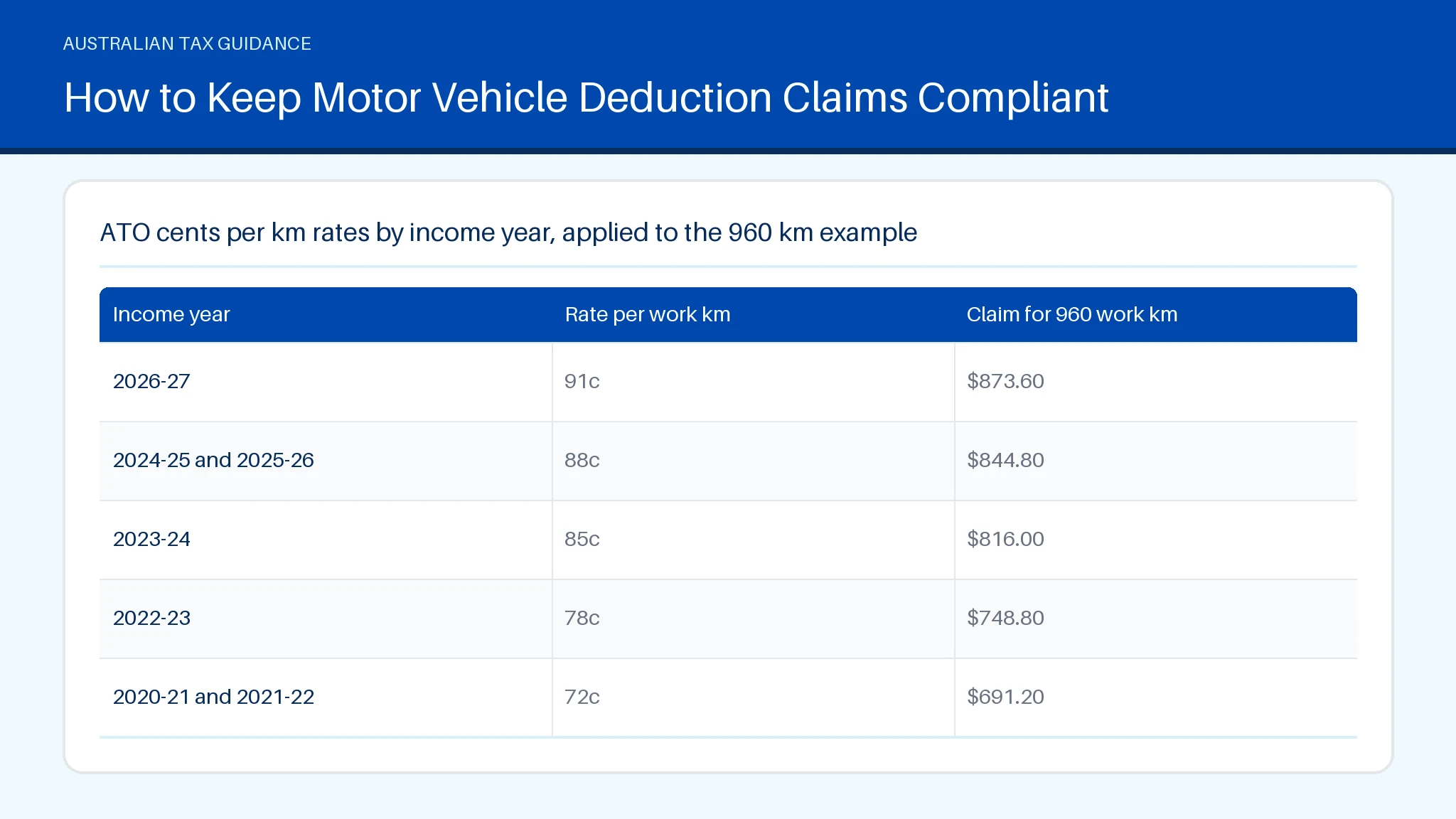
The official example shows how an estimate works. A 20 km work round trip once a week for 48 weeks gives 960 work km. At the 2025-26 rate of 88 cents per kilometre, that is a claim of $844.80.
| Income year | Rate per work km | Claim for 960 work km |
|---|---|---|
| 2026-27 | 91c | $873.60 |
| 2024-25 and 2025-26 | 88c | $844.80 |
| 2023-24 | 85c | $816.00 |
| 2022-23 | 78c | $748.80 |
| 2020-21 and 2021-22 | 72c | $691.20 |
Two factors matter more than the rate itself:
- The cap is per car. If you use two cars for work, the 5,000 km limit applies to each car separately.
- The rate replaces actual costs. You must choose one method, and the cents per kilometre rate ignores what the car really costs you. If you have large lease payments or regular repairs, the logbook method, which uses actual expenses, may give you a larger figure.
Work out the cents per kilometre figure first as a baseline. Then check whether a larger company car write off based on actual costs is worth the extra record-keeping. Deductit's car and deduction calculators show the formula behind each figure.
Car Expense Claim Errors That Attract ATO Scrutiny
The ATO's myTax instructions set out three limits worth checking before you lodge: you can't claim private travel, including normal trips between home and your regular place of work; you can't claim car expenses your employer reimburses or that you pay under a salary sacrifice or novated lease arrangement; and the cents per kilometre method covers a maximum of 5,000 work-related kilometres per car, per year.
- Counting the commute. You can't deduct normal trips between home and your regular place of work.
- Logging private detours as work. Dropping a passenger at school on the way to a job site adds a private leg. Only the work portion belongs in your figures.
- Claiming costs someone else covered. Employees cannot claim car costs their employer reimburses. Nor can they claim costs covered under a salary sacrifice or novated lease arrangement, such as lease payments made from pre-tax salary.
- Going over the cap. The cents per kilometre method stops at 5,000 work km per car per year. If you drive more for work than that, you need the logbook method and its records.
- Missing odometer readings. A valid logbook covers a continuous 12-week period and includes the readings for that period. A trip diary on its own does not support a work-use percentage.
- Forgetting the balancing adjustment. If you sell or stop using a car after claiming its decline in value, you may need to make a balancing adjustment.
Sole traders and company directors face another trap. Running personal and business car costs through the same account makes the business share hard to prove. Putting a car in a company or trust's name also does not remove the private share. Instead, private use by a director or employee raises fringe benefits tax questions for the entity.
Claiming Actual Business Vehicle Running Costs Backed by Records
To claim actual running costs, you total the year's car expenses and then deduct only the business share your records support. This is the actual cost approach the ATO uses in its logbook method. It suits cars with heavy work use, because there is no limit on the work km you can count.
The ATO lists these costs as part of the pool:
- running costs such as fuel, oil, maintenance and repairs
- interest on a car loan, or lease expenses
- depreciation of the car
Capital costs are left out. The purchase price, the principal you borrowed to buy the car and the cost of any improvements are not running expenses. That is why writing a car off happens gradually rather than in a single claim.
To claim business car expenses this way:
- Total the year's car expenses, including running costs, interest and leasing costs, and depreciation.
- Work out the business-use percentage from your 12-week logbook.
- Multiply that percentage by the total. The result is the amount you claim.
You can base fuel and oil on actual receipts or on a reasonable estimate. An estimate uses odometer readings at the start and end of the period you held the car, the car's fuel consumption and the average fuel price for the year. Every other item needs written evidence.
As an illustration of how vehicle expenses are split, the ATO's logbook method guidance multiplies your work-related use percentage by your car expenses, and in its worked example Lana applies a 69% logbook percentage to $17,275.33 of decline in value to claim $11,919.98. The claim is $6,000. If you run a business, see how these steps apply to a business vehicle on our business motor car rules page.
Company Car Write Off: Which Vehicle Deductions Are Available?
The vehicle deductions open to you depend on who owns the car and which method you use. Individuals choose between a set rate per kilometre and the logbook method. Either way, each tax deduction must relate to the share of use that earns your income.
Common vehicle deductions under the logbook method include these motor vehicle expenses:
- fuel and oil, based on actual records or a reasonable estimate
- maintenance and repairs
- interest on a car loan, or lease expenses
- depreciation, worked out on a cost capped at the car limit
Some costs never become a tax deduction under the car rules. These include the purchase price, loan principal, improvement costs, private travel and normal trips between home and work. The ATO's logbook method guidance treats the purchase price of a car as a capital cost, not a running expense, and works out decline in value on a cost capped at the car limit ($69,674 for 2025 to 26), so keep both points in mind when you read our small-business instant asset write-off page.
Company cars work differently. When an employer's company provides the car, the employee generally has no tax deduction for costs the employer pays or reimburses. The employer deals with the car in its own return and through any FBT obligations. Our FBT and worker benefits page covers the business side of private use.
How to Keep Motor Vehicle Deduction Claims Compliant
To keep claims for motor vehicle expenses compliant, the method, the evidence and the business share must all match for the same car in the same income year. Use this checklist before you lodge:
- Pick one method per car. You must use either the cents per kilometre method or the logbook method to work out a car claim.
- Match your evidence to the method. The set rate needs a record of how you worked out your work km. The actual cost approach needs a logbook covering 12 continuous weeks, odometer readings for that period and written evidence for costs.
- Watch the $300 line. If your total claim for work-related expenses is more than $300, you must have written evidence to prove it.
- Use a format you will keep. The ATO accepts an electronic record kept with the myDeductions tool in the ATO app, or a paper one.
- Keep everything for 5 years. In most cases, you must keep records for 5 years from the date you lodge your return.
Sole traders and other business owners should record which method each car uses each year, because evidence for one method does not support the other. If your business provides cars to staff, keep fringe benefits tax records separate from the income tax claim. For related car and travel rules, browse the Deductit deduction library.
Can You Claim Depreciation on a Business Vehicle?
You can claim depreciation on a business vehicle you own. The ATO calls it decline in value. For individuals, it forms part of the logbook method's pool alongside your other motor vehicle expenses, and you reduce it to your business-use percentage.
Cost × (days held ÷ 365) × (200% ÷ effective life)
Three inputs drive the result:
- Cost. This is the car's cost, capped at the car limit for the year you bought it. Keep the contract that shows both the price and the purchase date.
- Days held. If you buy a car late in the income year, you only get a part-year claim. The first-year figure can be much smaller than buyers expect.
- Effective life. The example uses the Commissioner's effective life of 8 years.
The ATO's logbook method guidance works out decline in value under the diminishing value method as cost × (days held ÷ 365) × (200% ÷ effective life), and its worked example caps the cost at the 2025 to 26 car limit of $69,674 and uses an effective life of 8 years. Your work-use percentage reflects each kilometre you drive for work during the 12-week recording period. If that period is busier than your normal year, it can overstate the claim. Lease expenses are a separate item in the list of car costs, so record them separately from depreciation.
How the Car Cost Limit Caps Your Depreciation Claim
The car cost limit caps the cost you can use to work out depreciation. For cars bought in 2025-26, the limit is $69,674. Anything you pay above that amount does not increase the claim.
The ATO's worked example shows the order of the steps:
- Lana bought her car in 2025-26, so its cost for decline in value purposes is reduced to the $69,674 car limit.
- She held the car for 362 days of the year and used the Commissioner's effective life of 8 years: $69,674 × (362 ÷ 365) × (200% ÷ 8) = $17,275.33.
- Her logbook shows 69% work-related use, so she claims $17,275.33 × 69% = $11,919.98.
The order matters. The cap applies first, then the part-year adjustment, then the work-use percentage. A buyer who expects to claim a share of the full sticker price will overestimate. Interest and leasing costs are separate items in the pool and are not part of this calculation. None of this applies under the cents per kilometre method, which uses the set rate instead.
Keep the purchase contract and receipts so you can prove the cost and the start date. Our guide to the logbook method explains how to record the percentage itself.
How Employees Claim Work-Related Vehicle Expenses
Employees claim work-related car expenses in their own tax return, using either the cents per kilometre method or the logbook method, according to the ATO's myTax 2026 instructions for work-related car costs. You can only claim kilometres you travel while earning assessable income. Normal trips between home and your regular place of work don't count, and you can't claim any private part of a cost. The ATO points to Taxation Ruling TR 2021/1 for when an employee's transport costs are deductible.
For 2025 to 26, the ATO's cents per kilometre method allows 88 cents per kilometre for up to 5,000 work-related kilometres per car. The same page lists 91 cents for 2026 to 27. You don't need receipts, but you do need a record showing how you worked out your kilometres. The logbook method has no kilometre cap, but you need a logbook covering a continuous 12-week period plus odometer readings for that period.
The myTax instructions cover individuals lodging their own return. A car supplied through your employer's company or trust is usually dealt with on the employer's side, which the next section covers. As an employee, you can't claim car expenses your employer reimburses, or costs you pay under a salary sacrifice or novated lease arrangement. The ATO notes these cars are usually leased by your employer from a financing company.
Under the ATO's logbook method, you claim your work-related use percentage of:
- fuel, oil, maintenance and repairs
- interest or lease costs
- decline in value (depreciation) on a car you own
Capital costs, such as the purchase price, the loan principal and improvement costs, are not included. You can base fuel and oil on receipts or on a reasonable estimate using odometer records, your car's fuel consumption and the average fuel price for the year. All other running costs need written evidence, such as receipts.
The ATO says that if your total claim for all work-related expenses is more than $300, you must have written evidence to prove it. In most cases, you keep records for 5 years from the date you lodge your return.
How Companies and Trusts Claim a Company Car Write Off
Companies and trusts claim a car's business costs in their own entity tax return, not in the individual car section of myTax. The two car methods quoted in this guide come from the ATO's guidance for individuals. Before using either approach, an entity should confirm that the ATO's business vehicle guidance applies to it.
The evidence a company or trust needs will look familiar:
- purchase, finance or leasing documents showing the cost and start date
- invoices for fuel, servicing, repairs and other running costs
- a logbook or trip record separating business trips from private kilometres travelled by directors, employees or family members
- a register of the vehicles the entity holds, because vans and utes may be classified differently from cars
Private use is where fringe benefits come in. If a director or employee drives a car owned by the entity for private purposes, this can create FBT obligations for the entity. The trip records that support the business claim also matter for the FBT side. Treat the car as a business asset with its own records, not as a personal car paid for from the business account.
Summary
A company car write off is usually a claim spread over several years, not a single upfront deduction. Eligibility depends on work or business use, and commuting and other private travel are excluded. You calculate the claim using either a set rate per km, capped at 5,000 km per car, or the business share of actual costs, with depreciation limited by the car limit. For records, you need a trip estimate for the set rate, or a 12-week logbook plus written evidence for actual costs. Deductit's calculators and rule pages explain each formula, and you can set up a Deductit workspace to work through your own figures. Neither is personal tax advice.
You may also find these related guides helpful: Balancing Account at the ATO: Stages, Delays and Tracking, Tax Deduction Record Keeping: What the ATO Expects, HECS Loan Balance: How to Check It and What Changes It, Log Book Method: How to Claim Your Car Deduction, Pay Calculator Australia: Work Out Your Take Home Pay, Salary Sacrifice: How It Works, Tax Saved and Caps, Tax Rates in Australia: 2025-26 and 2026-27 Brackets, Tax return steps from records and pre-fill to your refund, and ATO Late Lodgement Penalty: What to Know.
Frequently asked questions
What is the depreciation rate for cars in Australia?
Cars in Australia have no single depreciation rate. The rate depends on the car's effective life and the method used. In the ATO's worked example, the Commissioner's effective life of 8 years gives a diminishing value rate of 200% ÷ 8, which is 25% a year. That rate applies to the car's cost, capped at the car limit ($69,674 for 2025-26). It is then adjusted for the days you held the car and reduced to your work-use share.
What counts as business use of a motor vehicle?
Business use of a motor vehicle is travel you do in the car while earning your assessable income. Normal trips between home and your regular place of work are private, and so are detours for personal errands. You can only claim the work share of costs. Under the actual cost approach, 12 continuous weeks of trip records prove that share.
What records should you keep?
Keep written evidence of your car costs, your logbook and trip records, and a note showing how you worked out the claim. Written evidence must show:
- the supplier's name or business name
- the amount of the expense or the cost of the asset
- what you bought
- the date you bought it and the date the document was produced
In most cases, keep these records for 5 years from the date you lodge. Under the set-rate method, you only need a record showing how you calculated your work km.
What about fringe benefits tax and private use?
The driver can't claim private use. The ATO's myTax 2026 instructions say you can't claim any part of an expense that is private. That includes normal trips between home and your regular place of work. You also can't claim car expenses that your employer reimburses or that you pay under a salary sacrifice or novated lease arrangement. The ATO notes that these cars are usually leased by your employer from a financing company. The ATO's car expense instructions don't cover fringe benefits tax, so check it separately.
Can I claim the full cost of a car through my business?
Generally, no. Under the ATO's car rules, you can't claim the full purchase price of a car as a single expense. The purchase price is a capital cost, so you claim depreciation over time instead. The cost you use is capped at the car limit and then reduced to your business-use percentage. You claim running costs such as fuel and interest each year for the business share. Small-business write-off concessions have their own eligibility rules, so check them separately before assuming you can claim the cost upfront.