A "taxable offset" is not a separate category of tax relief in Australia. The phrase usually mixes up two different things. A deduction reduces your taxable income. A tax offset reduces the amount worked out on that income. This guide is for employees, retirees and small business owners who want to know which offsets exist, who is eligible, how each one is calculated and what records to keep.
The order matters. Your income minus deductions gives the figure you are taxed on, and offsets then come off the result. Some offsets, such as the low income tax offset, can only cut your tax payable to $0. Others work differently, and one is paid into your super fund instead of reducing what you pay.
By the end, you should be able to read your notice of assessment and see which offsets were applied. You should also be able to tell whether the taxable offset you were searching for is really one of your deductions, an offset, or a payment into super. This guide explains how the rules work. It is not personal advice.
Key takeaways
- "Taxable offset" is not a term the Australian Taxation Office uses. Deductions reduce the income you are taxed on, while an offset reduces the bill worked out on that income.
- You may be eligible for the low income tax offset (LITO) if you earn up to $66,667. It can only bring what you pay down to $0.
- The small business offset is capped at $1,000 per person per year across all your sources of small business income.
- The ATO works out LITO after you lodge. The small business offset needs its own entries in myTax, and you report your business income in two places.
- Keep income statements, receipts for expenses and your notice of assessment so you can check that each offset was applied.
Super-Related Tax Offsets: Spouse Contributions and Super Income Streams
Offsets linked to super, such as the spouse contribution offset and the super income stream offset, are not covered by the sources used for this guide. Check their conditions in current ATO guidance before you rely on them. The ATO does explain how a deduction differs from an offset. Its guidance on claiming deductions says deductions reduce your taxable income. Most relate to earning that income, with a few exceptions such as donations.
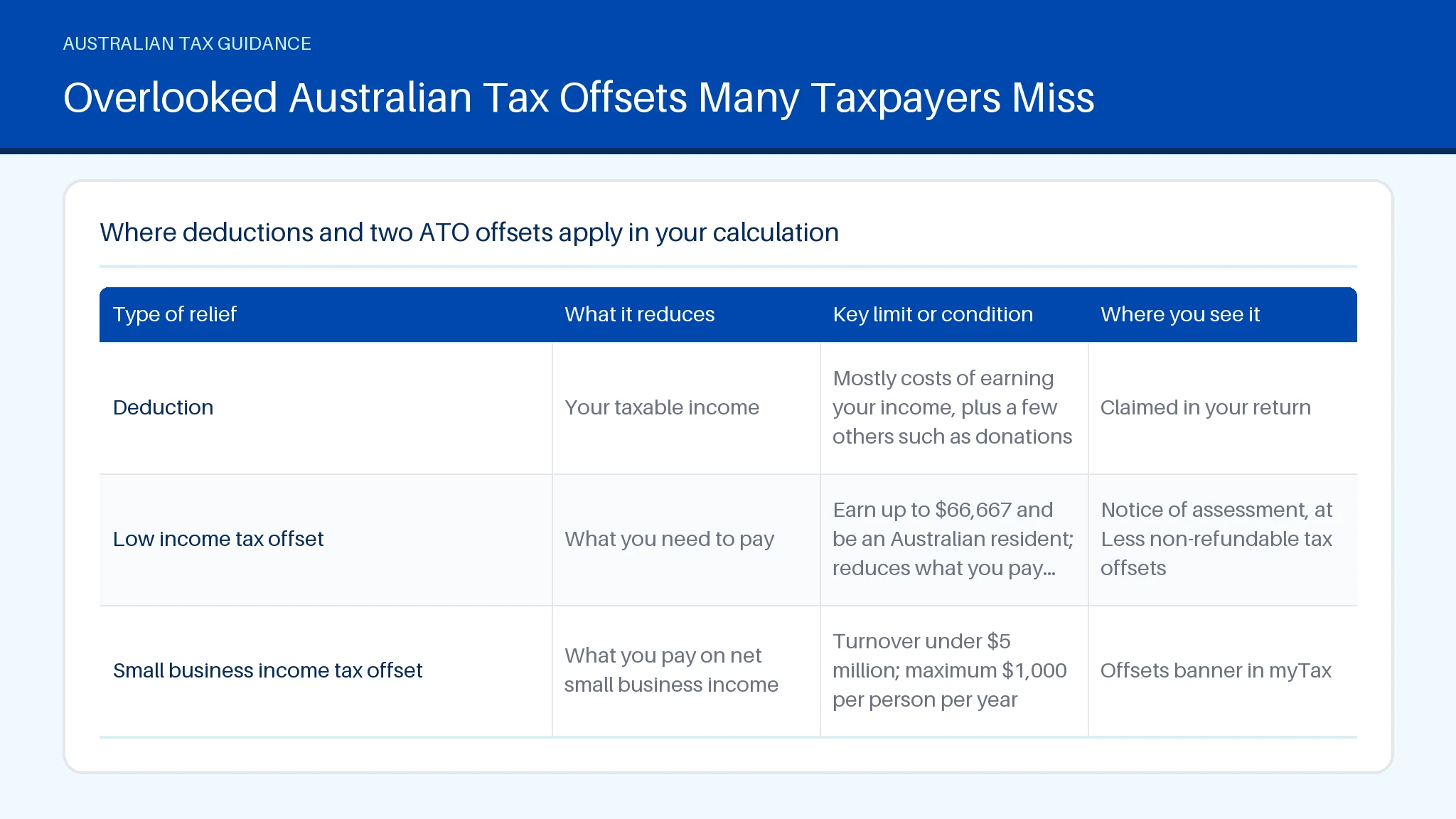
| Type of relief | What it reduces | Key limit or condition | Where you see it |
|---|---|---|---|
| Deduction | Your taxable income | Mostly costs of earning your income, plus a few others such as donations | Claimed in your return |
| Low income tax offset | What you need to pay | Earn up to $66,667 and be an Australian resident; reduces what you pay to $0 at most | Notice of assessment, at Less non-refundable tax offsets |
| Small business income tax offset | What you pay on net small business income | Turnover under $5 million; maximum $1,000 per person per year | Offsets banner in myTax |
A deduction lowers the income your tax is worked out on. An offset reduces the tax itself. The ATO's low income offset guidance says LITO can only reduce what you pay to $0. Its myTax instructions say the small business offset is worked out on net income. That means business income after any deduction relating to it.
Before you lodge your tax return, use the Deductit deduction library to check which expenses you may be able to claim. Treat any taxable offset you have read about, including the super-related ones, as a separate item to confirm with the ATO.
How Much Is the Low Income Tax Offset at Each Income Level?
The LITO amount depends on your taxable income, according to the official low income tax offset page. People who earn up to $66,667 may be eligible. The offset is calculated after you lodge, so you do not enter a figure yourself. If you earn more than $66,667, the offset no longer applies.
Because the amount depends on your income, it changes when your income changes. Three practical points follow:
- Check the amount for your income on the official LITO page for the year you are lodging. Don't rely on a figure from an older article.
- The offset can only reduce your tax payable to $0. Any unused part is lost, not paid to you.
- Deductions that lower your taxable income can change the offset. If what you pay is already $0, they may not change your result.
Lists that show a taxable offset by income band often carry outdated figures. The 2025-26 tax rates and brackets guide shows what you owe on your income. You can compare that with the offset on your notice of assessment.
Claiming Tax Offsets in Your Return: A Step-by-Step Process
What you need before you start: your income statement and other income records, receipts for work-related expenses, records of any business income, and last year's notice of assessment for comparison.
- Report all your income, including business income in each place myTax asks for it.
- Claim each tax deduction you have records for. Deductions come off your income before any tax is calculated.
- Let LITO apply on its own. It is worked out after you lodge, so you don't need to claim it separately.
- For the small business offset, personalise your return by selecting "You're claiming tax offsets or adjustments". Then choose Add/Edit at the Offsets banner.
- When your notice of assessment arrives, check which offsets are shown and whether you owe money or will get money back.
If you earn $60,000 or less, Moneysmart says you may be eligible for the ATO's free Tax Help program. It runs from July to October, and trained volunteers help people lodge online, by phone or in person. To test your numbers first, the Deductit calculators show the formula behind each estimate.
Why the Private Health Insurance Offset Is Refundable
The ATO uses the low income tax offset (LITO) to show how a non-refundable offset works. According to the ATO's low income tax offset page, LITO "reduces the tax you need to pay and can only reduce your tax payable to $0". The ATO works out LITO after you lodge. The amount appears on your notice of assessment at "Less non-refundable tax offsets". Any LITO above your tax payable is not paid to you as a refund.
The ATO pages used for this guide do not cover the private health insurance offset. For that reason, this section does not say whether that offset is refundable, how it is worked out or when it produces a refund. To see how it applies to you, read the ATO's private health insurance guidance and check which label it appears under on your notice of assessment.
The ATO pages cited here also explain how deductions and LITO relate to your income:
- The ATO's claiming deductions page explains that the deductions you claim in your tax return reduce your taxable income. LITO works differently because it reduces the tax you need to pay.
- The ATO says you may be eligible for LITO if you earn up to $66,667. You also need to be an Australian resident for tax purposes, and the amount you receive depends on your taxable income.
Overlooked Australian Tax Offsets Many Taxpayers Miss
People often miss these offsets because they need an entry or a condition you have to confirm. They are not applied automatically.
- Small business offset. Sole traders and partners in businesses with a turnover under $5 million can skip the offsets section without realising the offset can be worth up to $1,000.
- Zone offset. Residents of remote areas may qualify. The zone offset guide to the 183-day rule and eligibility covers the details.
- Spouse super contributions offset. The spouse who made the contribution claims it, and it is easy to forget months later.
- Future offsets. The Working Australians offset from 2027-28 does not apply to returns for earlier years.
Tips and common mistakes: Many taxpayers assume an offset turns into cash. Offsets such as LITO only reduce your tax bill, so if you owe nothing, any unused part is lost. Older articles also mention a middle income tax offset. Before you rely on any offset you read about, check that it applies to the year you are lodging.
How the Seniors and Pensioners Tax Offset Cuts Tax for Retirees
The seniors and pensioners tax offset (SAPTO) lowers the bill for eligible older Australians and pension recipients. Eligibility depends on conditions such as your age or pension status and your income, not on how much you spend.
These points can help retirees understand their result:
- SAPTO is an offset, not a tax deduction. The ATO explains that deductions reduce your taxable income and mostly relate to earning that income. Medical bills and other living expenses therefore work differently from an offset.
- An offset applies to the amount you owe, not to your income. For the low income offset (LITO), the ATO says it reduces the tax you need to pay and can only reduce it to $0. Your notice of assessment shows it under non-refundable offsets.
- Keep your pension, super and investment statements together so the income figures in your return are complete.
What Is the Low Income Tax Offset (LITO)?
The low income tax offset (LITO) reduces what Australian residents on lower incomes pay, and the ATO applies it once you lodge. To be eligible, you need to:
- be an Australian resident for tax purposes
- pay tax on your taxable income
- have income below the relevant thresholds. People earning up to $66,667 may be eligible.
Non-residents don't meet the first condition. If your income is too low to be taxed, there is nothing for the offset to reduce. Your notice of assessment shows the amount in the offsets section.
The Deductit pay calculator estimates how much is withheld from your pay during the year. It does not decide whether you receive LITO.
How the Low Income Superannuation Tax Offset Is Paid Into Super
The low income superannuation tax offset (LISTO) is paid into your super account. It does not reduce the amount in your return. It is designed to offset the amount of tax your fund deducts from concessional contributions made for eligible lower-income earners. The ATO works it out and pays it to your fund.
This has some practical consequences:
- You don't claim it as a tax deduction or enter it in your return. It appears as a credit in your super account.
- It doesn't change what is payable on your personal return. Look for it on your super statement, not your notice of assessment.
- Work expenses you claim reduce your income, and that can affect your eligibility because LISTO depends on income.
- Keep contribution statements with your other records so you can match any LISTO credit to the year it relates to.
Small Business Income Tax Offset for Unincorporated Business Owners
The small business income tax offset lets an eligible unincorporated business owner offset income tax directly, by up to $1,000 per person each year. The ATO's myTax 2026 instructions apply from 1 July 2025 to 30 June 2026. They say you may be entitled to the offset if you are an eligible small business entity with a turnover less than $5 million.
The offset is worked out on net small business income, not gross income.
- sole trader net small business income, which is business income after deductions
- share of partnership net small business income, less deductions relating to that share
- share of trust net small business income, less deductions relating to that share.
Two details are easy to get wrong:
- The $1,000 maximum covers all your sources of small business income combined. If you earn income from your own business and a partnership, you don't get $1,000 from each.
- Amounts you enter at the offset question are only used to work out the offset. They are not included in your taxable income. You still need to report your business income at Business income or losses so it is counted.
When you lodge your tax return in myTax, some offset details may be pre-filled from trust distributions. If they aren't, select the offset under Personalise return and use the official offset calculator to work out your entries. The offset reduces the amount of tax you would otherwise pay on that business income. If you skip the section, you don't get that reduction.
Summary
A taxable offset is really two separate ideas. Deductions come off your income first, and offsets reduce the tax worked out afterwards. LITO, SAPTO and the small business offset each have their own eligibility tests. LISTO is paid into super, and the private health rebate can come back to you. Keep your statements, receipts and notices of assessment together in your Deductit workspace before you check your return.
You may also find these related guides helpful: Balancing Account at the ATO: Stages, Delays and Tracking, Pay Calculator Australia: Work Out Your Take Home Pay, Superannuation Calculator: Estimate Your Retirement Balance, Superannuation in Australia: How Your Super Works, Aus Financial Year: What to Know, BAS Requirements: Who Must Report, Deadlines and How to File, Carry-Forward Concessional Contributions: Rules and Timing, and HECS Repayment Calculator: 2025-26 Rates and Thresholds.
Frequently asked questions
What is claiming a tax offset?
Claiming a tax offset means getting an amount taken off what you pay on your income for the year. Some offsets need no action: LITO is worked out after you lodge. Others, such as the small business offset, need entries in the offsets section of myTax. Keep the records behind each figure.
How can I offset income tax?
You reduce income tax by claiming deductions and by qualifying for tax offsets. The ATO says deductions reduce your taxable income, while an offset reduces the tax you need to pay. Australian residents earning up to $66,667 may be eligible for the low income tax offset (LITO), which the ATO works out after you lodge. It can only reduce your tax payable to $0.
Eligible small business entities with turnover under $5 million may also claim the small business income tax offset, worth up to $1,000 per person each year.
What is the income tax offset for 2026?
The main income tax offsets for the year ending 30 June 2026 are LITO and the small business offset. Official guidance says you may be eligible for LITO if you earn up to $66,667, and the amount depends on your income. The myTax 2026 instructions cap the small business offset at $1,000 per person per year.
Is there a low income tax offset for 2025-26?
The low income tax offset is available for 2025-26. The ATO's current guidance, updated in June 2026, says you may be eligible if you earn up to $66,667. You also need to be an Australian resident for tax purposes. The offset is worked out after you lodge and can only reduce what you pay to $0.
How do tax offsets work?
Tax offsets reduce the tax you need to pay. Deductions work differently because they reduce your taxable income. The ATO says it works out the low income tax offset (LITO) after you lodge, and you can see it on your notice of assessment at "Less non-refundable tax offsets". LITO can only reduce your tax payable to $0. Some offsets have their own rules. For example, the ATO's myTax instructions say the small business income tax offset is worked out on net small business income and is capped at $1,000 per person each year.