The ATO zone offset is a tax offset for people whose usual place of residence is in a remote or isolated area on the ATO's zone list. To claim the zone tax offset, that home generally needs to have been your residence for 183 days or more during the income year. Working in a remote location doesn't count on its own. The ATO says a fly-in fly-out worker who works in a qualifying area but lives somewhere else is not eligible.
This guide is for anyone living in, moving to or leaving remote Australia. It shows whether the offset applies to you, how the amount is calculated and what evidence to keep. It covers three separate questions in order:
- Eligibility: where your usual home was, and how many days it was your home during the year.
- Calculation: which zone you lived in and the two parts the ATO uses to set the amount.
- Records: the documents that show where you actually lived, including the dates you moved in or out.
An offset is not the same as a deduction. A deduction lowers your taxable income. An offset is taken off the tax worked out on that income. To see which deductions might suit your work, the Deductit deduction library groups them by category. The ATO says that people who work in a remote or isolated area but don't live there, such as fly-in-fly-out workers, are not eligible for the ATO zone offset, so check where you usually live before you read further in our Australian tax guides.
The ATO explains the ATO zone offset in its Zone or Overseas forces 2026 instructions. Those instructions also cover a separate offset for some people serving overseas. Everything below is general information drawn from ATO guidance. It is not personal tax advice, and the ATO decides what you are entitled to when it processes your return.
Key takeaways
- The zone tax offset depends on where your usual home is, not where you work. The ATO requires that home to be in a remote or isolated area on its zone list.
- The ATO generally requires that place to have been your home for 183 days or more in the income year you are claiming for.
- According to the ATO, FIFO workers who work in a zone but live somewhere else are not eligible.
- A shorter stay can still count if you meet the ATO's conditions for adding together days from two income years.
- An offset reduces the tax you pay. Keep dated evidence of where you lived before you lodge.
What Is the ATO Zone Offset for Remote Area Residents?
The ATO zone offset is for people who reside in remote or isolated parts of Australia, and the test is where you live, not where you work. The Australian Taxation Office publishes an Australian zone list of specified remote and isolated locations, and it notes that the list is not exhaustive. If your town isn't on the list, check further. It doesn't prove that you can't qualify.
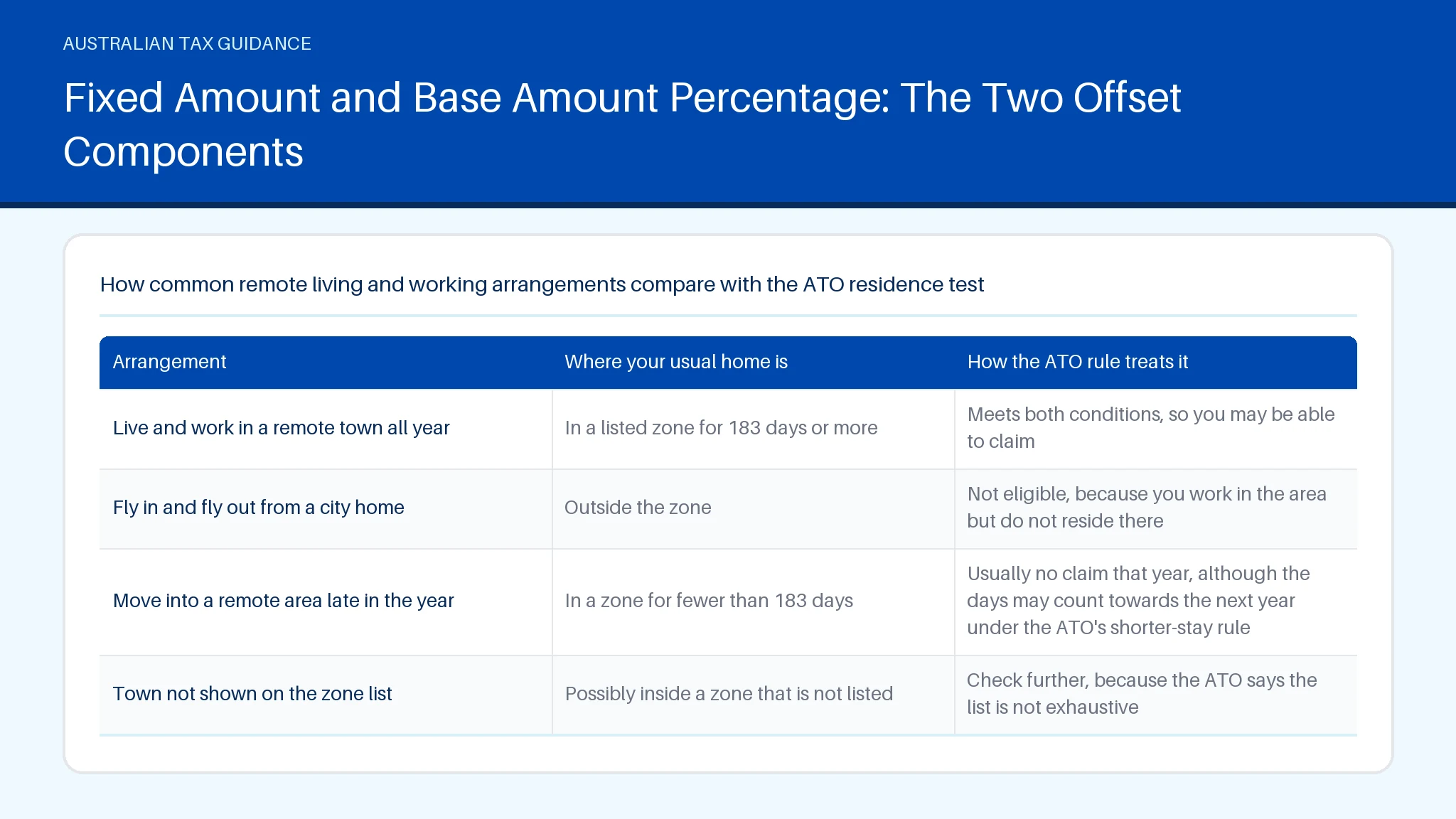
The ATO's own example makes the line clear: a person who works in a qualifying remote area but does not live there is not eligible. Your usual place of residence decides the question. The table below shows how common arrangements measure up against that test.
| Arrangement | Where your usual home is | How the ATO rule treats it |
|---|---|---|
| Live and work in a remote town all year | In a listed zone for 183 days or more | Meets both conditions, so you may be able to claim |
| Fly in and fly out from a city home | Outside the zone | Not eligible, because you work in the area but do not reside there |
| Move into a remote area late in the year | In a zone for fewer than 183 days | Usually no claim that year, although the days may count towards the next year under the ATO's shorter-stay rule |
| Town not shown on the zone list | Possibly inside a zone that is not listed | Check further, because the ATO says the list is not exhaustive |
According to the Australian Taxation Office, working in a qualifying remote or isolated area doesn't make you eligible if you don't live there, and it gives fly-in-fly-out workers as an example. The ATO asks about your usual home, so start there before you look at zones or amounts.
Who Can Claim the Zone Tax Offset?
You can claim the zone tax offset if your usual place of residence was both in a remote or isolated area and your residence for 183 days or more during the income year you are claiming for, according to the ATO's eligibility guidance. You must meet both conditions.
Working in a zone is not enough by itself. The ATO says you are not eligible for this tax offset if you work in a qualifying remote or isolated area but don't live there. It gives fly-in-fly-out workers as an example.
To check your location, use the ATO's Australian zone list. The ATO notes that the list is not exhaustive.
If your usual place of residence was in a zone for less than 183 days in the income year, the ATO says you may still be able to claim the tax offset. This applies if your residence in the zone lasted for a continuous period of less than 5 years, and all of these apply:
- you couldn't claim in the first year because the zone was not your residence for 183 days or more
- the days you lived there in the first year and the current income year add up to 183 days or more
- your time living in the zone in the current income year includes the first day of that income year
- in every income year between the first year and the current year, you lived in the zone for the full income year
Days from a first year that fell short of 183 can still count towards the total in a later year, as long as every condition above is met.
The ATO's Zone or Overseas forces 2026 instructions explain in more detail when you may be eligible to claim the zone tax offset.
Eligibility Criteria You Must Meet for the Zone Tax Offset
The zone tax offset reduces the tax you pay if you live in an isolated part of Australia. Eligibility depends on two residence conditions set by the ATO, and you are eligible only if your usual home meets both of them.
- Location: your usual place of residence is in a remote or isolated area. For this check the ATO points to its Australian zone list, and it notes that the list is not exhaustive.
- Duration: that place was your residence for 183 days or more during the income year you are claiming for.
If you fall short of 183 days, you may still be eligible in a later year under the ATO's rule for shorter stays, which the next section explains. If you work in a qualifying area but don't live there, the ATO says you are not eligible, whatever your roster or the length of your swing.
Meeting both conditions makes you eligible for the zone tax offset. The amount is worked out as a later step.
Confirming your eligibility means answering four questions in order:
- Where was your usual home during the income year, and on what dates did that change?
- Is that location on the ATO's zone list? If not, does it need further checking because the list is not exhaustive?
- How many days in the income year was it your home?
- If the count is under 183 days, do you meet every condition of the shorter-stay rule?
To be eligible, your answers need to match records you can show if the ATO asks. A day count from memory is weak evidence. What the ATO actually tests is whether your usual place of residence was in a remote or isolated area for 183 days or more during the income year you are claiming for.
Before you claim the tax offset, confirm the current rules in the ATO's Zone or Overseas forces 2026 instructions. They also cover a separate offset for some people serving overseas, which has its own conditions.
The 183-Day Rule: Counting Days From a Previous Income Year
If your usual place of residence was in a zone for less than 183 days in the income year, the Australian Taxation Office says you may still be able to claim the zone tax offset. The rule lets you add days from an earlier first year, when you could not claim, to the days in the year you are claiming for. To qualify under this rule, all of these conditions must apply:
- your stay in the zone lasted for an unbroken stretch of less than 5 years
- you could not claim in the first year because the zone was not your home for 183 days or more
- the days you lived there in the first year and the current income year add up to 183 days or more
- your time in the zone in the current income year includes the first day of that income year
- in any income years between the first year and the current year, you lived in the zone for the full year
The count depends on where you live, not where you work. The ATO says you are not eligible if you work in a remote or isolated area but do not live there, and gives a fly-in-fly-out worker as an example. Earning taxable income in a zone does not add days to the count on its own.
The ATO frames this count around living in a zone. It does not set a separate count for Zone A or Zone B.
Meeting the day count is only one step. Working out how the offset amount is calculated is a separate task. The ATO places this rule within its guidance on the zone or Overseas forces tax offset and points to its 2026 instructions for more detail on eligibility.
Fixed Amount and Base Amount Percentage: The Two Offset Components
The zone tax offset is built from two parts: a fixed amount tied to the zone you lived in, and a percentage of a base amount. For more information on when you may be eligible, the Australian Taxation Office points readers to its Zone or Overseas forces 2026 guidance. Use the version for the year you're claiming, not a number quoted in an older article or forum post.
Each part depends on something different:
- Fixed amount: this depends on where you lived. A home in Zone B, Zone A or a special area has a different fixed amount.
- Base amount percentage: a percentage applied to a base amount that the ATO instructions define. Your own circumstances feed into this part, so two neighbours in the same town won't always get the same offset.
Neither part applies until you pass the eligibility test. The ATO says your usual place of residence must be in a remote or isolated area, and it must have been your residence for 183 days or more in the income year. Working in a zone isn't enough on its own. A fly-in-fly-out worker who lives elsewhere isn't eligible. The ATO also notes that its Australian zone list isn't exhaustive, so if your town isn't specified on it, that doesn't settle the question either way.
If you lived in a zone for less than 183 days, the ATO says you may still be able to claim when all of these apply:
- your time in the zone was a continuous period of less than 5 years
- you couldn't claim in the first year because you didn't reach 183 days
- your days in the first year and the current year add up to 183 or more
- your time in the zone this year includes the first day of the income year
Write down your move dates when they happen. They're more reliable than anything you try to recall later. Neither part changes your taxable income. Before you turn to the figures in our guide to Tax Rates in Australia: 2025-26 and 2026-27 Brackets, note that the ATO requires your usual place of residence to be in a remote or isolated area for 183 days or more during the income year you are claiming for.
How to Check Whether You Meet the Zone Offset Conditions
The Australian Taxation Office sets two conditions for the zone tax offset. Your usual place of residence must be in a remote or isolated area, and it must be your residence for 183 days or more during the income year you are claiming for.
What to gather first:
- each address you lived at during the income year, with the dates you moved in and out
- what you found when you looked up each location on the ATO zone list of specified areas
- if you lived in the zone for only a partial year, the same dates for the earlier income years of that continuous stay
Then work through these checks:
- Confirm where you actually lived, not just where you worked. The ATO says you're not eligible if you work in a remote or isolated area but don't live there, for example as a fly-in fly-out worker.
- Look up the location on the zone list and note which zone it falls in, such as Zone B. The ATO notes that the list is not exhaustive, so if your town isn't listed, you need to check further.
- Count the days you lived there in the income year. At 183 days or more, you meet the duration condition.
- If you have fewer than 183 days, test the ATO's shorter-stay rule. Your continuous stay in the zone must be shorter than 5 years. You must have been unable to claim in the first year because you lived there for fewer than 183 days. Your days in the first year and the current year must add up to 183 or more. Your time there in the current year must include the first day of the income year. You must also have lived in the zone for the full year in every income year between the first year and the current year. If any one of these conditions fails, you don't qualify for that year.
Work out how the offset is calculated only after these checks. The ATO's Zone or Overseas forces 2026 instructions explain eligibility in more detail. The Australian Taxation Office points readers to its Zone or Overseas forces 2026 instructions for more detail on when you may be eligible to claim the zone tax offset, and our separate guide to tax return deadlines, deductions and records is a related read.
Where to Claim the Zone Tax Offset on Your Tax Return
You claim the zone tax offset in your individual tax return, at the offset question the ATO's instructions for the year call "Zone or Overseas forces". If you use myTax, our step-by-step guide on how to lodge a tax return in myTax walks you through the return itself. This section covers what to sort out before you reach the offset question.
Who can claim: anyone claiming must meet the two residence conditions described above. Your usual home must be in a listed area, and you must have lived there for at least 183 days, unless the shorter-stay rule applies to you.
Working out your claim: first check your eligibility, then identify your zone, then apply the two parts set out in the ATO instructions for that year. Living in Zone B, Zone A or a special area changes the result, so record your zone with your day count. The Deductit tax calculators can help you estimate related figures such as deductions. Check the offset amount itself against the ATO's current figures.
PO boxes: a PO Box doesn't support a claim on its own. The ATO test is about your usual place of residence. A postal address inside a zone doesn't meet the location condition if you live outside it. The reverse also holds: a mailing address outside the zone doesn't stop you claiming if you really live inside one.
FIFO arrangements: according to the ATO, FIFO workers who work in a remote or isolated area but live elsewhere are not eligible. The ATO uses fly-in fly-out work as its own example of this rule. The test follows your home, not your roster. If your usual home really is in a listed zone, the ATO assesses that home the same way as any other resident's, even if you fly to a different site for work.
A tax offset reduces the tax payable on your return, so the value of your claim depends on your return as a whole. Keep your day count and dated evidence with your other taxation records.
Practical Steps to Make Your Zone Tax Offset Claim
A zone tax offset claim is easier to check when you work through the ATO's conditions in order. The ATO's guidance on this tax offset sets out each test below.
- Confirm you lived in the zone and did not only work there. The ATO says you're not eligible if you work in a qualifying remote or isolated area but don't live there. Fly-in-fly-out workers are its example.
- Check your usual place of residence against the ATO's Australian zone list. The ATO notes the list is not exhaustive.
- Confirm that residence was your home for 183 days or more during the income year you are claiming for.
- If it was less than 183 days, test the ATO's shorter-stay rule. Your continuous stay in the zone must be less than 5 years. You must have been unable to claim in the first year. Your days in the first year and the current year must total 183 or more. Your current-year period must include the first day of the income year. You must also have lived in the zone for the full year in every income year in between.
- For more on when you may be eligible for this tax offset, the ATO points to its 2026 zone guidance. Before you lodge, check that each answer above matches your own dates.
If you keep tax-time notes in your Deductit workspace, record the dates you moved into and out of the zone. You can then recount your days for each test. Deductit does not decide whether you are entitled to the tax offset and does not submit returns. The ATO assesses your claim.
How the ATO Zone Offset Applies in the 2026 Income Year
The Australian Taxation Office says that to claim the zone tax offset, your usual place of residence must be in a remote or isolated area. It must also have been your residence for 183 days or more during the income year you are claiming for. For the 2026 income year, the ATO directs readers to its Zone or Overseas forces 2026 information for more detail on eligibility.
Points to check:
- Check your town against the ATO's Australian zone list. The ATO notes that the list is not exhaustive, so it has limited utility as a final answer if your town isn't named.
- If you lived in a zone for only a partial year of fewer than 183 days, you may still be able to claim under the shorter-stay rule.
- To use that rule, you must meet every condition specified by the ATO: you lived in the zone continuously for less than 5 years, you couldn't claim in the first year because you fell short of 183 days, your days in the first year and the current year add up to at least 183, and your time in the zone this year includes the first day of the income year.
- These ATO passages cover who is eligible. They don't explain how the offset amount is calculated.
Tips and common mistakes:
- Treating a work site as home. The ATO says you aren't eligible if you work in a remote area but don't live there, for example as a fly-in-fly-out worker. If you live in Perth and fly to a remote site, that isn't enough.
- Missing the full-year condition. Under the shorter-stay rule, you must have lived in the zone for the full income year in every year between your first year and the year you claim.
- Mixing up offsets. The ATO lists the zone offset alongside a separate offset for Overseas forces. Answer only the part that matches your situation.
Summary
The ATO zone offset depends on residence, not work. To be eligible, your usual home must be in a remote or isolated area on the ATO's zone list for 183 days or more in the income year. A narrow shorter-stay rule covers some people who fall short. The amount combines a fixed amount for your zone with a percentage of a base amount, using that year's figures. Your records should show where you lived and when. Deductit's guides and deduction library can help you sort out related claims. The ATO decides your entitlement, so check its current instructions before you claim.
You may also find these related guides helpful: ATO Number: Which Line to Call for Your Tax Query, Balancing Account ATO: What It Means for Your Return, Aus Financial Year: What to Know, End of Financial Year 2025: Dates and ATO Deadlines, Pay Calculator Australia: Work Out Your Take Home Pay, Working From Home Tax Deductions Australia, BAS Explained: What to Report, Lodge and When, and HECS Loan Balance: How to Check It and What Changes It.
Frequently asked questions
How to calculate your zone tax offset amount?
To work out your zone tax offset, first confirm you are eligible, because the amount only matters once you can claim. The ATO says your usual place of residence must be in a remote or isolated area (check its zone list, which is not exhaustive). It must also be your residence for 183 days or more in the income year. Working in a zone without living there, such as fly-in-fly-out work, does not qualify. If you lived there for fewer than 183 days, a limited ATO rule for continuous periods under 5 years may still let you claim. For more on eligibility, the ATO points you to Zone or Overseas forces 2026.
Which areas are Zone A, Zone B and Special areas?
The ATO's zone tax offset page doesn't list the areas itself. It directs you to the Australian zone list to check whether your usual place of residence is in a remote or isolated area, and it notes that the list is not exhaustive. For more detail on eligibility, the ATO refers you to Zone or Overseas forces 2026. The location alone isn't enough. The ATO says it must be your usual place of residence for 183 days or more in the income year, so working there without living there, as fly-in-fly-out workers do, doesn't qualify.
What if I lived in the zone for less than 183 days?
If you lived in the zone for less than 183 days, you may still be able to claim in a later year under the ATO's shorter-stay rule. You must meet all of these conditions:
- you couldn't claim in the first year
- your days in the first year and the current year add up to 183 or more
- your stay in the current year includes its first day
- the whole stay lasted less than 5 years
- you lived in the zone for the whole of any years in between
If you don't meet all of them, you are not eligible for that year.
Part of Australian Tax Guides