SMSF property investment is allowed, but only if the fund follows the rules. Moneysmart says the property must meet the sole purpose test of solely providing retirement benefits to members. It must not be bought from, lived in or rented by a member or a related party, although a business premises can be leased to a member at market rates. The ATO says a complying fund's rent is taxed at a concessional 15%, so SMSF property investment differs from owning property personally.
Key takeaways
- Moneysmart says fund property must meet the sole purpose test. A fund must not buy it from a related party of a member, and no member or related party can live in it or rent it.
- A fund that borrows to buy property uses an LRBA. Moneysmart says this can fund only one residential or commercial property, and the fund cannot make major alterations until the loan is repaid.
- A complying fund pays tax at a concessional 15% rate on assessable income such as rent. It also gets a one-third CGT discount on property held for at least 12 months.
- Setup, advice, loan interest, insurance and audit costs all come out of the fund and reduce members' balances. Model the cash flow before you commit.
- Keep the investment strategy, valuation, contract, lease, loan documents and rent statements together. The ATO recommends independent valuations suited to the type of asset. Moneysmart notes that business premises leased to a fund member must be at market rates, so file each valuation with the signed tenancy agreement.
SMSF Property Investment Explained: Buying Property Through Your Super
SMSF property investment happens at fund level. Trustees buy a residential or commercial property for the fund, and all money runs through the fund's bank account. Rent and capital gains support members' retirement benefits, including once they draw a pension.
Moneysmart says the property must:
- meet the sole purpose test of solely providing retirement benefits to members
- not be bought from a related party of a member, such as a relative or business partner
- not be lived in or rented by a member or a related party
Commercial premises differ from residential ones. Moneysmart says business premises can be rented to a fund member under a lease at market rates. The ATO treats business real property, generally land and buildings used wholly and exclusively in a business, as an exception to the related party acquisition rules.
Borrowing to buy property means using a limited recourse borrowing arrangement (LRBA). Moneysmart notes these LRBA points:
- An LRBA can fund only a single asset, such as one residential or commercial property.
- The fund cannot change the property's character until the LRBA is repaid.
- Trustees should consider whether LRBA borrowing suits the fund's investment strategy and risk profile.
Loan costs under an LRBA, such as interest, bank fees and extra life insurance, often come from super and reduce the balance (Moneysmart). Check that the fund can meet LRBA repayments and ongoing compliance. See our guide to self-managed super fund rules, costs and trustee duties.
Pros and Cons of SMSF Property Investment in Australia
SMSF property investment gives trustees direct control over a fund asset and concessional tax treatment. However, costs come out of members' super, loans are tightly limited, and the tax benefits depend on following the rules.
Advantages
- Concessional tax. The ATO says funds that comply with the rules for SMSFs pay a concessional 15% rate on assessable income, including rent.
- Discount on sale. The same guidance gives complying funds a one-third CGT discount on an asset held for at least 12 months.
- Retirement phase. Net capital gains on a segregated current pension asset are excluded from assessable income.
- Business premises. Moneysmart says a member can lease fund-owned business premises if the fund follows specific rules and charges market rates.
Disadvantages
- Costs come from super. Moneysmart lists advice fees, legal fees, duty, loan interest, bank fees, rates, management, maintenance and insurance. It says these expenses often reduce your super balance.
- Borrowing limits. Moneysmart says an LRBA buys only a single property, and its character cannot change until loan repayments are complete.
- Strict purchase rules. Moneysmart says the property must meet the sole purpose test, must not come from a related party, and must not be lived in or rented by a member or related party.
- Scheme risk. The Australian Taxation Office warns about property schemes aimed at these funds and recommends independent valuations.
- Policy change. Moneysmart notes that the 2026 Federal Budget, delivered on 12 May, announced changes to how CGT applies.
Questions to Ask Before Putting Super Money Into Property
Before committing to SMSF property investment, check whether the fund can actually carry a property, not just whether the property looks good. Record the trustees' answers in the investment strategy.
- Does the property meet the rules? Moneysmart sets out strict conditions. The property must meet the sole purpose test and must not be bought from a member's related party. No member or related party can live in it or rent it. A member's business can lease business premises only at market rates.
- What will costs take? Moneysmart lists legal fees, stamp duties, accounting, audit, insurance and maintenance. These costs often come out of super and reduce the balance.
- Can the fund carry loan repayments? Include interest and bank fees. Our SMSF Loan Calculator: What to Know guide shows one way to estimate them.
- Does a loan suit the fund? Under a limited recourse borrowing arrangement (LRBA), the fund can buy one asset only. It cannot change the property's character until the loan is repaid. Under the rules that apply to these loans, Moneysmart says the fund can buy only one property, such as one residential or commercial property, and cannot change the character of that property until the loan is repaid.
- How will income and a sale be taxed? The ATO says a complying fund pays a 15% concessional rate on assessable income, which includes rental income. Net capital gains are also assessable, with a one-third discount once the property has been held for at least 12 months.
- Is anyone pressuring you? Be wary of free flights or meals at sales meetings. Get independent valuations of the property.
Can Your SMSF Buy Residential Property Outright With Cash?
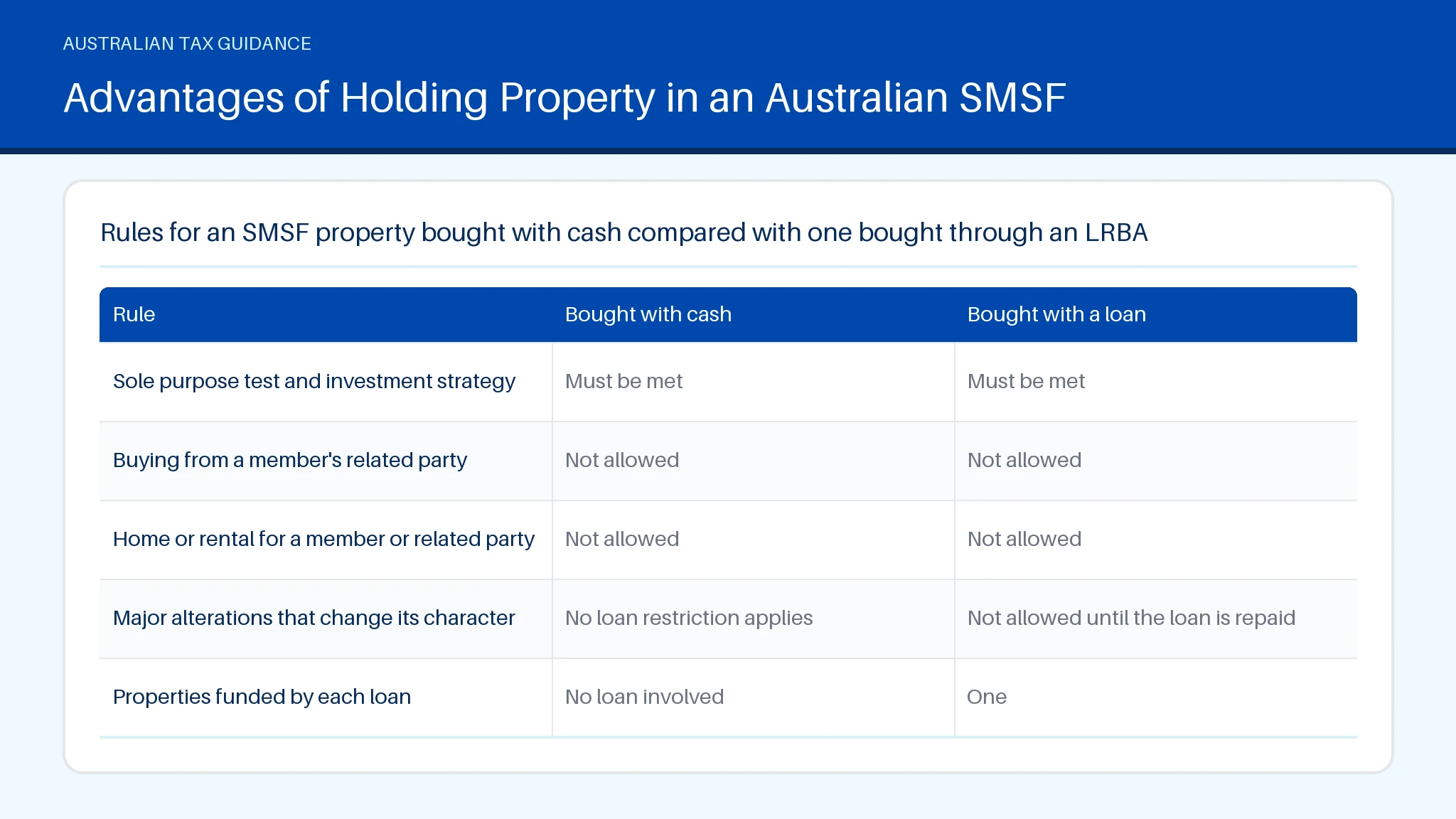
Yes. An SMSF can buy a property outright with cash if the purchase passes the sole purpose test and suits the fund's investment strategy. The only other way to fund it is a loan through an LRBA. Moneysmart says each of these loans can fund only a single property, whether residential or commercial. The property must still pass every test that applies to a cash purchase.
| Rule | Bought with cash | Bought with a loan |
|---|---|---|
| Sole purpose test and investment strategy | Must be met | Must be met |
| Buying from a member's related party | Not allowed | Not allowed |
| Home or rental for a member or related party | Not allowed | Not allowed |
| Major alterations that change its character | No loan restriction applies | Not allowed until the loan is repaid |
| Properties funded by each loan | No loan involved | One |
These are strict superannuation law requirements, not a lender's preferences. They apply for as long as the fund holds the property. Be wary of promoted schemes that roll super into a new fund and then lend members money for a house and land package. Check the Moneysmart Investor Alert List and get independent valuations before you invest.
Compliance Obligations for Australian Super Funds That Own Property
Compliance means showing each year that the property meets the sole purpose test of providing retirement benefits to members, as Moneysmart explains. SMSFs carry this duty through their trustees, not the property manager or lender.
- Related parties. Moneysmart says the fund must not buy from a related party of a member, and no member or related party may live in or rent it.
- Business premises. A fund member can rent business premises, but Moneysmart says specific rules apply and the lease must be at market rates. Keep rental statements and evidence of market rent.
- Business real property. The ATO treats land and buildings used wholly and exclusively in a business as an exception to the in-house asset and related party acquisition rules.
- Borrowing. An LRBA lets the fund buy only a single asset, and you cannot change the property's character until the loan is repaid. Keep all LRBA loan documents.
- Tax reporting. The Australian Taxation Office lists rent and net capital gains as assessable income. A complying fund pays 15%, with a one-third CGT discount after 12 months of ownership.
- Pension phase. A gain is not assessable if the property is a segregated current pension asset, so record when a member moves into pension phase.
- Audit. Moneysmart lists accounting and audit fees among ongoing costs, which often come from members' super.
Complete compliance records make the annual return easier. See our guide to SMSF accounting, audits, returns and fees.
Is Commercial Property the Last Option for Geared SMSF Purchases?
Commercial property is not the only choice for a geared fund purchase under current Moneysmart guidance, which says an LRBA can fund one residential or commercial property. The real difference between the two is who can use the property and what the fund can do with it after settlement.
Residential property. No member or related party can live in or rent a residential property owned by the fund. That rules out family holidays, a child renting at a discount, or a member moving in at retirement while the fund still owns it. A residential purchase suits a fund that is happy with an unrelated tenant and a return based on market rent.
Commercial property. Business premises can be leased to a member at market rates under specific rules, so a member's business can pay rent to the fund. The trade-off is linked risk. If the business struggles, the fund's income falls at the same time as the member's own finances come under strain.
Neither option lifts the single-property limit, so one loan cannot cover both a residential unit and a shop. For SMSFs comparing the two, the main factors are how reliable the rent is, the vacancy risk, the purchase price and whether a member's business really needs premises.
Residential buyers should also watch policy changes. Moneysmart notes that the 2026 Federal Budget, delivered on 12 May, announced changes to negative gearing and CGT. The detail matters for residential investors in general, so confirm the official position before assuming existing strategies will work as they do now.
Residential Versus Commercial Property: Which Suits Your SMSF?
The biggest difference is who can use the property. The ATO says an SMSF generally cannot buy residential property from a member or related party. Members, their relatives and other related parties also cannot live in it or rent it, even if they pay market rent.
Commercial property can offer more flexibility if it counts as business real property. The ATO describes this as land and buildings used wholly and exclusively in a business. An SMSF can buy business real property from a related party at market value and lease it to a member's business on commercial terms.
- Residential: more tenants to choose from, but no personal or related party use at any time.
- Commercial: a related party can lease it at market rent under a written agreement, but finding a new tenant can take longer.
Whichever type you choose, the purchase must meet the sole purpose test and fit the fund's investment strategy. Compare the expected rent with holding expenses such as council rates, insurance and repairs, and check whether the fund can cover periods without a tenant.
Advantages of Holding Property in an Australian SMSF
The main advantage is tax. The ATO says a complying superannuation fund that follows the SMSF rules qualifies for a concessional tax rate of 15% on assessable income, including rent and net capital gains.
- Lower tax on net rent: for a fund in the accumulation phase, rent forms part of assessable income taxed at 15%.
- Discount on sale: the ATO says complying SMSFs get a one third CGT discount on property owned for at least 12 months. The rest of the net gain is taxed at 15%.
- Pension assets: net capital gains are not assessable income if the property is a segregated current pension asset.
- Business premises: the ATO treats business real property as an exception to the in-house asset and related party acquisition rules. Moneysmart says the fund can lease it to a member at market rates.
Moneysmart notes that the 2026 Federal Budget announced changes to capital gains tax, so check current ATO guidance before you rely on the discount.
Risks to Weigh Before Your Fund Buys Property
A single property can tie up most of a fund's balance in one investment that is hard to sell quickly. The Australian Taxation Office expects trustees to keep an investment strategy that considers risk, diversification, liquidity and the fund's ability to pay benefits and meet costs when they fall due.
- Concentration: one building in one suburb exposes the fund to a single local market. Write down in the strategy why that exposure suits the members.
- Liquidity: you cannot sell part of a property to pay a member benefit, an insurance premium or an audit fee. Check the fund holds enough cash.
- Vacancy and repairs: rental income can stop for months while council rates, insurance and maintenance bills keep arriving.
- Related parties: the Australian Taxation Office says members and their relatives cannot live in or rent a home the fund owns.
Tax Benefits of Holding Property Inside Super
A self-managed super fund can pay less tax on property earnings than many individuals do. How much less depends on the fund's phase and on whether the fund stays complying.
- Net rental earnings: a complying fund in accumulation pays 15% tax on its assessable income.
- Profit on sale: if the fund has held the property for at least 12 months, it can generally apply a one-third discount.
Two limits often get overlooked:
- Where members are in different phases, the fund usually works out the exempt share as a proportion, which may need an actuarial certificate. The concession is then partial.
- Any tax loss on the property stays inside the fund. It cannot reduce members' personal taxable income, unlike negative gearing in your own name.
How a Limited Recourse Borrowing Arrangement Works for SMSFs
Moneysmart describes a limited recourse borrowing arrangement as the way a fund borrows to buy property, and it carries tighter limits than a cash purchase. The fund can buy one residential or commercial property under it. It cannot make major alterations that change the property's character until the loan is repaid.
Moneysmart notes that you cannot change the character of the property until the loan is repaid, so consider whether borrowing suits your fund's investment strategy and risk profile before accepting an offer.
- Extra costs. Moneysmart lists interest, bank fees and additional life insurance as costs that arise when SMSFs borrow to buy property.
- Strategy fit. Moneysmart suggests trustees consider whether borrowing to invest in property suits the fund's investment strategy and risk profile.
- Income and tax. Rent flows into the fund as assessable income. When the fund sells, capital gains are worked out at fund level, not in a member's personal return.
- Commercial tenants. If a member's business uses the premises, the lease must stay at market rates while the fund holds the property.
Interest on this loan is a fund cost, paid from fund money. For a property held in your own name, our deduction library explains how claiming interest works.
Legal Requirements Governing an LRBA Under Super Law
Moneysmart calls SMSF borrowing for property a limited recourse borrowing arrangement and lists the limits that apply:
- The loan can buy only a single asset, such as one residential or commercial property.
- You cannot make major alterations that change the character of the property until the loan is repaid.
- The property must meet the sole purpose test of solely providing retirement benefits to members.
- The fund generally cannot buy the property from a related party of a member, and members or their related parties cannot live in it or rent it.
The ATO treats business real property as an exception to the in-house asset and related party acquisition rules. Moneysmart says the fund can lease business premises to a member, but only under specific rules and at market rates. Moneysmart also says borrowing adds costs such as loan interest, bank fees and extra life insurance.
Can an SMSF Still Borrow to Buy Commercial Property?
Yes. According to Moneysmart's guide to SMSFs and property, an SMSF can borrow to buy property through a limited recourse borrowing arrangement. Moneysmart lists these key limits:
- The arrangement can only buy a single asset, such as one commercial or residential property.
- You cannot make major alterations or change the character of the property until the loan is repaid.
- Borrowing adds loan costs, such as interest and bank fees, and may add life insurance costs. These costs often come from your super.
This matters for commercial premises. The ATO's SMSF investment restrictions treat business real property, generally land and buildings used wholly and exclusively in a business, as an exception to the in-house asset and related party acquisition rules. Moneysmart also says to check whether borrowing suits your fund's investment strategy and risk profile.
SMSF Property Strategies That Still Work Without Residential Borrowing
Without a residential loan, a fund can still buy property outright, hold business real property, or borrow under a limited recourse borrowing arrangement (LRBA) with strict conditions. Moneysmart says any SMSF property investment must meet the sole purpose test of solely providing retirement benefits. The fund must not buy from a related party of a member, and no member or related party can live in or rent the property.
- Buy with cash. With no loan, the fund pays no interest or bank fees and avoids the extra life insurance that Moneysmart links to borrowing. Stamp duty, setup fees, audit and ATO fees, rates, maintenance and insurance still come out of members' balances.
- Use the business real property advantage. The ATO defines this as land and buildings used wholly and exclusively in a business. It is an exception to the in-house asset and related party acquisition rules. A farm with a private dwelling can still qualify if the dwelling sits on no more than 2 hectares and the property's main use is not private. Moneysmart says a member can lease the premises at market rates under specific rules.
- Borrow within tight limits. Moneysmart says an LRBA can fund only a single asset, and the fund cannot change the property's character until the loan is repaid.
The ATO says a complying fund pays 15% on assessable income, including rent. Net capital gains are total gains minus current and unapplied earlier losses, less a one-third discount if the fund held the asset for at least 12 months. Segregated current pension assets are excluded. Moneysmart notes the 2026 Federal Budget announced CGT changes.
Checklist: confirm the purchase suits the fund's investment strategy and risk profile, document how any member lease stays at market rates, and collect distributions from related trusts. The ATO warns that leaving them unpaid may breach the in-house asset rules, arm's length rule and sole purpose test. Moneysmart also warns against pressure tactics such as competitions, free flights or free meals.
A Strategic Planning Guide to SMSF Property Investment
A strategic plan for fund property maps the purchase across the members' whole timeline, from accumulation phase through retirement. Do this before any offer is made, working through four stages:
- Building years. Rental income and contributions should cover loan costs, rates and insurance, with a cash buffer for vacancies and repairs.
- Approaching retirement. When a member starts a pension, the fund needs cash to make the payments. A building cannot be sold in part, so plan the fund's cash needs years ahead.
- Pension phase. Check how the property will be treated for tax once members draw benefits, and record that decision.
- Exit. Budget for selling costs. Moneysmart also says extra costs can arise if the fund's investments change significantly or the fund closes.
Common mistakes to avoid:
- buying from a relative, business partner or other related party
- letting family members stay in or rent the property
- renovating a geared property before the loan is repaid
- paying fund costs from a personal account, which muddles the records
- giving in to pressure sales or buying in a market you do not know
- relying on older rules, when the ATO says the in-house asset rules applied differently to assets acquired before 11 August 1999 and that funds holding such assets should check their investments against the current rules
For members' own tax claims outside the fund, Deductit's deduction calculators show the formulas behind common personal claims.
Summary
SMSF property investment requires a property that passes the sole purpose test, comes from an unrelated seller and is never used by members or relatives. Business premises are the exception, rented to a member's business at market rates. Borrowing covers one property, with no major alterations until the loan is repaid. The fund pays 15% tax, with a one-third discount on property held 12 months. The investment strategy, valuation, tenancy and loan papers show compliance. For property you hold personally, the deduction library lists rental income deductions without giving personal advice.
You may also find these related guides helpful: Car Stamp Duty Calculator QLD: Estimate Vehicle Duty, Pay Calculator Australia: Work Out Your Take Home Pay, Superannuation Calculator: Estimate Your Retirement Balance, Vehicle Stamp Duty Calculator: What to Know, Balancing Account ATO: What It Means for Your Return, Stamp Duty Calculator for Used Cars: What to Know, and Aus Financial Year: What to Know.
Frequently asked questions
Is SMSF property investment worth it?
It is only worth it when the fund can absorb the costs, keep paying the loan through vacancies and still stay diversified. SMSF property investment actually means the fund buys and holds the property for members' retirement. All the rent and every cost stay inside the fund, not with you personally. Moneysmart points out that setup, advice, loan, insurance and property costs all come from super and reduce the balance. A smaller fund can lose much of the tax benefit to fees. Trustees with a member-run business may gain more from owning the business premises than trustees buying a home for an unrelated tenant.
What is the 5% SMSF rule?
Moneysmart's guidance on SMSFs and property doesn't give a 5% figure. If you hear about a percentage limit, check it against the ATO's information on SMSF investment restrictions before you act. For property, Moneysmart sets out the related-party rules. The fund must not buy the property from a related party of a member, and no member or related party can live in it or rent it. Business premises are the exception. A fund member can lease them, but only under specific rules and at market rates.
Can you refinance an SMSF residential loan after the ban?
The Moneysmart and ATO guidance used here does not describe a ban on SMSF residential borrowing, so it gives no basis for saying refinancing is blocked. Moneysmart still describes a limited recourse borrowing arrangement, where an SMSF can buy a single asset such as one residential or commercial property.
Moneysmart also says you cannot change the character of the property until the loan is repaid, and loan costs such as interest and bank fees often come from your super. Check how any new loan terms fit those rules before you act.
How do I pay for ongoing property expenses?
The fund pays ongoing property expenses from its own money, not from a member's personal account. Moneysmart lists the costs a fund carries, including:
- rates, management, maintenance and insurance
- loan interest and bank fees
- audit, ASIC and other fund administration fees
Rent paid into the fund's bank account is the first source of cash. If rent falls short, the fund uses its other cash, so the investment strategy should keep a buffer. Paying a fund bill personally muddles the fund's records, so get advice before you do it.