An SMSF loan calculator estimates what your self-managed super fund would repay on a property loan. It works from four inputs: the loan amount, the interest rate, the term and the repayment type. This guide is for trustees and members who want to check those numbers before they talk to a lender, and who want to know what the estimate leaves out.
The repayment figure is only one part of the decision. Under the Superannuation Industry (Supervision) Act 1993, an SMSF generally cannot borrow money. The ATO explains that the main exception is a limited recourse borrowing arrangement (LRBA). The fund borrows to buy a single acquirable asset, and a separate holding trust holds that asset until the loan is repaid. If the fund defaults, the lender can claim only that asset.
Because of this structure, look at any repayment figure under three headings:
- Eligibility: whether your fund's trust deed, its investment strategy and the property itself allow the purchase.
- Calculation: what the fund would repay each month, and whether rent and contributions can cover it.
- Records: the loan documents, holding trust deed, valuations and lease records your auditor will ask to see.
The sections below cover:
- a worked repayment example and the formula behind it
- a borrowing power check based on fund cash flow
- the loan to value limits that cap the loan
- the ATO's safe harbour terms for related-party loans
Reports suggest the rules for new residential borrowing may change. Check the ATO's current LRBA guidance before you rely on any figure.
Deductit does not arrange loans or give personal advice. To see how other tax figures are worked out step by step, try the Deductit tax calculators, which show every formula.
Key takeaways
- The ATO explains that an SMSF can generally borrow for property only through a limited recourse borrowing arrangement (LRBA). The property is held in a separate holding trust, and the lender can claim only that asset if the fund defaults.
- Repayment estimates depend on the loan amount, interest rate, term and repayment type. A $500,000 principal and interest loan at an illustrative 7% over 15 years costs about $4,494 a month.
- Borrowing power comes from the fund's own cash flow: net rent, contributions after 15% tax, and the cash left after settlement.
- The ATO's safe harbour terms for related-party loans over real property allow a maximum 70% loan to value ratio and a maximum 15-year term.
- The related-party rules for residential property and business real property are different, and borrowed money cannot be used to improve either type.
SMSF Loan Calculator: Estimate Your Fund's Property Loan Repayments
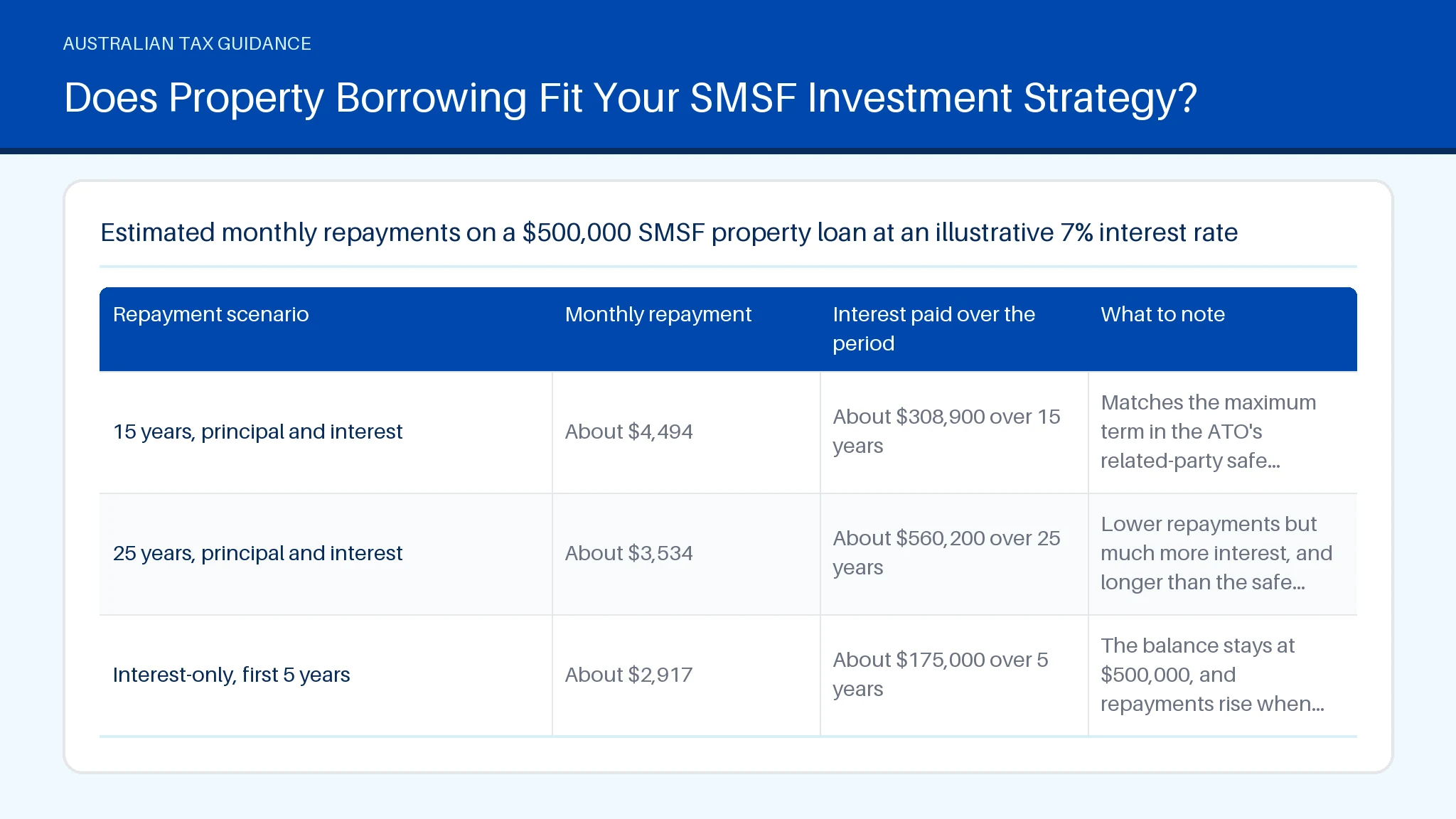
A worked example shows how much the term and repayment type change the result. The figures below assume a $500,000 loan at 7% a year, repaid monthly. The 7% rate is only for the maths, not a market rate. When you use an SMSF loan calculator, enter the rate from your own loan offer.
| Repayment scenario | Monthly repayment | Interest paid over the period | What to note |
|---|---|---|---|
| 15 years, principal and interest | About $4,494 | About $308,900 over 15 years | Matches the maximum term in the ATO's related-party safe harbour terms |
| 25 years, principal and interest | About $3,534 | About $560,200 over 25 years | Lower repayments but much more interest, and longer than the safe harbour term |
| Interest-only, first 5 years | About $2,917 | About $175,000 over 5 years | The balance stays at $500,000, and repayments rise when principal repayments begin |
The comparison shows three things:
- Stretching the term from 15 to 25 years cuts the monthly repayment by about $960, but adds roughly $251,300 in interest.
- With interest-only repayments the debt does not fall, so the fund only builds equity if the property rises in value.
- The ATO's Practical Compliance Guideline PCG 2016/5 sets safe harbour terms for related-party loans over real property: a maximum 15-year term and monthly principal and interest repayments. The cheaper-looking 25-year option would not meet those terms.
Residential or Commercial: Choosing Your SMSF Property Type
An SMSF can borrow to buy residential or commercial property. The ATO applies different related-party rules to each type, and those rules often decide which one suits the fund.
Residential property: the fund must buy it from an unrelated party. No member or related party can live in it or rent it, even at market rent.
Business real property: the ATO describes this as land and buildings used wholly and exclusively in a business. The fund can buy it from a related party at market value and lease it to a member's business on arm's-length terms. Offices, shops, warehouses and factories usually count, and so can some land used in primary production.
Buying commercial property through the fund usually follows these steps:
- Confirm that the trust deed allows borrowing and that the investment strategy allows a property of this size.
- Set up the holding trust and appoint its trustee. Many lenders also expect the fund to have a corporate trustee.
- Get a market valuation and loan approval in the fund's name.
- Have the holding trustee sign the purchase contract. Pay the deposit and costs from the fund's bank account.
- Settle the purchase, lease the property at market rent and keep the signed lease on file.
Two limits apply to both property types:
- The ATO states that borrowed money can pay for repairs and maintenance but cannot be used to improve the property.
- The property cannot be changed into a different asset while the loan is in place.
Pay for any renovation from fund cash, not from the loan. Our guide to SMSF rules, costs and trustee duties covers the wider rules for running a fund.
Why Use an SMSF Loan Calculator Before Buying Property
Running an SMSF loan calculator before you sign a contract shows whether the fund can carry the debt from its own income. Lenders and auditors will ask the same question. The deposit, stamp duty and holding trust costs all come out of fund cash. If you know the repayment early, you can size the purchase to fit instead of finding a shortfall at settlement.
What you need before you start:
- The likely purchase price and the deposit the fund can pay from its own cash.
- An indicative interest rate, loan term and repayment type from a lender's offer.
- The expected market rent, minus rates, insurance, strata and management costs.
- Each member's yearly employer and personal concessional contributions.
- The fund's current cash balance and any pension payments it must make.
With these figures, you can compare the estimated repayment with the fund's net yearly cash flow and see how much buffer is left.
How Loan Amount, Interest Rate and Term Produce Your Estimate
Every SMSF loan repayment calculator uses the same formula for principal and interest loans:
Monthly repayment = P × r ÷ (1 - (1 + r)-n)
- P is the loan amount.
- r is the yearly interest rate divided by 12.
- n is the number of monthly repayments, so a 15-year loan has 180.
In the $500,000 example at 7%, r is 0.005833 and n is 180, which gives about $4,494 a month. Interest-only repayments are simpler to work out: P × r, or about $2,917 a month.
Each input affects the result differently:
- Loan amount: repayments rise in direct proportion.
- Interest rate: a higher rate lifts the repayment and the share of it that goes to interest.
- Term: a longer term lowers the repayment but increases the total interest.
The formula usually leaves out fees such as establishment and annual account charges. Add these separately to see the true cost to the fund.
How Much Can Your SMSF Borrow for Property?
An SMSF can usually borrow up to two limits, and the lower one applies: the amount its own cash flow can repay, and the amount the lender's loan to value ratio allows. Members' salaries count only through the contributions they send to the fund. The loan belongs to the fund, and the lender can claim only the property.
Lenders generally assess three things:
- Fund income: net rent from the property, plus concessional contributions after the 15% contributions tax the ATO applies inside the fund.
- Repayments: usually tested at a rate above the offered rate, to leave a buffer.
- Liquidity: the cash the fund still holds after paying the deposit and purchase costs.
Worked example:
- Two members each earn $100,000. The ATO lists a Superannuation Guarantee rate of 12% from 1 July 2025, so each receives $12,000 in employer contributions.
- After 15% contributions tax, about $20,400 a year reaches the fund.
- Add $30,000 of net rent, and the fund has about $50,400 a year, or $4,200 a month.
- That is short of the $4,494 monthly repayment in the 15-year example. The fund would need a smaller loan, more contributions or a larger cash reserve.
Extra contributions have a limit. The ATO sets the concessional contributions cap at $30,000 per person for 2024-25 and 2025-26, and amounts above the cap can attract extra tax. To project member balances alongside the loan, see our guide to the superannuation calculator for retirement estimates. Run your figures through an SMSF loan repayment calculator twice, at the offered rate and at a higher buffer rate, to see both outcomes.
Maximum Loan to Value Ratios for SMSF Property Loans
Each lender sets its own maximum loan to value ratio (LVR) for SMSF property loans. It is often lower than for a personal investment loan, because the lender can only claim the property if the fund defaults. Related-party loans have a clear benchmark: the ATO's safe harbour terms in PCG 2016/5 cap the LVR at 70% of the property's market value.
To work out an LVR, divide the loan amount by the property value:
- A $500,000 loan on a $750,000 property is an LVR of about 66.7%, which is inside the 70% safe harbour limit.
- At 70%, the same property supports a loan of $525,000. The fund must then pay the other $225,000, plus stamp duty and costs.
When you use an SMSF home loan calculator, enter the loan amount the lender's LVR allows, not the amount you would like to borrow. The cash the fund has for the deposit and costs often sets the real limit on the purchase price.
What SMSF Loan Products Can Your Fund Choose From?
SMSF loan products come in a few general types, and each one changes the repayment estimate differently:
- Variable rate, principal and interest: repayments move with the lender's rate, and the balance falls each month.
- Fixed rate: repayments are set for an agreed period, and break costs can apply if the fund repays early.
- Interest-only period: repayments are lower for a set time, then rise when principal repayments start.
- Residential or commercial LRBA loan: lenders price and assess these separately, and commercial loans may have shorter maximum terms.
- Related-party loan: a loan from a member or a related entity. The ATO expects arm's-length terms, such as the PCG 2016/5 safe harbour terms.
Some products include an offset account in the fund's name. Check any offset or redraw feature carefully. Redrawn money can raise questions about whether it counts as new borrowing and how the fund uses it. An SMSF home loan calculator handles one product at a time, so run each option separately. Compare the total interest as well as the monthly repayment.
Does Property Borrowing Fit Your SMSF Investment Strategy?
Property borrowing fits an SMSF investment strategy only if the trustees can show it suits the members. They need to weigh risk, return, diversification, liquidity and the fund's ability to pay benefits. The ATO states that trustees must prepare a written investment strategy, review it regularly and follow it. The strategy must also consider whether to hold insurance for members.
A geared property often makes up most of a fund's assets, so the fund's risk sits in one asset. This matters more in two situations:
- A member is close to retirement, and the fund must pay minimum pension amounts.
- A member's death or disability could force the fund to sell.
Record the reasons for the purchase in the strategy or the trustee minutes before anyone signs a contract. Your auditor will check that the investment matched the strategy in place at the time. Also check whether the trust deed limits borrowing or property investment.
Typical Interest Rates and Fees on Super Fund Property Loans
Interest rates on super fund property loans are usually higher than standard investment loan rates. Limited recourse lending carries more risk for the lender, and fewer lenders compete for it. Compare offers on the comparison rate and total cost, not only the headline rate.
For related-party loans, the ATO publishes a safe harbour interest rate each year. It is based on the Reserve Bank's indicator lending rate for standard variable housing loans for investors. Use the ATO's current figure, not an earlier year's rate.
Costs to add on top of repayments include:
- loan establishment and valuation fees
- legal costs for the holding trust and loan documents
- ongoing account fees
- higher audit and accounting fees
The fund pays these costs, not the members. If you invest personally, see the investment and property deductions.
Tips and common mistakes:
- Paying the deposit from a member's personal account instead of the fund's account.
- Using loan money for renovations that improve the property.
- Leaving no cash buffer for vacancies or rate rises.
Summary
An SMSF loan calculator gives a useful first estimate, but three things decide whether a purchase works:
- Eligibility: the fund must borrow through an LRBA and follow the ATO's related-party rules for residential or commercial property. Borrowed money cannot pay for improvements.
- Calculation: the amortisation formula gives the repayment. Net rent, contributions after tax and cash reserves set how much the fund can borrow.
- Records: keep the loan, holding trust, valuation and lease documents for the auditor.
Deductit does not assess loans. You can browse the Deductit deduction library for personal claims and organise your own tax figures in your Deductit workspace. A licensed adviser can tell you what suits your fund.
You may also find these related guides helpful: Balancing Account ATO: What It Means for Your Return, Car Stamp Duty Calculator QLD: Estimate Vehicle Duty, Vehicle Stamp Duty Calculator: What to Know, HECS Repayment Calculator: 2025-26 Rates and Thresholds, Logbook Method: Claim Real Car Costs at Tax Time, Pay Calculator Australia: Work Out Your Take Home Pay, and Superannuation in Australia: How Your Super Works.
Frequently asked questions
How much can you borrow with SMSF?
An SMSF can usually borrow the lower of two amounts: what the lender's loan to value ratio allows, and what the fund's net rent and contributions can repay. For related-party loans over real property, the ATO's PCG 2016/5 safe harbour terms cap the loan at 70% of market value. Lenders set their own LVRs and also check that the fund keeps enough cash after settlement.
SMSF property loans are offered by a limited group of banks, non-bank lenders and specialist lenders. Related parties can also lend on arm's-length terms. Several major banks have pulled back from LRBA lending for three reasons:
Which banks lend money to SMSF?
- the limited recourse feature means they can only claim one asset
- the loans need specialist assessment
- the structure attracts regulatory scrutiny
No single lender has the cheapest rate for every fund, so compare comparison rates, fees and LVRs. Lenders usually ask for:
How can I calculate my SMSF borrowing power?
- the trust deed and investment strategy
- the holding trust deed
- recent fund financial statements
- in many cases, a corporate trustee
A mortgage broker who works with SMSF lenders can compare credit policies across lenders. Check that the broker holds an Australian credit licence or is an authorised credit representative.
What are the current interest rates for SMSF borrowing?
You can calculate SMSF borrowing power in four steps:
- Add the fund's yearly net rent and its concessional contributions after tax.
- Subtract the fund's other running costs and any pension payments.
- Compare the result with the loan repayments at a buffer rate above the offered rate.
- Cap the loan at the lender's LVR, and confirm the fund keeps enough cash after paying the deposit and costs.
What is the 5% SMSF rule?
Each lender sets its own SMSF borrowing rates, and they change with market conditions. Check current offers rather than published averages. SMSF loans are generally priced above standard investment home loans. For related-party loans, the ATO publishes a safe harbour rate each year under PCG 2016/5. It is linked to the Reserve Bank's indicator lending rate for standard variable housing loans for investors.
The 5% SMSF rule is the in-house asset rule. It limits a fund's in-house assets to 5% of the market value of its total assets. In-house assets include loans to related parties, investments in related parties and leases to them. The ATO excludes business real property leased to a related party under a legally binding lease, which is why a member's business can rent commercial property from the fund. Our guide to SMSF accounting services, audits and returns explains how auditors check this limit.