An ATO vehicle log book template is a simple record, on paper or in a spreadsheet, that captures every work journey so you can work out what share of your car running costs relate to earning income. It suits sole traders, employees claiming work car travel, partners in partnerships and company directors who drive their own vehicle for work. The template itself is not the claim. It is the evidence behind the claim, and it only holds up if each journey shows dates, odometer readings, kilometres travelled and the purpose. This guide sets out what to record, how long the record must run, and how the finished figures feed a tax deduction calculator with every formula shown.
Key takeaways
- The ATO does not publish a single mandatory form, so any ATO vehicle log book template works provided it captures every detail the ATO requires for each journey.
- A logbook must cover at least 12 continuous weeks that are representative of your usual driving, and it stays valid for five years unless your circumstances change.
- Each entry needs the start and end date, start and end odometer readings, kilometres travelled, and the reason the trip related to earning income.
- The business use percentage from your logbook is applied to actual running costs, including fuel, registration, insurance, servicing and depreciation.
- Keep the logbook, odometer records and receipts for five years from the date you lodge, because the ATO can ask to see them.
Which Trips Count as Business Kilometres and Which Are Private
A business kilometre is a kilometre driven while carrying out your work or running your business, not a kilometre driven to get yourself to work. The ATO treats ordinary home to work travel as private, even when you live a long way from the office or work outside normal hours. That distinction drives the whole car expense claim, because only work travel lifts the percentage you apply to your running costs under the logbook method.
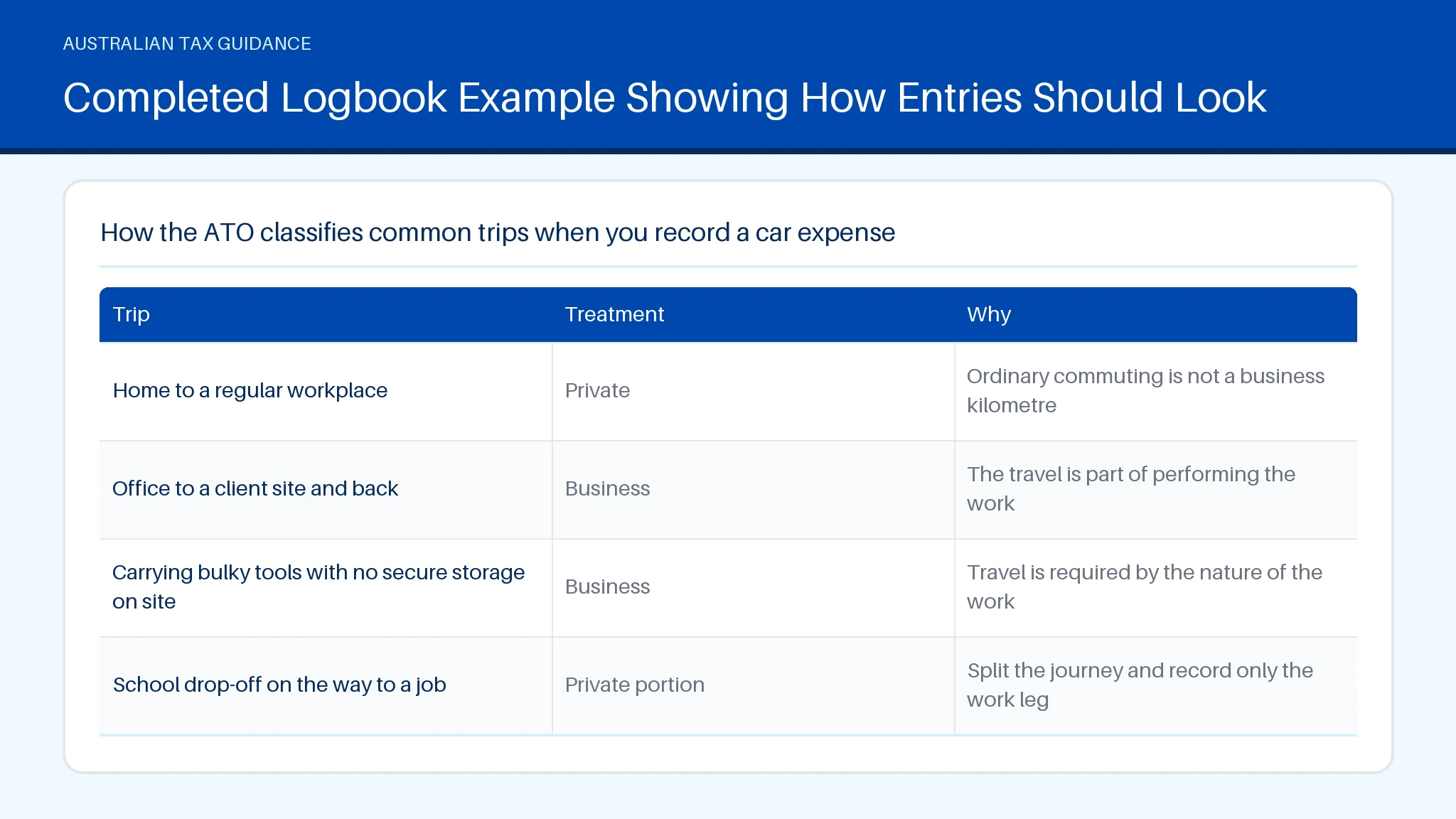
| Trip | Treatment | Why |
|---|---|---|
| Home to a regular workplace | Private | Ordinary commuting is not a business kilometre |
| Office to a client site and back | Business | The travel is part of performing the work |
| Carrying bulky tools with no secure storage on site | Business | Travel is required by the nature of the work |
| School drop-off on the way to a job | Private portion | Split the journey and record only the work leg |
Our work expenses tax deductions library sets out the eligibility tests for each type of car expense, and every ATO vehicle log book template entry should show which category the kilometre falls into. Record private travel separately so the total distance still reconciles against your odometer.
How Long Must a Logbook Run and Stay Valid
A logbook must cover at least 12 continuous weeks of driving and that period has to be representative of your travel for the full year. Start it at any point, provided the 12 weeks finish inside the same income year. Record the opening and end odometer figures for the period, plus the odometer reading at 30 June each year, so the calculation of total kilometres is supportable.
The 12 week logbook then stays valid for five years. Start again earlier if your work pattern, vehicle or employer changes enough to shift your business use. Keep the tax vehicle log book and supporting records for five years after lodgement. That applies whether you use paper, a spreadsheet based ATO vehicle log book template or an ATO vehicle log book app. If you switch to the cents per kilometre basis instead, the deductible amount is a set rate and no 12 week record is needed.
Free ATO Vehicle Log Book Template to Download
A free ATO vehicle log book layout needs only seven columns to meet the ATO requirement: date started, date ended, start odometer, end odometer, kilometres travelled, purpose of the trip, and vehicle registration. Add a running total row so the logbook tallies work kilometres against total kilometres and produces the percentage automatically.
Build it once and reuse it for five years. Two practical additions most free templates miss: a column for the odometer figure at 30 June, and a notes field recording any period the car was off the road. Our what can I claim on tax deduction library shows which running costs that ATO car log book percentage can then be applied to.
Does the ATO Provide an Official Logbook Form
The ATO does not mandate one official form. It publishes the details a logbook must contain and accepts any format that captures them, including pre-printed booklets, spreadsheets and an ATO vehicle log book app such as the record keeping tool in myDeductions. A compliant logbook is judged on content, not appearance.
That gives you a genuine choice. Apps capture odometer data and kilometres travelled with less effort and timestamp entries as you drive. Paper and spreadsheets cost nothing and never lose data to an account change. Either way you still need each receipt for fuel, servicing and insurance to support the business use percentage, because the logbook alone does not prove the cost.
Details Every Logbook Entry Must Record for Compliance
Every journey line in a compliant logbook records six things: the date the trip started and ended, the odometer figure at the start and finish, the kilometres travelled, and the reason for the trip. Describe the purpose in enough detail that a reviewer can see the work connection. "Client meeting, Parramatta" works; "work" does not.
At the file level, note the vehicle make, model, engine capacity and registration, plus the logbook period dates. Then keep each receipt that supports the running costs you apply the business use percentage to. If you are unsure which line of the ATO contact number list to ring about a record keeping question, our guide to which ATO line to call covers it, and any ATO log book template you build should mirror those same fields.
Excel Vehicle Logbook Spreadsheet You Can Copy and Use
An excel logbook is the fastest way to remove arithmetic errors from a vehicle expense claim. Set one row per trip and let excel subtract the start figure from the end odometer reading, then total the work column and divide it by total distance for the percentage.
Lock the formula cells so a stray keystroke cannot change them, and add data validation on the date fields so entries stay in the right income year. Sort by date before you finalise the logbook, since out of order rows make odometer continuity hard to verify. Any ATO log book template built in excel should also carry a short note on how each trip related to your income. Our car expenses tax deduction guide sets out the ATO phone number options for further help.
ATO Vehicle Log Book Template in Printable and Digital Formats
A printable ATO vehicle log book suits tradespeople and anyone who prefers to write an entry in the cabin, while an ATO vehicle log book template Excel file suits people who already reconcile expenses on a laptop. Both meet the same ATO requirement.
To use either one, write the opening odometer reading on day one, record each work trip as you go, then enter the end odometer reading on the final day of the 12 weeks. Calculate business kilometres as a share of total distance to get your business use percentage. Note the reason each trip related to earning income at the time, not months later from memory. If you use the logbook method, that one percentage then applies to fuel, insurance, registration, repairs and decline in value for the year. Deeper mechanics of the logbook method are covered in our logbook method guide.
Completed Logbook Example Showing How Entries Should Look
A finished logbook line reads like this: 14 July, odometer reading 42,310 to 42,368, 58 kilometres, site inspection at Bankstown then return to office. Twelve weeks of entries totalling 2,480 work kilometres against 4,000 total kilometres gives a business use percentage of 62 per cent.
Get Your ATO Vehicle Log Book Template and Start Tracking
Starting today beats reconstructing a year later, because the ATO expects contemporaneous records. Note today's odometer reading, set up your tax vehicle log book, and run it for 12 continuous weeks that reflect normal driving.
Before you commit, compare the two bases. The cents per kilometre route is capped at 5,000 kilometres per car and needs only a reasonable estimate. The logbook method has no distance cap and usually produces a larger deduction for higher mileage or expensive vehicles, but demands the full record. Whichever applies, keep the opening and closing odometer reading for each year, note how each trip related to work, and use the Deductit calculators to check the calculation. For a business vehicle used to relate car costs to trading income, see small business tax deductions.
Summary
Eligibility turns on work travel rather than commuting, the calculation applies your 12 week percentage to real running costs, and records must last five years. Deductit publishes the ATO rule behind each figure so you can check your own workings.
You may also find these related guides helpful: Balancing Account ATO: What It Means for Your Return, BAS Explained: What to Report, Lodge and When, Pay Calculator Australia: Work Out Your Take Home Pay, Working From Home Tax Deductions Australia, and ABN Registration: How to Apply, Costs and Who Qualifies.
Frequently asked questions
What is required in a logbook for ATO?
The ATO requires each entry to show the trip start and end dates, the start and end odometer readings, the kilometres travelled and the purpose of the journey, plus the vehicle details and the dates of the 12 week period. You then keep receipts for the running costs you claim, such as fuel, oil, servicing, insurance, registration and decline in value.
Is there a free ATO compliant logbook app?
Free compliant options exist, including the myDeductions tool in the ATO app, which records trips and stores the details the ATO asks for. Check that any free tool exports your data, since you need to retain the record for five years.
Can you provide me with a template for the ATO logbook?
Deductit does not distribute a form, but the field list above is all a template needs: seven columns per trip plus vehicle and period details at the top. Build it in a notebook or a spreadsheet and it meets the same standard.
Can you provide a free download for the vehicle log book format in Excel?
You can build the same seven column layout in a spreadsheet in about ten minutes, and it will be tailored to your vehicle. Personal trips do not need a line each, though you should record total distance travelled so private use is clear.
Where can I get Excel templates for free?
Free spreadsheet templates are widely available online, and a blank file you set up yourself is usually safer for tax records. Compare your working with the formulas in our home and assets tax deductions library, or start a workspace to keep the figures together.