The Medicare levy and private health insurance do different jobs, so buying a policy does not remove the levy. Moneysmart explains that most people pay a Medicare levy of 2% of their taxable income, and it is applied when they lodge a tax return. Private hospital cover matters for a separate charge called the Medicare levy surcharge (MLS). The ATO describes the MLS as an amount you may need to pay on top of the Medicare levy.
This guide is for employees, investors, couples and families working through the Medicare levy vs private health insurance decision, either at tax time or before a policy renews. It looks at three questions separately: whether you can avoid the MLS, how its cost compares with a premium, and which records the ATO expects you to keep.
Moneysmart explains that most people pay a Medicare levy of 2% of their taxable income, which helps fund part of Australia's public health care system, and you can read more in our guide to how the Medicare levy works, including its rates and surcharge. This page focuses on how insurance affects those charges.
In short, the Medicare levy vs private health insurance comparison is not a choice between one bill and the other. The 2% levy applies to most taxpayers whatever cover they hold. The right kind of hospital policy can stop the extra charge applying for the days you hold it. That only matters if your income for MLS purposes is above the relevant threshold in the first place.
What you need before you start:
- Your income statement for the year, available through myGov or from your employer.
- Your private health insurance statement, which shows the days you held hospital cover.
- Your policy documents, so you can confirm the hospital excess.
- Your spouse's income and the number of each dependent child, if you are assessed as a family.
- A quote or renewal notice showing next year's premium.
Key takeaways
- The Medicare levy is generally 2% of taxable income, according to Moneysmart. Holding private health insurance does not change how it is worked out.
- The Medicare levy surcharge (MLS) is a separate amount charged on top of the levy. The ATO says it can apply only for periods when your income for MLS purposes is above the threshold and you don't have an appropriate level of private patient hospital cover.
- Extras-only cover does not count. The ATO accepts hospital cover with an excess of $750 or less for a one-person policy, or $1,500 or less for other policies.
- The rebate lowers the cost of a policy, not your tax. Compare the premium after the rebate with the MLS you would otherwise pay.
- Keep your private health insurance statement. If you held hospital cover for only part of the year, myTax asks for the number of days you were covered.
Medicare Levy vs Private Health Insurance: How the Two Differ
Private health insurance does not exempt you from the Medicare levy, because the levy and a health policy belong to separate systems. In any Medicare levy vs private health insurance comparison, the levy is a tax assessed through your tax return, while a policy is a contract with a health fund. That is why your notice of assessment can show the Medicare levy even if you held top-level hospital cover all year. This is normal, not an error.
Most people cannot avoid the Medicare levy by buying cover. Exemptions and reductions do exist, but they depend on things like Medicare eligibility and income, not on insurance. Our guide to who qualifies for a Medicare levy exemption and how to claim it covers those cases.
What hospital cover can change is the surcharge. If you think of it as private health insurance vs Medicare levy, it looks like you pay one bill or the other. In fact there are two separate tests. The levy applies to most taxpayers, while the levy surcharge applies only for periods when both of the ATO's conditions are met.
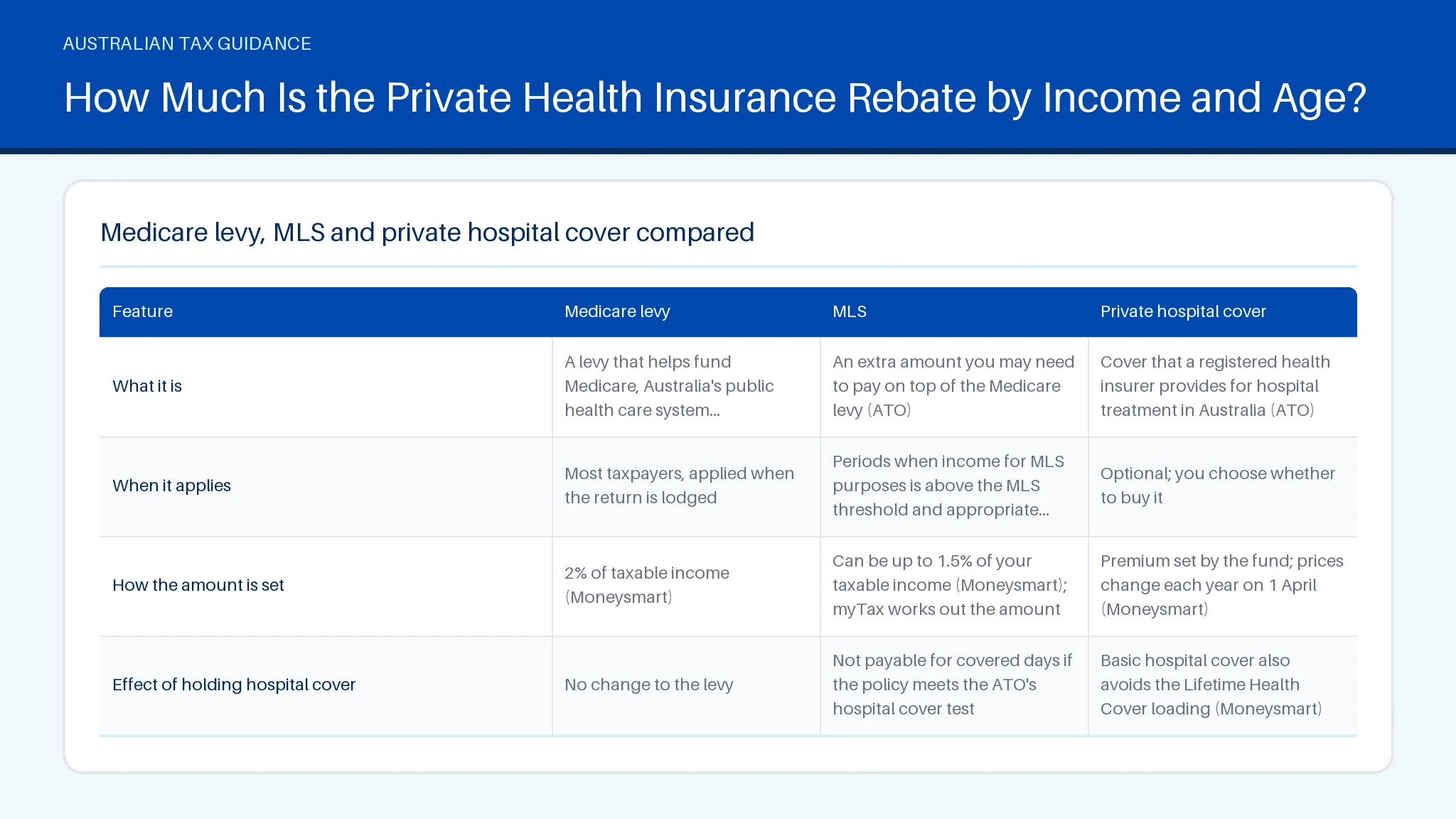
| Feature | Medicare levy | MLS | Private hospital cover |
|---|---|---|---|
| What it is | A levy that helps fund Medicare, Australia's public health care system (Moneysmart) | An extra amount you may need to pay on top of the Medicare levy (ATO) | Cover that a registered health insurer provides for hospital treatment in Australia (ATO) |
| When it applies | Most taxpayers, applied when the return is lodged | Periods when income for MLS purposes is above the MLS threshold and appropriate hospital cover is missing | Optional; you choose whether to buy it |
| How the amount is set | 2% of taxable income (Moneysmart) | Can be up to 1.5% of your taxable income (Moneysmart); myTax works out the amount | Premium set by the fund; prices change each year on 1 April (Moneysmart) |
| Effect of holding hospital cover | No change to the levy | Not payable for covered days if the policy meets the ATO's hospital cover test | Basic hospital cover also avoids the Lifetime Health Cover loading (Moneysmart) |
The MLS is not a single flat rate. The ATO says MLS may apply for any period when you, your spouse or any of your dependants didn't have an appropriate level of private patient hospital cover and your income for MLS purposes was above the applicable surcharge threshold, and Moneysmart notes the surcharge can be up to 1.5% of your taxable income. Which tier applies depends on whether you are assessed as a single or as part of a family. Our guide to who pays the Medicare levy surcharge and how it adds up sets out each tier and its figures, so this page does not repeat them.
Income is the part most people get wrong. The test uses income for MLS purposes rather than salary alone, and the ATO's definition can include reportable fringe benefits, reportable super contributions and net investment losses. Income earners with salary-packaged fringe benefits, or an investment property running at a loss, can go over the line, or into a higher tier, sooner than their pay slip suggests. Salary sacrifice contributions are worth checking for the same reason. The Medicare levy surcharge vs private health insurance comparison only matters once you know which side of the threshold you are on.
When Private Hospital Cover Exempts You From the Surcharge
Private hospital cover exempts you from the surcharge only when it meets the ATO's definition of private patient hospital cover. The ATO describes this as cover a registered health insurer provides for hospital treatment in Australia, with an excess of $750 or less for a policy covering one person, or $1,500 or less for any other policy. That figure is the amount you pay before the fund pays a claim.
Three practical points follow from that definition:
- Extras alone do not count. General cover for things like dental, optical, physiotherapy or chiropractic treatment is not hospital cover. An extras-only policy leaves you exposed to the MLS.
- The ATO's test for MLS purposes turns on the policy excess: appropriate cover is hospital cover from a registered health insurer with an excess of $750 or less for a policy covering only one person, or $1,500 or less for all other policies. A policy with an excess above the ATO limit does not qualify, whatever its tier is called.
- Everyone has to be covered. The ATO's conditions look at you, your spouse and all of your dependants. If someone is left off the policy, the MLS can still apply for that period.
The MLS is worked out by period, not for the whole year at once. If you held cover for only part of the year, myTax asks for the number of days covered, which your insurer shows on your private health insurance statement. For example, if you take out qualifying cover in March and your income is high enough, you are assessed only on the uncovered days before your cover started.
For anyone weighing up Medicare levy vs private health insurance, check your income first. Cover only matters if your income for MLS purposes, which includes more than your taxable income, is above the threshold. Below it, a policy makes no difference to your MLS. Moneysmart notes that basic hospital cover also avoids the Lifetime Health Cover loading. This is a 2% loading on your premium for every year after age 30 that you went without cover. In the Medicare levy surcharge vs private health insurance decision, that loading is a longer-term cost to factor in.
How Much Is the Private Health Insurance Rebate by Income and Age?
The private health insurance rebate is a government contribution towards the cost of your policy. The percentage you receive depends on your income and age. Before you compare policies, check the percentages and income bands the ATO currently publishes. An old table may be out of date.
Start by comparing two costs: the net cost of a qualifying policy and the Medicare levy surcharge you might otherwise pay. Then weigh up what the cover itself is worth to you. Here is a simple test:
- Check whether the MLS could apply. The ATO says you may have to pay it for any period when both of these apply:
- you, your spouse or any of your dependants didn't have an appropriate level of private patient hospital cover
- your income for MLS purposes, including your spouse's income if relevant, was above the applicable surcharge threshold.
- Make sure the policy qualifies. The ATO counts hospital cover from a registered health insurer with an excess of $750 or less for a policy covering one person, or $1,500 or less for other policies. General or extras cover, such as dental or optical, is not private patient hospital cover.
- Estimate the surcharge. Moneysmart notes it can be up to 1.5% of your taxable income.
- Find the annual premium for a qualifying hospital policy after the rebate, then add any Lifetime Health Cover loading. Moneysmart explains that you pay a 2% loading on top of your premium for every year after you turn 30 that you haven't been insured. It also reported an average premium increase of 4.41% for 2026.
If the net cost is lower than the possible surcharge, a basic qualifying policy costs less than paying the charge. If it is higher, you are paying extra for the hospital benefits themselves. Moneysmart also points out that you can still choose to be a public patient in hospital if you have private cover.
The official guidance links hospital cover to the surcharge, not to your income tax. Moneysmart explains that most people pay a Medicare levy of 2% of their taxable income, applied when they lodge their tax return. Holding appropriate hospital cover affects whether you also pay the Medicare levy surcharge on top of that levy.
- If you held cover for only part of the 2025 to 26 income year, myTax asks for the number of days covered. You'll find this on your private health insurance statement.
- If you had private patient hospital cover for any part of the year, myTax directs you to the Private health insurance section next.
The income used for your rebate band may not match your salary. Your spouse's income can matter too. For example, the myTax 2026 instructions refer to a combined income for surcharge purposes of over $202,000, plus $1,500 for each dependent child after the first. Deductit's tax deduction calculators can help you estimate your deductions before you check which rebate band you fall into.
What Counts Toward Surcharge Income Beyond Your Salary?
Surcharge income is broader than your salary, and for couples and families the ATO's test includes your spouse's income too. Higher-income earners often look only at the salary line on a pay slip, but income for MLS purposes is a wider measure than taxable income alone.
Items to check beyond salary include:
- Reportable fringe benefits, which appear on your income statement when your employer provides certain benefits.
- Reportable employer super contributions, including amounts you salary sacrifice into super.
- Net investment losses, such as losses from a rental property or shares.
The ATO's definition sets out how each item is treated, and our pillar guide summarises how the MLS is worked out on that income, so we don't repeat the detail here. For families, the ATO's 2025-26 myTax instructions use a combined income figure for Medicare levy surcharge purposes of $202,000, plus $1,500 for each dependent child after the first.
For higher-income earners, the private health insurance vs Medicare levy question usually depends on these extra items. The ATO says you may have to pay the MLS for any period when you, your spouse or any of your dependants didn't have an appropriate level of private patient hospital cover and your income for MLS purposes, including your spouse's income if relevant, was above the applicable surcharge threshold. To see how changes to your pay flow through, try our pay calculator or read the guide to working out your take home pay in Australia.
Tips and common mistakes:
- Assuming extras cover avoids the MLS. The ATO only accepts hospital cover.
- Choosing the cheapest hospital policy without checking its out-of-pocket amount against the ATO limits of $750 for one person or $1,500 for other policies.
- Leaving a spouse's income out of the test, or leaving a dependant off the family policy.
- Losing the private health insurance statement that shows your days of cover.
- Checking your MLS position using salary alone.
Summary
The Medicare levy vs private health insurance comparison comes down to two separate charges. The 2% Medicare levy applies to most taxpayers whatever cover they hold. The surcharge applies only for periods when your MLS income is above the threshold and you, your spouse or your dependants don't have hospital cover that meets the ATO's definition. To compare costs, weigh the premium after the rebate against the surcharge you would otherwise pay. Keep your income statement and private health insurance statement for your return. This is general information, not personal advice. You can browse related claims in the Deductit deduction library and organise your tax-time records in your Deductit workspace.
You may also find these related guides helpful: Salary Calculator: Gross and Take Home Pay in Australia, ATO Number: Which Line to Call for Your Tax Query, Balancing Account ATO: What It Means for Your Return, Contractor Pay Calculator: Rate to Salary in Australia, Self Managed Super Fund: Rules, Costs and Trustee Duties, and SMSF Borrowing Calculator: What Can Your Fund Borrow?.
Frequently asked questions
Does everyone pay the 2% Medicare levy?
Not quite. Moneysmart says most Australians pay the Medicare levy. It is 2% of taxable income and helps fund some of Medicare, Australia's public health care system. The levy is applied when you lodge your tax return. Private health insurance is a separate matter. The ATO describes the Medicare levy surcharge as an amount you may need to pay on top of the Medicare levy. It applies when you lack an appropriate level of private patient hospital cover and your income is above the surcharge threshold.
Can I avoid the Medicare levy?
Most taxpayers cannot avoid the Medicare levy, and buying private health insurance does not change that. What insurance can help you avoid is the Medicare levy surcharge. If your income for surcharge purposes is above the threshold, appropriate hospital cover for you, your spouse and your dependants means the MLS does not apply for the days you are covered.
Does having private health insurance reduce Medicare levy?
Not the levy itself. Moneysmart describes the Medicare levy as 2% of taxable income for most Australians. Hospital cover affects the Medicare levy surcharge (MLS) instead, which the ATO describes as an amount on top of the levy. MLS may apply for any period when you, your spouse or dependants lacked appropriate private patient hospital cover and your income for MLS purposes was above the surcharge threshold. Moneysmart says it can be up to 1.5% of taxable income. The ATO notes extras-only cover does not count.
Why is the Medicare levy so high?
The Medicare levy is set at 2% of taxable income for most people, so the dollar amount goes up as your income goes up. If the Medicare amount on your assessment looks higher than 2%, check whether it includes the MLS. The MLS is charged on top of the levy for any period without cover when your income is above the threshold. Our pillar guide on the levy, linked at the top of this article, explains how both amounts are calculated.
How much to avoid Medicare levy?
No amount spent on insurance avoids the Medicare levy itself, because the levy is based on your income. To avoid the surcharge, the ATO requires hospital cover from a registered fund where you pay $750 or less before the fund pays a claim on a one-person policy, or $1,500 or less on other policies. Cheap hospital cover can meet that test. Moneysmart suggests checking what a policy includes before you sign up, and notes that policies covering more services generally cost more. A low premium usually means fewer services are covered. Extras-only and ambulance-only policies do not qualify.
Part of What Is the Medicare Levy? Rates, Rules and Surcharge