An SMSF borrowing calculator estimates how much a self managed super fund could borrow and repay under a limited recourse borrowing arrangement, using the fund's expected rent, contributions and cash reserves against a proposed loan amount, interest rate and term. It is a planning tool for trustees weighing up a property purchase inside super, not a lending decision and not a tax ruling.
The arithmetic matters because the constraints on a super fund are tighter than on a personal mortgage. The fund, not the member, must service the loan from its own income. Contributions are capped by law. Rent is the other main income source, and it stops if the tenant leaves. A fund that can technically afford a repayment schedule in month one can still fail its own liquidity test in a quiet quarter.
This guide is written for trustees and prospective trustees who want to understand the inputs before they talk to anyone about finance. It walks through what an SMSF borrowing calculator actually models, how loan to value limits and servicing buffers interact, what the ATO requires of a borrowing arrangement, and what records the fund needs to keep so the annual audit and return are straightforward.
The structural rules for running a fund sit in our guide to Self Managed Super Fund: Rules, Costs and Trustee Duties. For the retirement side of the picture, the superannuation calculator projects a balance without gearing, which is a useful comparison point before you add debt to the plan.
Key takeaways
- An SMSF borrowing calculator estimates what a fund could repay by combining the loan amount, interest rate, term and repayment cycle, then testing that figure against rent and concessional contributions already flowing into the fund.
- Borrowing inside a fund is done through a limited recourse borrowing arrangement (LRBA), where a single acquirable asset is held in a separate holding trust and the lender's recourse is limited to that asset.
- Lenders typically cap SMSF lending below standard home loan levels, so deposit, liquidity buffer and loan to value ratio usually set the ceiling before servicing does.
- Fund income and deductions must be reported in the SMSF annual return, so trustees need loan statements, rent records, bare trust documents and audit evidence kept for the periods the ATO requires.
- A calculator produces an estimate only. It is not an approval, a valuation, or personal tax or financial advice.
SMSF Borrowing Calculator: Estimate What Your Fund Can Borrow
An SMSF borrowing calculator works backwards from the money the fund can reliably commit each year. Three inputs do most of the work: net rent after property outgoings, concessional and non-concessional contributions the members can sustain, and the cash the fund must hold back for expenses, insurance premiums, audit fees and any pension payments.
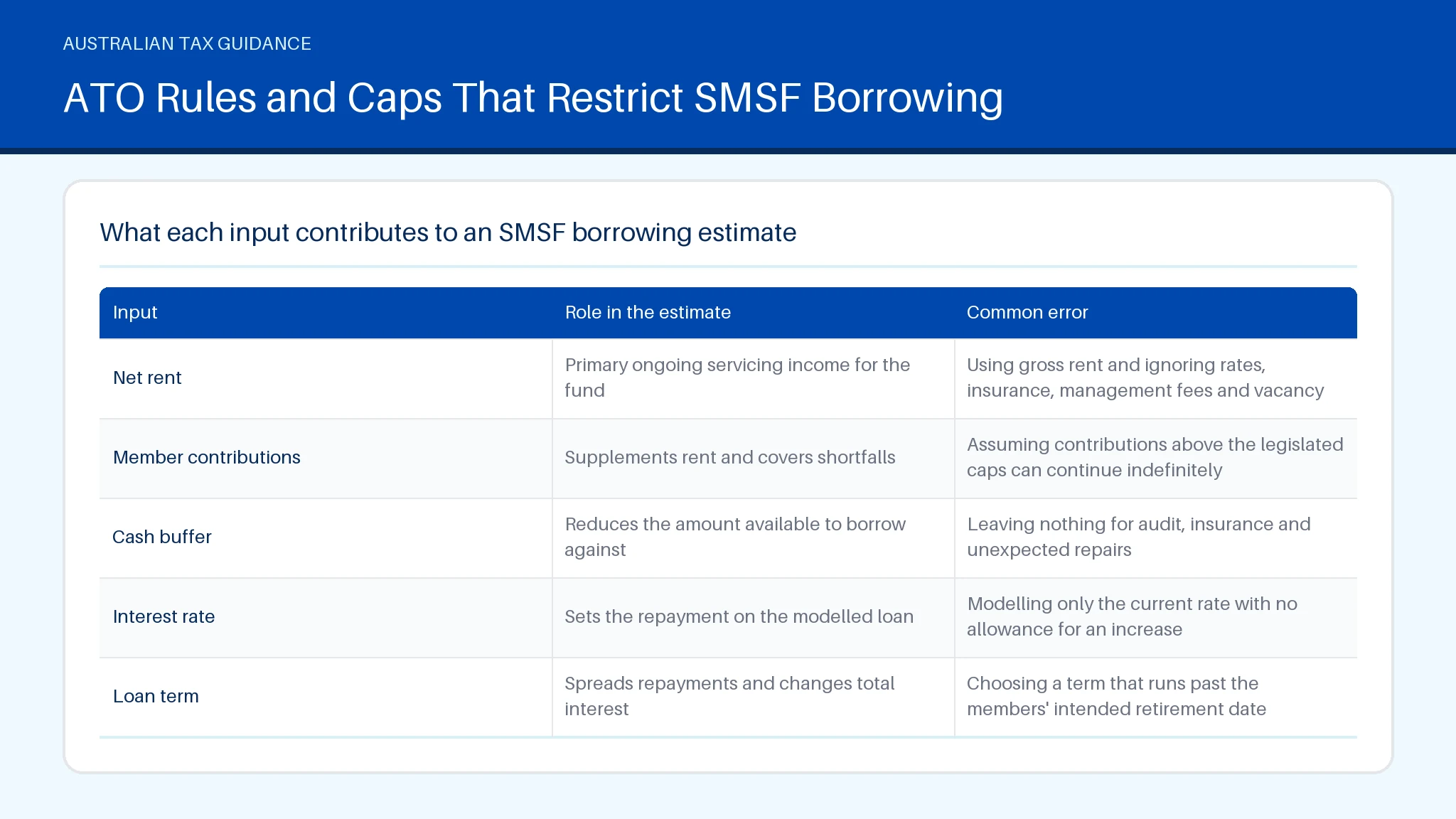
The table below sets out what each input contributes and where trustees most often get it wrong.
| Input | Role in the estimate | Common error |
|---|---|---|
| Net rent | Primary ongoing servicing income for the fund | Using gross rent and ignoring rates, insurance, management fees and vacancy |
| Member contributions | Supplements rent and covers shortfalls | Assuming contributions above the legislated caps can continue indefinitely |
| Cash buffer | Reduces the amount available to borrow against | Leaving nothing for audit, insurance and unexpected repairs |
| Interest rate | Sets the repayment on the modelled loan | Modelling only the current rate with no allowance for an increase |
| Loan term | Spreads repayments and changes total interest | Choosing a term that runs past the members' intended retirement date |
How the SMSF Borrowing Calculator Works Out Your Result
An SMSF borrowing calculator converts your inputs into a periodic repayment using standard amortisation, then compares that repayment to the fund's modelled income. The repayment is driven by the loan amount, the annual interest rate divided across your payment cycle, and the number of periods in the term. Weekly or fortnightly cycles produce a slightly lower total interest cost than monthly on the same nominal rate, because you make the equivalent of an extra month of payments each year.
The second step is the servicing test. The calculator subtracts the annual repayment and the fund's fixed running costs from projected rent plus contributions. What remains is the surplus. A negative surplus means the fund cannot carry the loan without drawing down existing assets.
Interest-only periods flatter early results. Model the principal and interest repayment that applies once the interest-only term ends, because that is the number the fund has to live with for most of the loan.
Typical SMSF Loan Amounts and What They Mean for Retirement
Loan size inside a fund is usually dictated by the deposit the fund can raise rather than by appetite. Because lenders generally require a substantial contribution from the fund and trustees should hold a cash reserve on top, a fund typically needs a balance well above the purchase deposit itself before a borrowing arrangement is practical.
The retirement consequence is concentration. One geared property can dominate a fund's asset mix, which runs against the diversification consideration trustees must address in the fund's investment strategy. If the property is the only growth asset, a soft market at the point members start drawing a pension forces either a sale or a reliance on contributions that may no longer be available.
Run the numbers both ways. Compare the geared outcome from an SMSF borrowing calculator against an ungeared projection from the superannuation calculator guide before committing the fund to a long loan term.
Working Out the Maximum Loan Your Fund Can Service
Maximum serviceable loan is the point where annual fund income minus running costs still covers repayments at a stressed interest rate. Work it out in this order:
- Total expected annual rent, then deduct management fees, council and water rates, insurance, strata levies and an allowance for vacancy.
- Add the concessional and non-concessional contributions members can realistically make within the caps, not the maximum theoretically allowed.
- Deduct the fund's fixed annual costs, including audit, administration, the supervisory levy and any insurance premiums held inside the fund.
- Apply a rate buffer above the quoted rate and solve for the loan amount that the remaining surplus supports.
Contribution capacity is the input most worth checking carefully, because it depends on each member's salary arrangements. Our pay calculator shows how employer super and voluntary contributions sit against take home pay.
Loan to Value Ratio Limits on SMSF Property Loans
Loan to value ratio limits for SMSF lending sit below standard residential lending, because the lender's recourse is restricted to the single asset in the holding trust. Commercial security is usually capped more conservatively again than residential security, and specialised property such as hospitality or rural land is often declined outright or held to a much lower ratio. Lenders also commonly require the fund to retain liquid assets after settlement, expressed as a percentage of the fund's balance or a fixed dollar amount.
An SMSF needs a substantial document pack for a property loan. Expect to supply the signed fund trust deed and any amendments, the holding trust deed and corporate trustee constitution, the fund's investment strategy showing the purchase is permitted, two to three years of audited financial statements and SMSF annual returns, recent member contribution histories, bank statements for the fund, the contract of sale, a valuation, and for commercial property the lease and the tenant's details. Missing or unsigned trust documentation is the most frequent cause of delay.
Which Types of Lenders Still Offer SMSF Property Loans
Not all lenders offer SMSF loans. Several large institutions withdrew from the market, and the remaining supply sits mainly with non-bank lenders, specialist credit providers, smaller mutual and regional institutions, and the related party lending option where a member or related entity lends to the fund on commercial terms. Related party loans must meet the ATO's safe harbour terms for interest rate, term, loan to value ratio and security, or the trustee must otherwise demonstrate the arrangement is on arm's length terms, because non-arm's length income is taxed at the top marginal rate.
Buying commercial property with an SMSF follows the same LRBA structure as residential, with one significant difference. Business real property can be acquired from a related party and leased back to a member's business, provided the lease is on arm's length commercial terms with market rent paid in full and on time. That makes owner-occupied premises the most common commercial use of fund borrowing.
If the tenant business is yours, keep the two sets of books clean. Rent paid by the business is dealt with under business rent, rates and occupancy costs, while the fund reports that same rent as income.
What to Do After You Find the Right Property
Sequence matters once you have a property in mind, because getting the order wrong can invalidate the arrangement. Work through these steps:
- Confirm the fund's investment strategy covers the acquisition and document the trustee decision in minutes before you commit.
- Establish the holding trust and its trustee before contracts are exchanged, so the correct entity is named as purchaser.
- Check the contract names the holding trustee as buyer and the fund as beneficial owner, and have a solicitor review the LRBA documents against the loan offer.
- Confirm the fund has settlement funds plus stamp duty, legal costs and the post-settlement liquidity buffer available in cash.
- Arrange building insurance in the correct entity name from the date of exchange or settlement, as the contract requires.
Record every trustee resolution as you go. The auditor will ask for them, and reconstructing minutes after the fact is far harder than writing them at the time.
ATO Rules and Caps That Restrict SMSF Borrowing
The ATO permits borrowing only through a limited recourse borrowing arrangement that satisfies the Superannuation Industry (Supervision) Act conditions. The core restrictions are consistent:
- The borrowing must fund a single acquirable asset, or a collection of identical assets with the same market value, held in a separate holding trust.
- The lender's recourse on default is limited to that asset alone, not to the fund's other investments.
- Residential property acquired under an LRBA cannot be bought from a related party and cannot be lived in or rented by a member or relative. Business real property is the exception.
- Borrowed funds cannot be used to improve the asset. Repairs and maintenance are allowed, but an improvement that creates a different asset breaches the rules.
- LRBA balances can count towards a member's total super balance, which affects contribution eligibility.
Trustees also face the usual sole purpose test and arm's length requirements, both of which the fund's annual audit examines.
Interest Rates on SMSF Loans Versus Standard Home Loans
SMSF loan interest rates sit above comparable owner-occupier and standard investor home loan rates. The margin reflects the limited recourse structure, the smaller pool of lenders, the additional legal and trust documentation, and the higher cost of assessing a fund rather than an individual borrower. Commercial security usually attracts a higher rate again than residential security, and related party loans must at minimum meet the ATO's published safe harbour rate for the relevant year.
Because published rates move, model a range rather than a single figure. Running the loan at the quoted rate, then at two or three percentage points higher, shows whether the fund's surplus survives a rate cycle. A fund with thin contribution capacity can be comfortable at the lower figure and in deficit at the higher one.
Interest paid by the fund is a fund expense, which is different territory from the personal position covered in rental loan interest and borrowing expenses. Compare both figures using the Deductit calculators before you choose a structure.
Summary
Eligibility to borrow inside a fund depends on a compliant limited recourse borrowing arrangement over a single acquirable asset, held in a holding trust, with related party and improvement restrictions observed. Calculation comes down to net rent plus sustainable contributions against a stressed repayment, bounded by the lender's loan to value and liquidity requirements. Record keeping covers trust deeds, loan statements, trustee minutes, rent evidence and the annual audit file. Check the deduction position for each expense in the Deductit deduction library and sort your paperwork in the Deductit workspace. This is general information, not personal tax advice.
You may also find these related guides helpful: Salary Calculator: Gross and Take Home Pay in Australia, Balancing Account ATO: What It Means for Your Return, Superannuation in Australia: How Your Super Works, What Is the Medicare Levy? Rates, Rules and Surcharge, Working From Home Tax Deductions Australia, and ATO Number: Which Line to Call for Your Tax Query.
Frequently asked questions
How can I calculate my SMSF borrowing power?
You calculate SMSF borrowing power by totalling the fund's net rental income and sustainable member contributions, subtracting the fund's running costs and a cash buffer, then solving for the loan amount whose repayments the remaining surplus can cover at a stressed interest rate. Model the principal and interest repayment rather than any introductory interest-only figure, and sanity check the contribution side against each member's actual capacity using the take home pay guide. The output is an estimate for planning, not a credit assessment.
How much money can my SMSF borrow?
How much a fund can borrow is set by whichever limit binds first: the lender's loan to value ratio on the chosen security, the deposit and costs the fund can pay in cash, or the fund's ability to service repayments from rent and contributions. For most funds the deposit and the post-settlement liquidity requirement bind before servicing does. Commercial security generally attracts a lower maximum ratio than residential, and specialised property lower again, so the property type materially changes the answer.
What are the current interest rates for SMSF borrowing?
Current SMSF interest rates are higher than standard home loan rates because of the limited recourse structure, the narrower lender market and the extra documentation involved. Rates move with the cash rate and with each lender's funding costs, so check current offers directly rather than relying on a published figure. For a related party loan, the ATO publishes safe harbour terms each year, including a benchmark interest rate, and meeting those terms keeps the arrangement from being treated as non-arm's length income.
Is it worth buying property through SMSF?
Buying property through an SMSF suits trustees with enough balance to hold a deposit, costs and a liquidity buffer without concentrating the entire fund in one asset. The advantages are the fund's concessional tax treatment on rental income and the ability for a business to occupy its own premises. The drawbacks are higher interest, limited lender choice, restrictions on improvements using borrowed money, illiquidity when members start drawing a pension, and ongoing audit and administration costs. Weigh those against an ungeared strategy before deciding.
What is the 5% SMSF rule?
The 5% rule limits a fund's in-house assets to 5% of total fund assets measured at market value at the end of the income year. In-house assets include loans to, investments in, or leases with related parties. Business real property leased to a member's business is specifically excluded, which is why owner-occupied commercial premises can sit outside the cap. If the ratio exceeds 5% at year end, the trustee must prepare a written plan to dispose of the excess by the end of the following income year. Fund accounting obligations are covered in our guide to SMSF Accounting Services: Audits, Returns and Fees, and you can start a records file in the Deductit get started workspace.