To find your marginal rate of taxation, start with Schedule 7 of the Income Tax Rates Act 1986, published in the ATO legal database. Each rate applies to the part of a resident's ordinary taxable income that falls within its band. For 2025-26 the rates are nil up to $18,200, 16% to $45,000, 30% to $135,000, 37% to $190,000 and 45% above that. The government's Moneysmart income tax page notes these rates exclude the 2% Medicare levy.
Employees, sole traders and investors can use these bands before lodging a return, when weighing up a pay rise, or when deciding whether a deduction is worth the paperwork. The sections below cover which documents to gather, how to match your taxable income against each band, and common mistakes that make people overstate or understate what extra income really costs.
Australia taxes personal income progressively. The Explanatory Memorandum to the Treasury Laws Amendment (Personal Income Tax Plan) Act 2018 explains that individuals pay higher rates as their income rises past particular thresholds. Crossing a threshold does not change the rate on the parts of your income below it. Schedule 7 sets each rate only for the part of taxable income that exceeds one threshold and does not exceed the next.
Three things decide which rates apply to you:
- Whether you use the resident adult scale. Moneysmart's tables cover Australian residents aged 18 and over. Foreign residents, working holiday makers and people under 18 are referred to the ATO website for their own rates.
- The financial year. Moneysmart shows the first taxed band falling from 16% in 2025-26 to 15% in 2026-27. The 30%, 37% and 45% bands keep the same thresholds.
- Your taxable income. Moneysmart's 2026-27 example for $60,000 applies nil to the first $18,200, 15c per dollar to the next $26,800 and 30c per dollar to the final $15,000. That gives $8,520 of tax before the Medicare levy.
Deductit's tax deduction calculators show the formula behind each estimate. For the full rate tables side by side, see the guide to the 2025-26 and 2026-27 resident tax brackets.
Key takeaways
- Under the Income Tax Rates Act 1986, each rate applies only to the part of taxable income within its band. Dollars in lower bands keep their lower rates.
- For Australian residents aged 18 and over in 2025-26, the rates are nil up to $18,200, then 16%, 30%, 37% and 45%, according to Schedule 7 of the Income Tax Rates Act 1986 in the ATO legal database.
- In 2026-27 the 16% rate drops to 15%. The $45,000, $135,000 and $190,000 thresholds stay the same, according to Moneysmart.
- The published rates leave out the 2% Medicare levy, so an extra dollar of income can cost you more than the bracket rate on its own.
- Your band depends on taxable income, not gross pay. Gather your income and deduction records before you work out the rate.
Documents to Gather Before Calculating Your Marginal Rate of Taxation
Under Schedule 7 of the Income Tax Rates Act 1986, as published in the ATO legal database, each marginal tax rate applies only to the part of your taxable income that falls within its threshold band, such as 30% on the part above $45,000 up to $135,000 for the 2024-25 and 2025-26 income years. Australia has a progressive income tax system for individuals, so "higher rates of tax are payable by individuals as their income increases beyond particular thresholds", as the Explanatory Memorandum to the Treasury Laws Amendment (Personal Income Tax Plan) Act 2018 explains. Each rate applies only to the part of taxable income that falls inside its band.
The Schedule 7 rates table in the ATO legal database sets these rates for resident taxpayers in the 2024-25 and 2025-26 income years: 16% above the tax-free threshold up to $45,000, 30% above $45,000 up to $135,000, 37% above $135,000 up to $190,000, and 45% above $190,000. Moneysmart lists the tax-free threshold as $18,200.
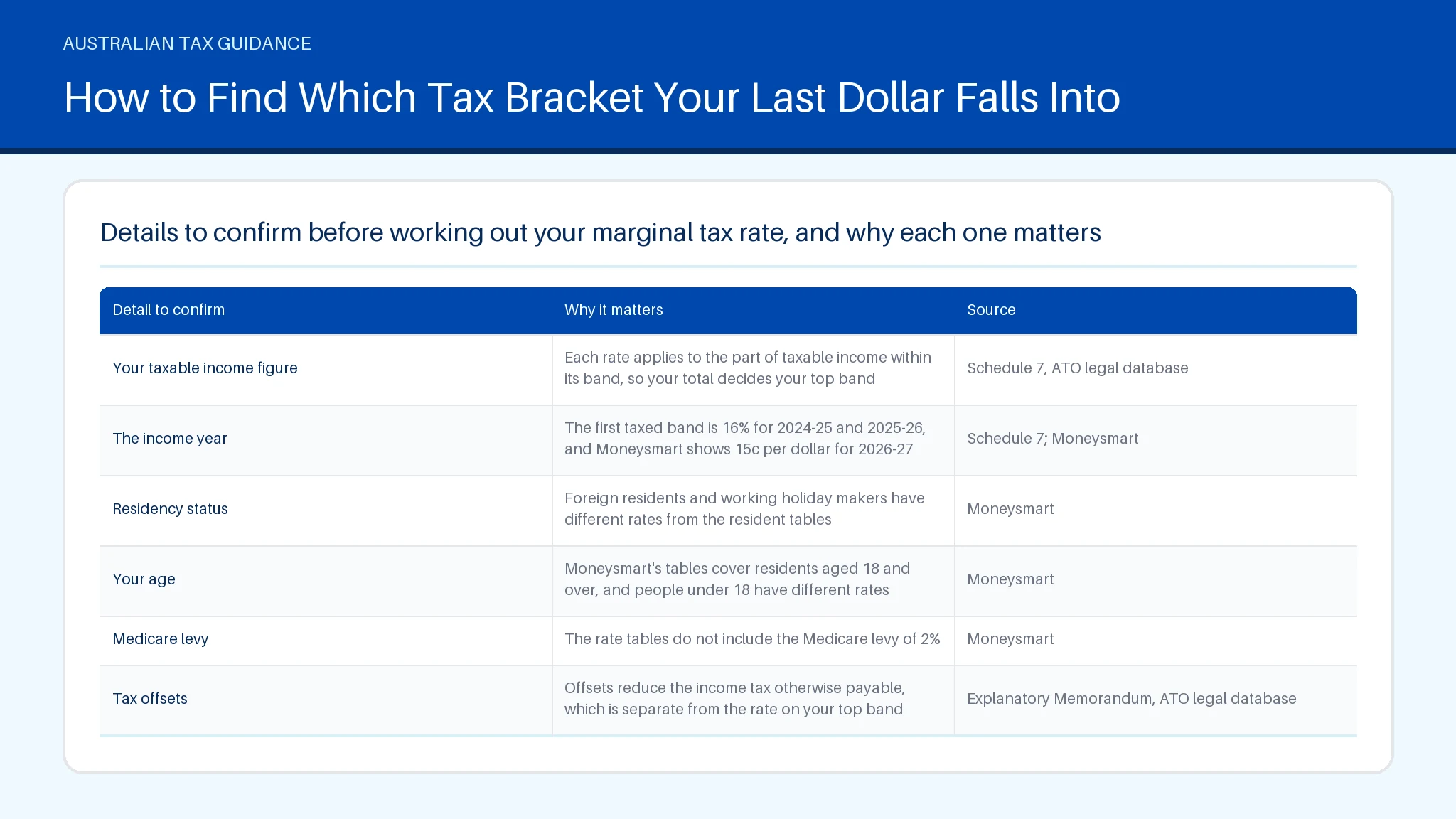
Before you work out your marginal rate of taxation, confirm the details below. Each one changes which table or band applies to you.
| Detail to confirm | Why it matters | Source |
|---|---|---|
| Your taxable income figure | Each rate applies to the part of taxable income within its band, so your total decides your top band | Schedule 7, ATO legal database |
| The income year | The first taxed band is 16% for 2024-25 and 2025-26, and Moneysmart shows 15c per dollar for 2026-27 | Schedule 7; Moneysmart |
| Residency status | Foreign residents and working holiday makers have different rates from the resident tables | Moneysmart |
| Your age | Moneysmart's tables cover residents aged 18 and over, and people under 18 have different rates | Moneysmart |
| Medicare levy | The rate tables do not include the Medicare levy of 2% | Moneysmart |
| Tax offsets | Offsets reduce the income tax otherwise payable, which is separate from the rate on your top band | Explanatory Memorandum, ATO legal database |
Your marginal rate does not apply to all of your income. In Moneysmart's worked example, someone with $60,000 of taxable income in 2026-27 pays nil on the first $18,200, 15c per dollar on the next $26,800 ($4,020) and 30c per dollar on the last $15,000 ($4,500). That gives $8,520 before the Medicare levy. Their marginal rate is 30%, but only $15,000 of their income is taxed at that rate.
To check which expenses might count, browse the Deductit deduction library. The guide to the records the ATO expects for deductions explains what records you need to keep for any claim you make.
How to Find Which Tax Bracket Your Last Dollar Falls Into
Your last dollar falls into the band where your taxable income ends. Follow these steps in order:
- Add up all income for the financial year from the records you gathered.
- Subtract the deductions you can support with records to get your taxable income.
- Choose the rate table for that year: 2025-26 (16% first band) or 2026-27 (15% first band).
- Find the band your taxable income ends in. The thresholds are $18,200, $45,000, $135,000 and $190,000.
- Work out how far you are from the next threshold up or down.
Moneysmart gives a worked example of $60,000 taxable income in 2026-27. The first $18,200 is taxed at nil. The next $26,800 is taxed at 15c in the dollar, which is $4,020. The final $15,000 is taxed at 30c in the dollar, which is $4,500. That makes $8,520 in total, before the Medicare levy. Your marginal rate of taxation at that income is 30%, while your average rate is about 14.2%. The same income in 2025-26 gives $4,288 plus $4,500, or $8,788, because the first band is taxed at 16%.
To see how those bands flow through to a regular pay, try the Deductit pay calculator.
Common Mistakes People Make About the Marginal Rate of Taxation
Most mistakes come from applying one rate to all of your income instead of only to the top slice.
- Fearing a pay rise into a higher band. The ATO legal database sets each resident rate "for the part" of taxable income that falls within a band. Only the dollars above a threshold pay the higher rate, so a pay rise does not lower your income after tax.
- Using gross pay instead of taxable income. The bands apply to taxable income. The bracket you read off your salary figure may not be the one your last dollar falls in.
- Confusing your top rate with your average rate. In Moneysmart's worked example, $60,000 in 2026-27 attracts $8,520 in tax before the Medicare levy. The top slice is taxed at 30c in the dollar, but total tax is only about 14.2% of income.
- Relying on old thresholds. The 2018 Explanatory Memorandum lists earlier resident bands of 19%, 32.5%, 37% and 45%, with thresholds of $37,000, $87,000 and $180,000. Older guides still quote figures like these.
- Forgetting the Medicare levy. Moneysmart notes that the published rates exclude the 2% levy. Our Medicare levy guide explains how the levy is worked out and when it is reduced.
Using the wrong year's table is the mistake people are least likely to notice. At $40,000, your marginal rate of taxation is 16% in 2025-26 and 15% in 2026-27, so check the income year before you compare figures.
Summary
Schedule 7 of the Income Tax Rates Act 1986 applies your marginal rate of taxation only to income above your highest threshold. Three things set it: whether the resident adult scale applies to you, the financial year, and your taxable income after deductions. For 2025-26 the resident rates are nil, 16%, 30%, 37% and 45%. In 2026-27 the 16% rate becomes 15%. The 2% Medicare levy sits on top of these rates.
Start with complete income and deduction records, because income near a threshold can change your band. Deductit does not give personal tax advice or lodge returns. You can use your Deductit workspace to keep your deduction details in one place before you check them against the rate table for the correct year.
You may also find these related guides helpful: Pay Calculator Australia: Work Out Your Take Home Pay, Salary Calculator: Gross and Take Home Pay in Australia, Contractor Pay Calculator: Rate to Salary in Australia, and End of Financial Year 2025: Dates and ATO Deadlines.
Frequently asked questions
What is the marginal tax rate in Australia?
For resident adults in 2025-26, the marginal tax rate in Australia is nil, 16%, 30%, 37% or 45%, depending on the band your last dollar of taxable income falls in. Under the Schedule 7 table in the ATO legal database, the thresholds are $18,200, $45,000, $135,000 and $190,000. Moneysmart shows the 16% rate falling to 15% in 2026-27. The 2% Medicare levy is charged on top.
Which financial year should you use?
Use the rate table for the year of income you are working out. Schedule 7 of the Income Tax Rates Act, published in the ATO legal database, sets one table for the 2024-25 and 2025-26 years of income and a separate table for 2026-27. Moneysmart shows the lowest resident rate dropping from 16c to 15c in 2026-27. The Australian financial year guide explains which dates fall into each year. The ATO legal database also records that the 2024-25 and 2025-26 table is repealed on 1 July 2026.
How do marginal tax brackets work in practice?
In practice, each slice of your income is taxed at the rate for the band it falls in. Take $60,000 of taxable income in 2026-27. The first $18,200 is tax free, the next $26,800 costs $4,020 at 15%, and the last $15,000 costs $4,500 at 30%. That totals $8,520 before the Medicare levy, according to Moneysmart. The 30% rate applies only to the top $15,000.
How do marginal tax rates work?
Each marginal rate applies only to the slice of taxable income inside its band. It does not apply to your whole income. The Explanatory Memorandum to the Personal Income Tax Plan Act 2018 describes a progressive system, where higher rates apply as income passes set thresholds. For 2025-26, the ATO's legal database lists 16% above the tax-free threshold up to $45,000, then 30% up to $135,000. In Moneysmart's $60,000 example, only the $15,000 above $45,000 is taxed at 30c per dollar. That figure excludes the 2% Medicare levy.