A CGT calc is the set of steps that turns a sale price into the capital gain you actually declare on your tax return. It is not a separate tax rate and it is not a refund estimate. The calculation establishes one number, your net capital gain for the income year, which the ATO treats as part of your assessable income and taxes at your marginal rate for that year.
That distinction matters more than most sale-price estimates suggest. Two people can sell identical investment properties for the same price in the same week and pay very different amounts of tax, because the gain lands on top of different salaries, different carried-forward capital losses and different ownership periods. The asset does not set the rate. Your return does.
This guide is for individuals who have sold, or are about to sell, an investment property, a parcel of shares, an ETF holding or a crypto asset, and who want to understand what the numbers are doing before they look at an estimate. It separates the three things people usually blur together: whether a gain is assessable at all, how the gain is worked out, and what the ATO expects you to be able to produce if it asks.
What you need before you start. Gather these before you run any calculation, because missing items are the most common reason an estimate is wrong:
- The contract date and settlement date for both the purchase and the sale. The ATO uses the contract date for the CGT event, not settlement.
- Purchase price, plus stamp duty, conveyancing and any buyer's agent fee.
- Sale price, less agent commission, marketing and legal costs.
- Capital improvements, such as a new deck or a kitchen replacement, kept separate from repairs.
- Any depreciation or capital works amounts already claimed, which reduce the cost base.
- Unapplied capital losses from earlier years, taken from your last notice of assessment or prior returns.
- Your expected taxable income for the year of sale, so you can see which bracket the gain falls into using the current Australian tax rates and brackets.
With those inputs assembled, a CGT calc becomes arithmetic rather than guesswork, and you can test the effect of selling in one financial year rather than another before you sign anything.
Key takeaways
- A CGT calc works out your net capital gain for the year, not a separate tax bill: the ATO adds the net gain to your taxable income and taxes it at your marginal rate.
- The order matters. Subtract the cost base from the sale proceeds, apply current and carried-forward capital losses, then apply the 50% discount only if you are an individual or trust that held the asset more than 12 months.
- Cost base is more than the purchase price. The ATO lets you include stamp duty, legal fees, agent commission, advertising and certain holding costs that were never claimed as a deduction.
- Capital gains tax is a federal tax, so your state or territory does not change the CGT outcome, though state stamp duty paid on purchase feeds into the cost base.
- Keep purchase and sale contracts, settlement statements and expense receipts for at least five years after the CGT event, per ATO record-keeping rules.
What Is CGT Calc?
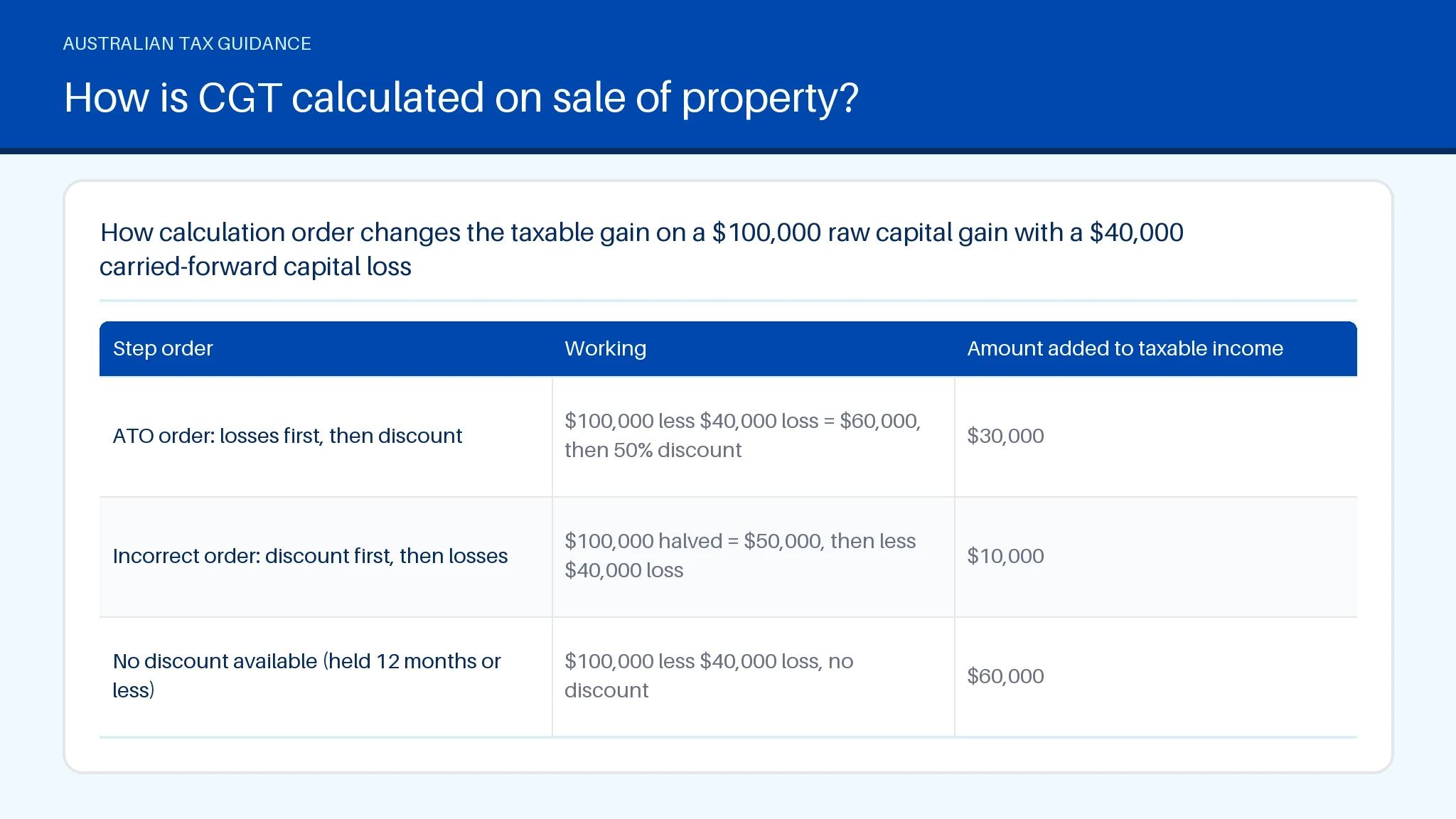
CGT calc describes the working that produces your net capital gain: sale proceeds, less the cost base, less eligible capital losses, less any discount you qualify for. Each step has its own rules, and skipping one changes the answer. The most common mistake is applying the 50% discount before offsetting losses, which overstates the benefit of the discount.
The correct ATO sequence is to calculate the raw gain, reduce it by capital losses from the current year, then by unapplied losses from earlier years, and only then halve what remains if the discount applies. The table below shows why the order changes the result on a $100,000 gain with a $40,000 carried-forward loss.
| Step order | Working | Amount added to taxable income |
|---|---|---|
| ATO order: losses first, then discount | $100,000 less $40,000 loss = $60,000, then 50% discount | $30,000 |
| Incorrect order: discount first, then losses | $100,000 halved = $50,000, then less $40,000 loss | $10,000 |
| No discount available (held 12 months or less) | $100,000 less $40,000 loss, no discount | $60,000 |
The ATO treats capital losses as usable only against capital gains, never against salary or business income, and unapplied losses carry forward indefinitely until a gain absorbs them. The detailed rules on offsetting and the 12-month holding test sit with our page on capital losses and the CGT discount. Which disposals trigger the calculation in the first place is covered under a capital gains event on an asset.
How the CGT Calc Applies ATO Rules and Rates
There is no standalone CGT rate in Australia. A CGT calc produces a net capital gain, the gain is added to your other assessable income, and the combined figure is taxed under the ordinary individual rates and brackets published by the ATO. The Medicare levy also applies to the higher taxable income, which is a cost many sale estimates leave out entirely.
Three ATO rules do most of the work in the calculation:
- Timing. The CGT event happens on the contract date. Signing on 28 June and settling in August puts the gain in the earlier financial year, which can be the single largest lever available to you.
- Entity type. Individuals and trusts can access the 50% discount after 12 months of ownership. Companies cannot, so a company gain is taxed in full at the company rate. Complying super funds use a one-third discount.
- Deductions already claimed. Capital works and depreciation claimed over the holding period reduce the cost base, so earlier rental capital works deductions increase the eventual gain. This is a timing shift, not a loss of benefit, but it surprises most first-time sellers.
Legislated changes also apply from 1 July 2027, including a 30% minimum tax on certain capital gains. If a sale is likely to straddle that date, compare both regimes rather than assuming today's rules continue.
Working Out the Indexed Cost Base of Pre-1999 Assets
Assets acquired before 11.45am on 21 September 1999 can use indexation instead of the 50% discount, and a CGT calc for those assets should test both methods. Indexation lifts the cost base in line with the consumer price index up to the September 1999 quarter, then freezes it. The discount method leaves the cost base alone and halves the gain instead.
The practical choice depends on how much the asset appreciated relative to inflation during the frozen window. Indexation tends to win where the asset grew slowly in the 1980s and 1990s and the indexed uplift is large relative to the total gain. The discount tends to win where the asset has multiplied in value since 1999, because halving a very large gain beats adding a fixed amount to the cost base.
Working through it:
- Identify the exact acquisition date and each cost base element with its own date, because indexation applies element by element.
- Index each pre-1999 amount using the ATO's published CPI factors, stopping at the September 1999 quarter.
- Calculate the gain twice, once indexed and once discounted, and compare the net figures.
- Note that indexation cannot be used to create or increase a capital loss.
Inherited, part-interest and pre-CGT assets add further layers, and those sit with our page on complex CGT assets and exceptions.
Does Your State or Territory Change the CGT Outcome?
Your state or territory does not change the CGT outcome. Capital gains tax is part of the federal income tax system, administered by the ATO under Commonwealth law, so a $200,000 gain is calculated the same way in Perth as it is in Hobart. There is no state surcharge on capital gains and no state CGT return.
State taxes still touch the calculation indirectly, in two places worth checking:
- Stamp duty on purchase. The transfer duty you paid when you bought the asset forms part of the cost base, so a higher-duty jurisdiction gives you a slightly larger cost base and a slightly smaller gain.
- Land tax during ownership. Land tax is generally deductible against rental income while the property is income-producing, and amounts already claimed as deductions cannot be added to the cost base.
The trap is double counting. Any holding cost you already claimed as a deduction against rental income, including rates, insurance and interest, cannot also go into the cost base. Where a property was never income-producing, some of those same holding costs may be includible instead. Our investment and property deduction library sets out which costs were claimable in which years, which is the fastest way to work out what is still available.
How Your Taxable Income Sets the Marginal Rate on a Gain
Your taxable income for the year of sale decides the rate applied to a capital gain, because the gain is stacked on top of everything else you earned. The first dollars of the gain are taxed at whatever bracket your salary already reached, and the gain can push the later dollars into a higher bracket.
This produces a split rate on a single gain. Someone earning $70,000 who makes a $60,000 discounted gain pays one rate on the portion that fits inside their current bracket and a higher rate on the portion above the next threshold, plus the Medicare levy on the lot. Averaging the two produces an effective rate that sits between the brackets, which is why a single headline percentage rarely matches the real bill.
- Year of sale. Selling in a year with lower other income, such as a year of parental leave, retirement or a business downturn, reduces the rate applied to the gain.
- Deductible contributions. A personal deductible super contribution reduces taxable income in the same year, which can reduce the rate on the top slice of the gain, subject to the concessional cap.
Modelling your income for the year first with the pay calculator gives you the starting bracket before the gain is added.
Summary
A CGT calc separates three questions that deserve separate answers. Eligibility decides whether a gain is assessable at all, with main residence, personal use and pre-CGT assets sitting outside the net. Calculation follows a fixed order: proceeds less cost base, then current and carried-forward losses, then the 50% discount if you held the asset more than 12 months as an individual or trust. Record-keeping underpins both, and the ATO expects contracts, settlement statements and expense evidence to be kept for at least five years after the event.
None of this is personal tax advice, and the right answer depends on your own figures. To work through yours, start with the deduction finder to identify which holding costs were already claimed, then check the figures in your Deductit workspace before you lodge.
You may also find these related guides helpful: What Is the Medicare Levy? Rates, Rules and Surcharge, Medicare Levy Surcharge: Who Pays and How It Adds Up, Pay Calculator Australia: Work Out Your Take Home Pay, Superannuation Calculator: Estimate Your Retirement Balance, ATO Number: Which Line to Call for Your Tax Query, Balancing Account ATO: What It Means for Your Return, and Contractor Pay Calculator: Rate to Salary in Australia.
Frequently asked questions
How is CGT calculated on sale of property?
CGT on a property sale is calculated by subtracting the cost base from the sale proceeds, then reducing that gain by any capital losses and, if you qualify, the 50% discount. Sale proceeds are the contract price less selling costs such as agent commission, marketing and conveyancing. The cost base is the purchase price plus stamp duty, legal fees, buyer's agent fees and capital improvements, reduced by any capital works and depreciation you already claimed as deductions.
The result goes on your tax return as a net capital gain and is taxed at your marginal rate.
Do I pay 18% or 28% CGT?
Neither. The 18% and 28% rates are United Kingdom capital gains tax rates and have no application in Australia. Australian residents pay CGT at their ordinary marginal income tax rate, because the net capital gain is added to taxable income rather than taxed separately. Depending on your total income for the year, the effective rate on a discounted gain can range from zero within the tax-free threshold up to the top marginal rate plus the Medicare levy. From 1 July 2027 a legislated change to the CGT rules introduces indexation and a minimum rate on certain gains, so check which regime applies to your contract date.
Which assets are exempt from CGT?
Several categories of asset are exempt from CGT. Your main residence is generally exempt for the period you lived in it, subject to use and land size tests. Cars and motorcycles designed to carry less than one tonne and fewer than nine passengers are exempt. Personal use assets such as furniture or a boat are exempt if acquired for $10,000 or less, and collectables such as art or jewellery are exempt if acquired for $500 or less. Assets acquired before 20 September 1985 are pre-CGT and generally outside the system, and depreciating assets used wholly for a taxable purpose are dealt with under the depreciation rules instead. Winnings from gambling and most personal injury compensation payments are also exempt. Our guide to capital gains tax exemptions and discounts works through the conditions on each.
Is this the same as a capital gains calculator?
Yes, a CGT calc and a capital gains calculator do the same arithmetic under different names. Both take the sale proceeds, the cost base, the holding period and any capital losses, and return the net capital gain to include in your return. The useful difference is in what each one includes. Some estimates stop at proceeds less purchase price, which overstates the gain by ignoring stamp duty, selling costs and improvements, and others omit the Medicare levy on the increased taxable income. If you are comparing two estimates that disagree, check which cost base elements each one accepted and whether the discount was applied before or after capital losses. You can model the income side separately with the Deductit calculators.
Can I use this calculator for shares?
Yes, the same method applies to shares, ETFs and crypto, with one difference in how parcels are handled. For property, you usually hold one asset. For shares and units, each parcel bought on a different date is a separate CGT asset with its own acquisition date and cost base, so selling part of a holding means identifying which parcels you sold. Brokerage is added to the cost base on purchase and deducted from proceeds on sale. ETF distributions often include a capital gains component reported in the annual tax statement, which must be included even though you did not sell anything. Crypto disposals include swapping one token for another and using crypto to buy goods, not just converting to dollars. To start a record for any of these, set up your Deductit workspace and keep each parcel separate from the outset.