An ATO deceased estate matter begins when someone dies and the person legally responsible for their affairs has to finalise their tax. This guide is for executors, administrators and family members. It explains what the Australian Taxation Office (ATO) expects, the order to do things in, and which documents to keep.
According to the ATO, the legal personal representative must formally tell it about the death and lodge any outstanding returns for the deceased. They must also work out whether the estate needs its own trust tax returns for income earned after death. Every ATO deceased estate task falls into one of three groups:
- Responsibility: who can act and which returns are due.
- Calculation: how income before and after death is taxed, and who pays that tax.
- Records: the documents that prove your authority and support each figure.
For related topics such as tax rates and lodgment deadlines, browse our Australian tax guides.
Key takeaways
- The ATO deals with the legal personal representative. That person must formally notify the ATO of the death and show their identity and their authority to act.
- A date of death return covers income from 1 July to the date of death. Income earned after death belongs to the estate and may need a trust tax return each year until administration ends.
- Presently entitled beneficiaries report their share of estate income in their own returns. The trustee pays tax on income that no one is presently entitled to.
- Finish outstanding returns and pay tax debts before you distribute any assets. A representative who distributes after receiving notice of a tax claim can be held personally liable.
Which Tax Returns Must Be Lodged for a Deceased Estate?
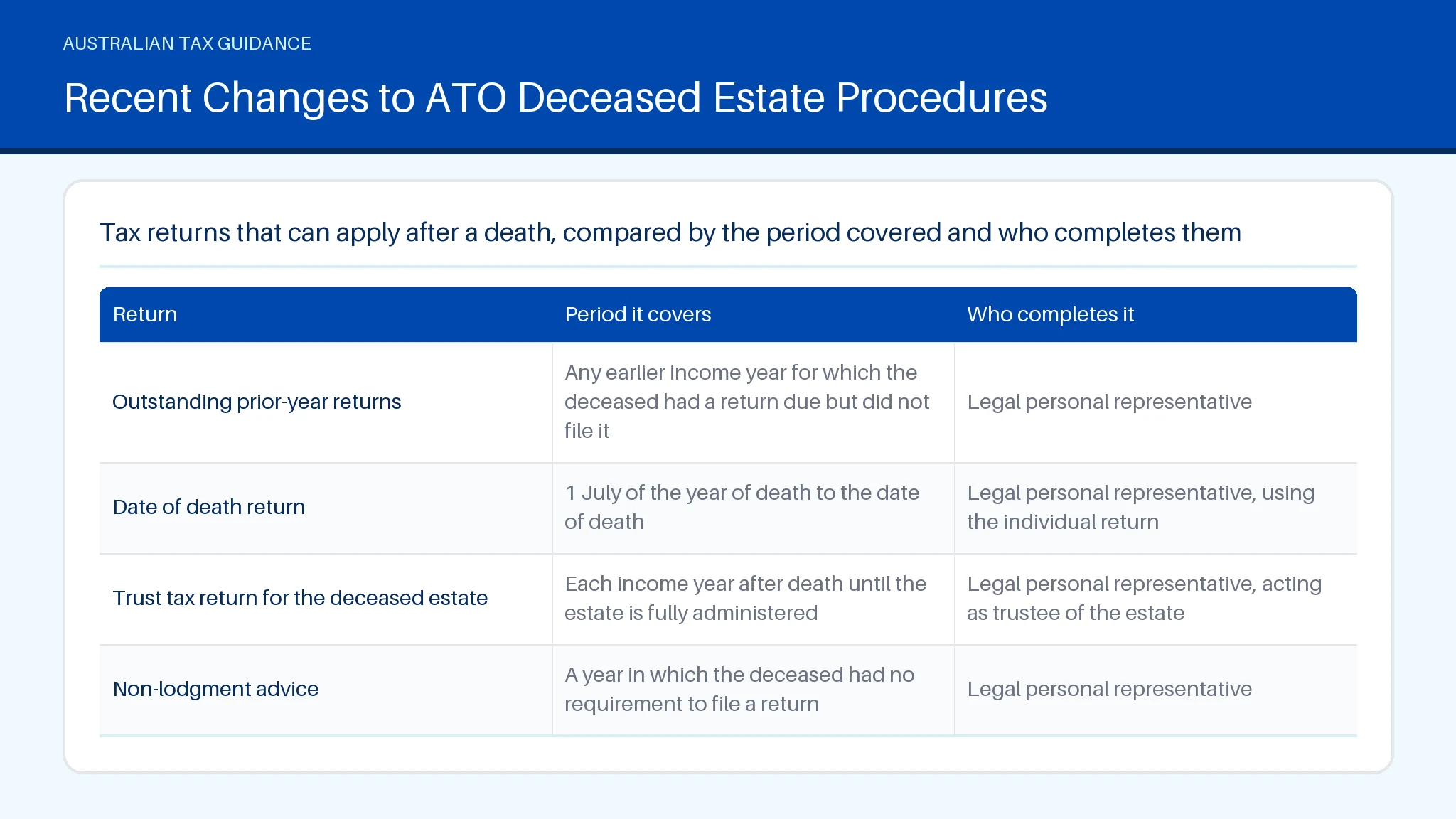
Up to three kinds of return can apply. The legal personal representative is responsible for each one. This is the executor named in the will or, if there isn't one, a court-appointed administrator. The representative must lodge any returns the deceased had not lodged for earlier years, then lodge a date of death return covering 1 July to the date of death. If the estate earns income after death, the ATO says you may need to lodge a trust tax return for the estate each year until administration is complete.
| Return | Period it covers | Who completes it |
|---|---|---|
| Outstanding prior-year returns | Any earlier income year for which the deceased had a return due but did not file it | Legal personal representative |
| Date of death return | 1 July of the year of death to the date of death | Legal personal representative, using the individual return |
| Trust tax return for the deceased estate | Each income year after death until the estate is fully administered | Legal personal representative, acting as trustee of the estate |
| Non-lodgment advice | A year in which the deceased had no requirement to file a return | Legal personal representative |
Any refund owed to the deceased is paid to the representative for the estate, not to a family member personally. Assets inherited by a beneficiary are not reported as income in these returns. The beneficiary deals with them later, for example when they sell. Costs the deceased paid before death, such as work-related expenses, can still be claimed in the date of death return if they meet the usual rules. You can check those rules in our deduction library.
How the ATO Deceased Estate Process Works
The process follows a set order. First, the executor tells the ATO about the death and proves their authority to act. Next, the deceased's outstanding returns and the date of death return are finalised. From the date of death, the estate is treated as a trust for any income it earns until it is fully administered.
The ATO says that if the deceased was an Australian resident, some estate income is taxed at individual rates, including the tax-free threshold. This applies to income that no beneficiary is presently entitled to, for the income year of death and the next two income years. Different trustee rates apply after that. Superannuation usually sits outside this process, because the fund pays death benefits directly under its own rules or a valid nomination.
Tax Checklist: What to Do After Someone Dies
When someone dies, the tax tasks are easier if you work through them in order and hold back any distributions until the end. Before you start, gather the documents listed in step 1.
- Collect the deceased's tax file number, the death certificate, the will and your own proof of identity.
- Notify the ATO and any registered tax agent the deceased used.
- Check for returns from earlier years that were never filed.
- Prepare the date of death return. If the deceased's income was below the threshold that requires a return, send a non-lodgment advice instead.
- Open an estate bank account and track all income received after death.
- Cancel any ABN, GST or PAYG withholding registrations.
- Record each asset's purchase date and cost.
Managing the steps in this order means each return is built on complete information.
How to Notify the ATO That Someone Has Died
The legal personal representative should formally notify the ATO as soon as practical after the death. A family member who is not the representative can give the ATO an informal notice, which helps stop letters addressed to the deceased. The ATO still needs a formal notification from the person authorised to act.
According to the ATO, a formal notification generally includes:
- the deceased's full name, date of birth, date of death and tax file number, if you know it
- a copy of the death certificate
- a copy of the will and the grant of Probate, if one has been obtained
- your name, contact details and proof of identity
Notifying the ATO early lets it link the deceased's records to you. You can then see taxable payments reported for the deceased, their past returns and any debt. At the same stage, collect details of any assets the deceased bought or sold. Capital gains tax records such as purchase dates and costs are hard to rebuild later. To reach the right team, see our guide to which ATO phone line to call.
Recent Changes to ATO Deceased Estate Procedures
The ATO has moved more of its process online in recent years. Representatives can notify the ATO of a death and supply documents through its online services. Family members can also give an informal notice by phone, which stops correspondence while the formal paperwork is prepared.
The ATO has also explained that probate is not always needed before it will deal with you. If no grant is sought, for example for a small estate, it may accept other evidence that you are authorised to act, such as the will and the death certificate. The evidence it asks for can depend on whether you are an executor or a court-appointed administrator. Check the current ATO guidance before you send documents.
These process changes do not change the underlying law. For example, the capital gains tax rules for inherited assets still apply in the same way.
Simplified Lodgment Options That Ease Estate Administration
Several options cut paperwork when administering a small or simple estate.
- Non-lodgment advice: if the deceased person had no requirement to lodge for a year, the ATO accepts this advice instead of a full return.
- Registered tax agent: once the ATO has the notification, an agent can add the deceased to their client list, view prefilled data and file returns electronically.
- One estate account: running rental income, interest and expenses through a single account makes the trust tax return quicker to prepare.
- Prompt finalisation: an estate that is wound up quickly may need fewer trust tax returns.
A common mistake is mixing the deceased's own tax obligations with income the estate earned after death. An administrator or other representative who keeps the two periods separate avoids double reporting and amended returns.
Is a Tax Return Required for Someone Who Has Died?
Someone who has died needs a final tax return if they would have needed one for that period had they lived. Common reasons are that tax was withheld from their pay or their taxable income was above the level that requires a return. If the deceased person had no such requirement, the representative sends a non-lodgment advice instead.
You usually prepare the date of death return once Probate or letters of administration are granted, or once the ATO accepts other evidence of your authority. Anyone administering the estate should check every earlier year as well, because one unfiled year can hold up finalisation. For claims on costs the deceased paid before death, our tax deduction calculators set out the formulas.
How Deceased Estate Income, Assets and Capital Gains Are Taxed
Income is taxed according to when it was earned. Income the deceased earned up to the date of death goes in the date of death return. Interest, dividends, rent and other income that arises after death is estate income.
For CGT, the ATO says a gain or loss is generally disregarded when an asset passes to the executor or a beneficiary on death. For assets the deceased acquired on or after 20 September 1985, the beneficiary takes over the deceased's cost base. For earlier assets, the beneficiary takes the market value at the date of death. Tax then arises when the asset is later sold. Exceptions apply, for example when an asset passes to a foreign resident or a tax-advantaged entity. A former home can have its own rules, covered in our home and former home CGT review.
Superannuation death benefits are taxed under separate rules that depend on whether the recipient is a dependant. To meet these obligations, the representative can ask the ATO for the deceased's past returns and assessments after notifying it of the death.
Who Pays Tax on Estate Income: Estate, Trustee or Beneficiaries?
Whether presently entitled beneficiaries or the trustee pays tax on estate income depends on who has a legal right to that income. According to the ATO, beneficiaries who are presently entitled to a share of the estate's net income include that share in their own returns. The trustee pays tax on income that no one is presently entitled to, such as income held in the estate during administration. The trustee may also pay tax on shares that belong to minors or non-residents.
The executor usually acts as trustee once the will is proved through a grant of Probate. Any tax comes out of estate funds, not the executor's own money. Before paying anyone, make sure the ATO has been told about the death, every return has been processed and you hold the notices of assessment. Distributing too early is a common mistake. The ATO can hold a representative personally liable if they distribute assets after receiving notice of a tax claim.
Summary
An ATO deceased estate involves three jobs. You confirm who is responsible and which returns are due, work out how income before and after death is taxed, and keep the documents that prove your authority and asset costs. You can keep track of those records in a Deductit workspace. Deductit does not give personal tax advice or submit returns.
You may also find these related guides helpful: Balancing Account ATO: What It Means for Your Return, Self Managed Super Fund: Rules, Costs and Trustee Duties, BAS Explained: What to Report, Lodge and When, Aus Financial Year: What to Know, Superannuation in Australia: How Your Super Works, Superannuation Calculator: Estimate Your Retirement Balance, and CGT Calc Explained: Eligibility, Cost Base and Discount.
Frequently asked questions
What triggers an estate tax return?
An estate tax return is needed when the deceased estate earns income after the date of death, such as interest, dividends or rent. The ATO says the representative completes a trust tax return for the estate for each income year until administration is complete. The return shows how the net income is split between the trustee and any beneficiary who is presently entitled to it.
Does the estate need to pay tax before assets are distributed?
The estate should generally pay its tax before any assets are distributed. The ATO advises finishing all outstanding returns and paying any tax debts first. A representative who distributes assets after being notified of a tax liability can become personally liable for it. For this reason, many executors keep cash in the estate until the final notices of assessment arrive.
Can a tax agent deal with the ATO on the estate's behalf?
A registered tax agent can deal with the ATO on the estate's behalf once the ATO has been notified of the death and the legal personal representative has authorised the agent. The agent can then access the deceased's records, prepare the date of death and trust returns, and handle correspondence. If you plan to use one, read our guide on how to choose a registered tax agent.
What should you know about if the deceased ran a business?
If the deceased ran a business, the representative must wind up its tax affairs as well as the personal returns. This usually means lodging final activity statements and cancelling the ABN and any GST and PAYG withholding registrations. Any super contributions still owed for employees must also be paid. If the business was a partnership, company or trust that continues, that entity keeps its own tax responsibilities, so confirm who now controls it.
Who is responsible for a deceased person’s tax?
The legal personal representative is responsible for the deceased's tax. This is the executor named in the will or, if there is no will or no executor willing to act, an administrator appointed by the court. Family members are not liable for the deceased's tax debts just because they are related. Those debts are paid from the estate. The representative becomes personally liable only in limited cases, such as distributing assets after receiving notice of a tax claim.
Part of Australian Tax Guides