PAYG meaning, in Australian tax, is Pay As You Go. It is the system that collects income tax across the year, rather than as one lump sum after you lodge. It works in two ways. PAYG withholding is tax that a payer holds back from wages and sends to the ATO. PAYG instalments are amounts you prepay yourself on business and investment income that has no tax taken out at the source.
This guide is for employees, business owners, trusts and investors who want the full PAYG meaning before a notice or activity statement arrives. It covers who has to enter the instalment system, how the instalment amount is worked out and which records help you reconcile each quarter at tax time. It is general information, not personal tax advice.
Key takeaways
- PAYG has two parts: PAYG withholding, where a payer holds back tax from payments such as wages, and PAYG instalments, where you prepay tax on business and investment income.
- The ATO says these amounts are usually paid once every 3 months. They are offset against your tax when you lodge your return.
- Individuals and trusts enter automatically only when they meet all three tests: $4,000 of instalment income, $1,000 of tax payable on the latest assessment and $500 of notional tax.
- Instalment income is gross business and investment income, excluding GST and capital gains. PAYG and GST are separate taxes.
- Keep your notices, activity statements and calculator estimates together so you can match each quarter to your final assessment.
PAYG Meaning: Instalments as Prepaid Annual Income Tax
Both parts of PAYG spread tax across the year, but different people do the work. Under PAYG withholding, an employer or other payer holds back tax from payments before you receive them. Under instalments, nobody does that for you. You prepay tax on your business and investment income, using figures the ATO already has from your latest return.
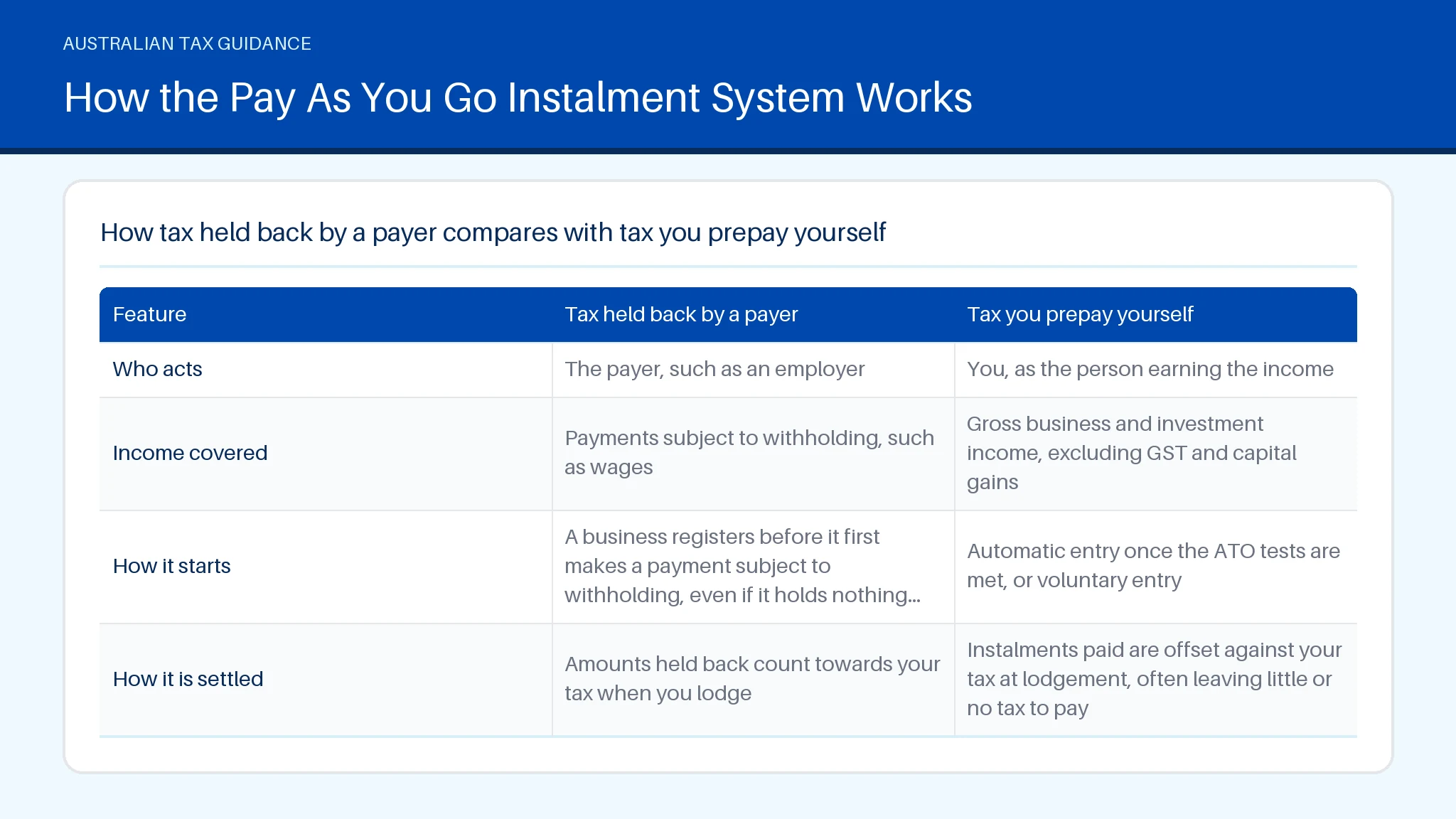
| Feature | Tax held back by a payer | Tax you prepay yourself |
|---|---|---|
| Who acts | The payer, such as an employer | You, as the person earning the income |
| Income covered | Payments subject to withholding, such as wages | Gross business and investment income, excluding GST and capital gains |
| How it starts | A business registers before it first makes a payment subject to withholding, even if it holds nothing back | Automatic entry once the ATO tests are met, or voluntary entry |
| How it is settled | Amounts held back count towards your tax when you lodge | Instalments paid are offset against your tax at lodgement, often leaving little or no tax to pay |
Many people fall into both columns. One example is a salaried worker who also earns rent.
Sole Traders, Companies and Investors Who Pay PAYG Instalments
PAYG instalments are regular prepayments of the income tax you expect to owe on business and investment income. The people who pay them have income that arrives with no tax taken out. Typical entrants include:
- a sole trader whose business profit arrives with no tax held back
- trusts with business or investment income
- companies earning business income
- investors with rent, interest or dividends. One ATO example is a landlord with $55,000 of investment income and $5,500 of property deductions, which leaves $49,500 of taxable income.
Taking part helps your cash flow. Spreading payments across the year means you avoid one large sum at lodgement, and the amounts you have paid are offset against your final tax. Costs such as the landlord's repairs and agent fees lower taxable income. The Deductit deduction library lists similar claims.
Business owners with staff usually have two obligations: PAYG instalments on their own profit and PAYG withholding on wages paid to employees. Our page on deducting wages and directors' fees explains how wage costs are claimed. Each instalment is calculated from your latest return figures, so it can lag behind a sudden rise or fall in income.
How the Pay As You Go Instalment System Works
The instalment system runs in a cycle of estimate, payment and offset. Figures from your past return set the amount. You put money aside as you earn, and what you have paid reduces the tax you owe when you lodge.
- Your latest return supplies your instalment income, and your latest notice of assessment shows the tax on that income.
- Each period, usually every 3 months, you report and pay the instalment amount.
- At lodgement, the instalments you paid are offset against your tax liability.
In an ATO worked example, a calculator estimates $20,437 for the year. Dividing that by 52 means setting aside $393.02 a week, which covers each quarterly BAS. This habit matters because PAYG withholding works differently. Withholding comes out of payments before you see them, but there is no withholding on instalment income. That is the main practical trade-off in this part of the taxation system.
Income Thresholds That Trigger PAYG Instalments
Individuals and trusts enter PAYG instalments automatically once they meet all three of the ATO's entry tests together. For these tests, instalment income means gross business and investment income, excluding GST and any capital gains.
- Instalment income of $4,000 or more on your latest tax return
- Tax payable of $1,000 or more on your latest notice of assessment
- Estimated (notional) tax of $500 or more
Two of the tests look back at last year's paperwork. If contractors or investors earn much more this year, they can stay outside the system until a later return shows the higher income. Failing a test does not stop you joining voluntarily, which is what the landlord above was considering. These tests do not apply to PAYG withholding.
Before you start, gather your latest return, your notice of assessment and a list of the income you expect. Store each activity statement and calculator estimate with your tax records.
Summary
PAYG meaning comes down to two things: tax a payer holds back, and tax you prepay through instalments. Entry depends on income and tax tests. Amounts come from your figures, and records link each quarter to your assessment. Deductit's tax calculators and workspace help organise those figures.
You may also find these related guides helpful: Pay Calculator Australia: Work Out Your Take Home Pay, Salary Calculator: Gross and Take Home Pay in Australia, Balancing Account at the ATO: Stages, Delays and Tracking, BAS Requirements: Who Must Report, Deadlines and How to File, and Is Bank Interest Taxable in Australia? Examples, Company Tax.
Frequently asked questions
How does PAYG tax get calculated?
PAYG tax is calculated differently for each part. For withholding, the payer works out the tax on each wage payment and holds it back. Our guide to take-home estimates from gross wages covers that side. For prepaid tax, the instalment amount is based on your business and investment income. The ATO's PAYG instalments calculator can estimate a yearly figure, which you can divide into weekly or quarterly savings.
Is PAYG the same as GST?
PAYG is not the same as GST. PAYG collects income tax during the year, while GST is a separate tax that registered businesses charge on their sales. Both can appear on the same activity statement, but GST is left out when you work out instalment income. Our guide to GST and PAYG labels on a BAS shows where each figure goes.
How do I set up PAYG?
How you set up PAYG depends on which part you need. A business registers for PAYG withholding through the Australian Business Register before it first makes a payment subject to withholding, even if it holds no amount back. Individuals and trusts that meet the entry tests join the instalment system automatically. Others can join voluntarily after checking their figures with the individuals calculator. You then report each instalment and make the payment by the due date on your activity statement. If you are starting a business, our ABN registration guide covers the related registrations.
What is the PAYG threshold for 2026?
Under ATO guidance, an individual (including a sole trader) or trust automatically enters the PAYG instalments system when all three tests are met: instalment income of $4,000 or more on your latest tax return, tax payable of $1,000 or more on your latest notice of assessment, and estimated (notional) tax of $500 or more. Instalment income is gross business and investment income, excluding GST and capital gains. Payroll tax thresholds are separate state and territory settings. Business.gov.au lists 2025 to 26 monthly thresholds of $83,333 for Victoria and $125,000 for South Australia.
Who pays PAYG instalments?
PAYG instalments are paid by self-employed individuals, trusts, companies and investors whose business or investment income has no tax held back. They start paying once they meet the entry tests or join voluntarily. Employees whose only income is salary generally do not need them, because their employer already holds back tax from their wages. Business owners can have both obligations at once: they prepay tax on their own profit and hold back tax from staff wages.