The Division 293 election form is the ATO approved form that lets you choose how to pay a Division 293 tax liability: from your own money, or by releasing an amount from one of your superannuation funds. It is not an objection form and it does not change the amount assessed. It simply records your payment choice and, where you elect to use super, authorises the ATO to issue a release authority to the fund you nominate.
You will only meet a Division 293 election form if the ATO has already issued you an assessment. That usually happens after your return is processed and your fund has reported your contributions. Most people who receive one earn a high salary, make salary sacrifice contributions, or hold a defined benefit interest. The sections below set out who it applies to, how the amount is worked out, and what you should keep on file.
Key takeaways
- The Division 293 election form is the ATO approved form you use to tell the ATO how you want to pay a Division 293 tax debt, including releasing money from a super fund.
- Division 293 tax applies at 15% on low tax contributions where your Division 293 income plus those contributions exceeds $250,000, according to the ATO.
- You only need the form if the ATO has issued you a Division 293 notice of assessment or a debt account discharge liability notice for a deferred amount.
- You can pay from your own funds instead of lodging a release authority election, and paying personally leaves your superannuation balance untouched.
- Keep your notice of assessment, your fund correspondence, and proof of payment so the amounts in your records match the ATO's.
What Is Division 293 Election Form?
Division 293 tax is an extra 15% tax on concessional (before tax) super contributions for higher income earners, and the Division 293 election form is how you nominate the source of payment once the ATO assesses it. The ATO treats the assessment and the payment choice as separate steps, so lodging the form does not dispute the figures.
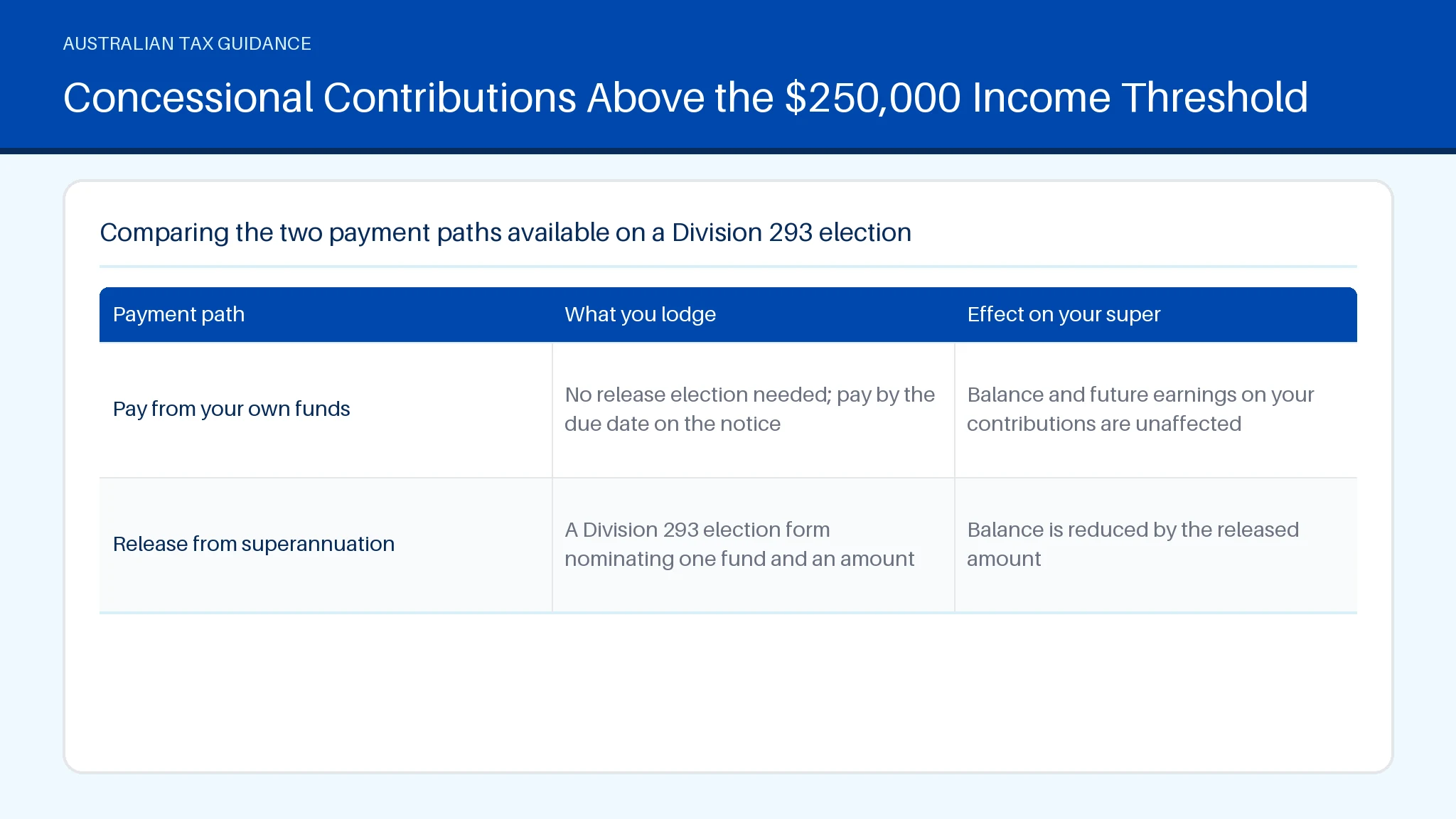
Two broad payment paths exist, and the choice has a practical cost either way. Your own super contributions stay invested if you pay personally, while a release reduces your retirement balance.
| Payment path | What you lodge | Effect on your super |
|---|---|---|
| Pay from your own funds | No release election needed; pay by the due date on the notice | Balance and future earnings on your contributions are unaffected |
| Release from superannuation | A Division 293 election form nominating one fund and an amount | Balance is reduced by the released amount |
How Division 293 Thresholds and Assessment Mechanics Work
The ATO applies Division 293 when your income for surcharge purposes plus your low tax contributions exceeds the $250,000 threshold for the income year. The tax is 15% of the lesser of your low tax contributions and the amount by which the combined total exceeds that threshold, so a small breach produces a small liability rather than a tax on the whole amount. Assessments are issued after both your tax return and your fund's reporting are matched, which is why a Division 293 election form can arrive many months after year end. Our pay calculator for Australian salaries helps you sanity check your income figure.
Receiving a Division 293 Notice of Assessment From the ATO
A Division 293 notice of assessment tells you the amount assessed, the income year, the due date, and the funds holding your reported contributions. Pay it the same way you pay any other ATO liability: by BPAY, card or bank transfer using the payment reference number on the notice, or by lodging a Division 293 election form to release the money from super.
Check three things before you pay. Confirm the income year matches your return, confirm the contributions listed match your fund statements, and confirm the due date, because general interest charge can apply after it. If the reported contributions look wrong, contact your fund first, since the ATO assesses what the fund reports. If you salary sacrifice, our guide to how salary sacrifice works and the caps that apply explains how those amounts arise.
Why Your Liability Was Deferred for Defined Benefit Interests
Deferral happens because some super interests cannot legally release money until a benefit becomes payable. Defined benefit interests and certain constitutionally protected funds fall into this group, so the ATO records the amount in a debt account instead of demanding immediate payment. Notional contributions for those interests still count towards your assessment, and interest accrues on the deferred balance. When a benefit is finally paid, the ATO issues a debt account discharge liability notice. You can pay a deferred amount voluntarily at any time to stop further interest accruing on those contributions.
High Income Super Tax Explained at a Glance
Division 293 removes part of the concession on before tax super for high earners. Inside the fund, concessional contributions are generally taxed at 15%; the extra 15% lifts the effective rate on the affected amount to 30%, which is still below the top marginal rate. That is why salary sacrifice often remains worthwhile even after an assessment. The tax applies to the contributions, not to your superannuation earnings or to your after tax money. Employer contributions are covered in our page on business super contributions, and personal amounts in personal super contributions.
How to Calculate Your Division 293 Election Form Amount
Work out the amount in four steps. First, take the assessed liability from your notice; you do not recalculate it on the form. Second, decide how much to pay yourself and how much to release. Third, if you are electing a release, nominate one fund and the dollar amount, and keep the total at or below the assessed amount. Fourth, sign and date the Division 293 election and lodge it through myGov or the paper channel shown on the notice.
Two details catch people out. A fund cannot release more than the amount stated on the release authority, and a partial release leaves the balance payable by you. Released money is not assessable income to you. Before electing, check whether your superannuation balance is in a pension phase or an illiquid investment, because release may not be practical.
Worked Example: Calculating One Individual's Liability
Take an employee with a $255,000 salary and $30,000 of concessional contributions. Division 293 income plus those contributions is $285,000, which exceeds the $250,000 threshold by $35,000. The tax is 15% of the lesser of the two figures, so 15% of the $30,000 of contributions, giving $4,500. If the excess had been only $12,000, the tax would be 15% of $12,000, or $1,800. The notice states the final figure, and the Deductit tax calculators can help you model your income side.
Concessional Contributions Above the $250,000 Income Threshold
Concessional superannuation contributions are before tax amounts: compulsory employer super guarantee, salary sacrifice, and personal contributions you claim a deduction for. They are taxed at 15% inside the fund and count towards your concessional cap for the year.
Division 293 income is broader than taxable income. The ATO builds it from taxable income, reportable fringe benefits, net investment losses, net amounts on which family trust distribution tax has been paid, and certain other items, then adds your low tax contributions to test the threshold. Because of that breadth, a one off capital gain or a negatively geared investment can push you over in a single year without any change to your superannuation strategy.
Using your superannuation balance to pay is a timing decision rather than a saving. The money leaves a concessionally taxed environment permanently, so compare the lost compounding against your cash flow. Our overview of how superannuation works in Australia covers the wider system.
Key Facts Every High Earner Should Know
Keep the paperwork for at least five years: the notice of assessment, fund statements showing the reported contributions, your election form, and receipts for any payment. The ATO expects records that support the amounts in your return and your assessment.
Common mistakes include assuming a pay rise alone triggers the tax, ignoring a deferred debt account, and treating the assessment as an income tax amendment. A bonus can lift your salary past the threshold in one year only. The broader giving and super deductions library sets out related rules.
Summary
Eligibility turns on income plus low tax contributions above $250,000, the calculation is 15% of the lesser amount, and records should match the ATO notice. A form only records your payment choice. Start in the Deductit workspace to organise your documents.
You may also find these related guides helpful: Pay Calculator Australia: Work Out Your Take Home Pay, Balancing Account ATO: What It Means for Your Return, Salary Calculator: Gross and Take Home Pay in Australia, and Superannuation Calculator: Estimate Your Retirement Balance.
Frequently asked questions
What are non-concessional superannuation contributions?
Non-concessional superannuation contributions are after tax amounts you or your spouse put into super without claiming a deduction, including personal contributions from your take home pay and most spouse contributions. They are not taxed again in the fund and they are not counted as low tax contributions, so they do not form part of a Division 293 assessment. They do count towards the separate non-concessional cap.
How is Division 293 tax calculated?
Division 293 tax is 15% of the lesser of your low tax contributions for the year and the amount by which your Division 293 income plus those contributions exceeds $250,000. The ATO performs this calculation and states the result on the notice.
How will you know if you need to pay?
You will know you need to pay because the ATO issues a notice of assessment, available through myGov or your registered tax agent, after your return and your fund's reporting are matched. No notice means no amount is currently payable.
Can you pay Division 293 tax from your own funds?
Paying from your own funds uses the payment reference number on the notice and leaves your super balance intact, which preserves future earnings on those contributions. You can still elect a release later for an unpaid amount.
Do super guarantee amnesty contributions count towards Division 293?
Super guarantee amnesty contributions an employer made under the former amnesty are excluded from low tax contributions, so the ATO does not count them in your Division 293 assessment. Check our deduction finder and get started guide to keep the rest of your records in order.