The taxation of redundancy payments in Australia depends on one question first: whether the ATO treats your payout as a genuine redundancy. If it does, part of the payment is tax free, the excess is taxed as an employment termination payment, and unused leave is taxed under its own rules. If it does not, the whole amount is taxed as ordinary termination income.
This guide is for employees who have been told their role is ending and who want to understand the taxation of redundancy payments before the money lands. It separates three things people often blend together: eligibility for concessional treatment, how the tax is actually calculated, and the records you need to keep to check the figures your employer reports.
Key takeaways
- A genuine redundancy exists only when the position itself is abolished and the employer has no intention of filling it, according to the ATO.
- The tax free part of a genuine redundancy payment is a base amount plus an amount for each completed year of service, indexed annually by the ATO.
- Anything above the tax free limit becomes an employment termination payment (ETP) and is taxed at concessional rates up to the ETP cap, then at the top marginal rate.
- Unused annual leave and long service leave are taxed separately from the redundancy payment and are never part of the tax free limit.
- Keep your termination letter, final payslip, ETP payment summary and income statement so the amounts on your return match what your employer reported.
What Makes a Redundancy Genuine Under ATO Rules
A genuine redundancy happens when an employer dismisses an employee because the job itself is no longer required to be performed by anyone, not because of the employee's performance or conduct. The ATO applies that test strictly, and it is the gateway to every concession in the taxation of redundancy payments.
Resigning, taking voluntary early retirement outside an approved scheme, reaching the end of a fixed-term contract, or being dismissed for conduct do not qualify. Age and payment timing also matter: the ATO applies conditions relating to dismissal before pension age and to the payment being made in connection with the dismissal.
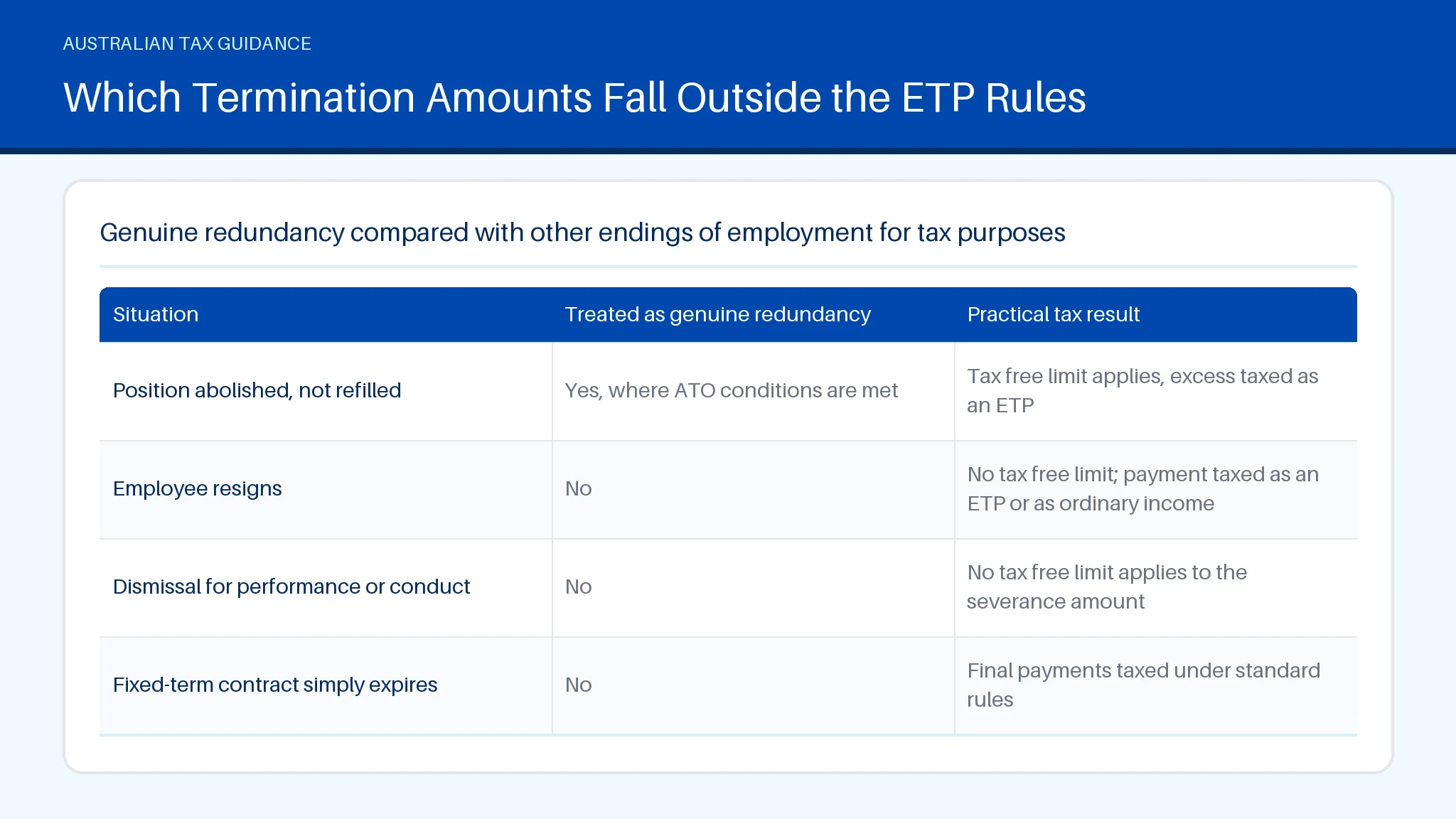
| Situation | Treated as genuine redundancy | Practical tax result |
|---|---|---|
| Position abolished, not refilled | Yes, where ATO conditions are met | Tax free limit applies, excess taxed as an ETP |
| Employee resigns | No | No tax free limit; payment taxed as an ETP or as ordinary income |
| Dismissal for performance or conduct | No | No tax free limit applies to the severance amount |
| Fixed-term contract simply expires | No | Final payments taxed under standard rules |
Our Australian deduction library follows the same approach of naming the ATO rule behind every figure.
Tax Treatment of Redundancy Payments in Australia Explained
Redundancy payments are only partly tax free in Australia. A genuine redundancy is split into a tax free portion set by an ATO formula, a taxable excess, and separate amounts for unused leave, each with its own tax treatment.
The tax free portion is not counted as assessable income and does not affect your marginal rate. The excess is taxed at a concessional rate plus the Medicare levy up to a cap. Payments that are really deferred salary, bonuses or a lump sum for work already performed sit outside redundancy tax treatment entirely and are taxed as ordinary income. For rules specific to your circumstances, the ATO phone number for individuals is 1300650286.
How Much Tax Will You Pay on Redundancy?
The tax on a redundancy payout depends on three separate calculations, not one. Work out the tax free redundancy amount first, then the tax on the excess employment termination payment (ETP), then the tax on unused leave.
Once you know your gross payout, model the effect on your annual income with our Australian pay calculator, because redundancy and taxation interact with everything else you earn that year. Withholding on the excess includes the Medicare levy. The ATO business line is 1300661508 if your employer needs guidance on reporting.
Tax Free Limit: Base Amount Plus Years of Service
The tax free limit for a genuine redundancy payment is a base amount plus a set amount for each completed year of service with the employer. Both figures are indexed by the ATO each income year, so always check the current year's values before you calculate.
Only completed years count. Part years are excluded from the tax free component, which is why a redundancy that takes effect days before a work anniversary produces a smaller tax free amount. The concessional tax outcome also applies per employer, so two redundancies in one year each carry their own tax free limit. Anything above the limit loses tax free status.
How Unused Annual Leave and Long Service Leave Are Taxed
Unused annual leave and long service leave paid out on redundancy are taxed separately from the genuine redundancy payment, at a concessional flat rate of 32 per cent including the Medicare levy where the payment results from a genuine redundancy. These amounts never form part of the tax free limit.
Leave loading paid with the leave is treated the same way. Unused sick leave is generally not paid out and is not part of the calculation unless an award or agreement requires it. A payment in lieu of notice is different again and is usually part of the ETP. Because leave payouts lift your assessable income, redundancy and taxation questions often turn on timing rather than rate, and the same applies to any final salary owed. See how work expense deductions can offset income in the same year.
What Counts as an Employment Termination Payment?
An employment termination payment is a lump sum paid because your employment ended, made within 12 months of termination. The amount of a genuine redundancy payment above the tax free portion becomes an employment termination payment (ETP), as do payments in lieu of notice, gratuities and compensation for loss of job.
The concessional tax rate applies to the ETP up to the lower of the ETP cap and the whole-of-income cap. Amounts above that are taxed at the top marginal rate plus the Medicare levy. A free redundancy component never counts toward those caps. Check your termination payment figures against your income statement, then use our tax deduction calculator to model the year.
Which Termination Amounts Fall Outside the ETP Rules
Several amounts paid when you are made redundant sit outside the ETP rules entirely. A payment for unused annual leave or long service leave, superannuation benefits, and any lump sum of accrued salary or bonus for work already done are excluded, along with the tax free part of a genuine redundancy payment.
These excluded amounts are still relevant to taxation on redundancy payments australia wide, because the taxable ones push your income toward and past the tax free threshold and can change your Medicare levy outcome. Severance above the limit keeps its concessional tax treatment only within the caps. The ATO contact number is on the ATO phone line guide.
Summary
Eligibility turns on a genuine abolition of the role, calculation follows the indexed base plus years of service formula, and records mean your termination letter, payslips and income statement. Deductit publishes the ATO rule behind each figure in its deduction finder.
Frequently asked questions
How much tax will I pay on 60,000 redundancy?
A $60,000 genuine redundancy payout is usually taxed in two parts. The portion within the indexed tax free limit for your completed years of service is not assessable at all, and only the balance is taxed as an ETP at the concessional rate plus Medicare levy, so many long-serving employees pay nothing on the full amount.
How are redundancy payments taxed in ATO?
The ATO taxes redundancy payments by splitting them into a tax free genuine redundancy amount, a concessionally taxed excess, and separately taxed unused leave. Your employer reports each component differently on your income statement.
Is tax payable on a redundancy payment?
Tax is payable on the part of a redundancy above the tax free limit, and on unused leave. If the redundancy is not genuine, for example a resignation or a contract simply ending, no tax free limit applies at all.
What is the tax-free limit for genuine redundancy payments in 2026?
The tax free limit for 2026 is a base amount plus a set amount for each completed year of service, both indexed annually. Confirm the current figures on the ATO website before you calculate, because they change every 1 July.
How do I calculate the tax on a redundancy payment in Australia?
Calculate the tax free limit first, subtract it from the redundancy payment, then apply the ETP rate to the remainder and the leave rate to unused leave. Our Australian tax guides and the Deductit deductions hub show the working.
You may also find these related guides helpful: what is the medicare levy rates rules and surcharge, contractor pay calculator rate to salary in australia, pay calculator australia work out your take home pay, and salary calculator gross and take home pay in australia.