SMSF Contributions are the payments a self managed super fund can accept for its members, and the rules that govern them sit with the member's annual caps, not with the fund's investment strategy. Getting them right means knowing three separate things: whether the fund is allowed to accept the money, how the amount counts against a cap, and what the trustee has to record once it lands in the bank account.
This guide is written for trustees and members who already have a fund running, or who are close to it, and want a practical handle on contribution types, caps and paperwork. If you are still deciding whether to run your own fund at all, the structural questions are covered in our guide to Self Managed Super Fund: Rules, Costs and Trustee Duties.
Three ideas do most of the work. Concessional contributions are made from before-tax money and the fund pays 15% tax on them. Non-concessional contributions come from after-tax money and are not taxed again on entry. Rollovers from another fund are neither, so they do not use a cap at all.
Mixing those up is the single most common cause of an excess contributions assessment. The ATO applies caps per member per financial year across every fund that member belongs to, so SMSF Contributions have to be read alongside anything an employer is paying into a separate account. You can sanity check employer amounts against your gross wage using the pay calculator for 2026-27.
Key takeaways
- SMSF Contributions fall into two main buckets: concessional (before-tax, taxed at 15% in the fund) and non-concessional (after-tax, not taxed on the way in).
- The ATO sets a concessional cap of $30,000 and a non-concessional cap of $120,000 for 2024-25 onward, with a three-year bring-forward option for non-concessional amounts if your total super balance allows it.
- Unused concessional cap amounts from the past five years can be carried forward if your total super balance was under $500,000 at 30 June of the previous year.
- Trustees must check eligibility before accepting money: work test rules, age limits and the member's tax file number all affect what the fund can keep.
- Every contribution needs a dated record showing the member, the amount, the type and the cap year it counts toward, because the ATO assesses excess amounts against the member personally.
Super Guarantee Payments Employers Must Pay Into Your SMSF
An employer must pay super guarantee for an eligible employee into whichever complying fund the employee nominates, including a self managed fund, at the rate the ATO publishes for that quarter. The rate reached 12% of ordinary time earnings from 1 July 2025 and applies to payments made from that date. Your fund needs an electronic service address and a bank account in the fund's name before an employer can send the money, because superannuation guarantee amounts must travel through the SuperStream data standard.
Super guarantee is a concessional amount. So is any salary sacrifice arrangement you set up, and so is a personal contribution for which you claim a deduction. Non-concessional amounts never pass through an employer: you move them yourself from after-tax savings, and they sit outside the employer's reporting obligations entirely.
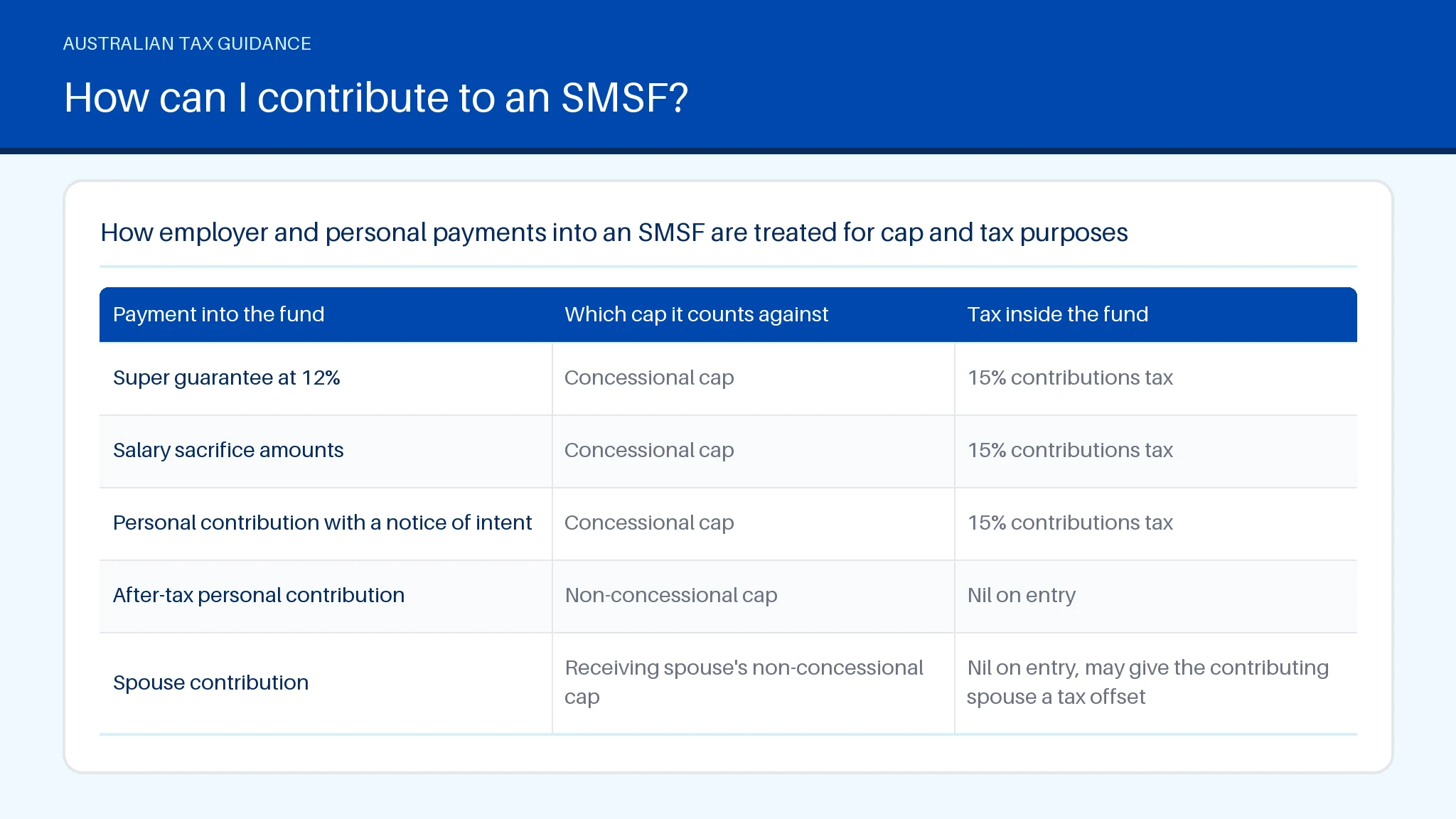
| Payment into the fund | Which cap it counts against | Tax inside the fund |
|---|---|---|
| Super guarantee at 12% | Concessional cap | 15% contributions tax |
| Salary sacrifice amounts | Concessional cap | 15% contributions tax |
| Personal contribution with a notice of intent | Concessional cap | 15% contributions tax |
| After-tax personal contribution | Non-concessional cap | Nil on entry |
| Spouse contribution | Receiving spouse's non-concessional cap | Nil on entry, may give the contributing spouse a tax offset |
Employer contributions and deductible personal amounts are detailed separately in our pages on business super contributions and personal super contributions.
How to Transfer or Roll Over Super Into an SMSF
A rollover moves existing superannuation benefits from one fund to another and is not a contribution, so it uses neither cap. You request it through your myGov account linked to the ATO, or by giving the transferring fund a rollover initiation request, and the money must arrive in the SMSF's own bank account.
Two practical conditions trip people up. First, the fund has to be registered with an ABN, listed on Super Fund Lookup and holding an electronic service address, or the transferring fund will reject the request. Second, the ATO verifies that the member requesting the rollover is a member of the receiving fund, which means your fund details must be current before you start.
Think carefully about sequencing. Rolling over a large balance lifts your total super balance at the next 30 June, which can reduce or remove your non-concessional capacity and your ability to use carry-forward concessional room. Insurance held in the old fund usually ends on rollover too, so check cover before you transfer.
If you want a quick view of how a transfer and ongoing salary sacrifice contributions reshape your projected balance, the superannuation calculator models the difference. Rollovers never attract a deduction, and no non-concessional reporting applies to them.
Which Payments Count as SMSF Contributions
A contribution is any payment that increases a member's benefits in the fund and is not a rollover, an investment return or a transfer from a government scheme. SMSF Contributions split cleanly into two categories, and every acceptance decision starts by naming which one applies.
Non-concessional contributions are made from money that has already been taxed. They include after-tax personal amounts, spouse contributions and amounts in excess of the concessional cap that you choose to leave in the fund. The cap is $120,000 a year. Members under 75 with a total super balance under $1.66 million at the previous 30 June can bring forward up to three years, giving a possible $360,000 in one year, with the bring-forward amount scaled down as the balance rises. Excess non-concessional contributions are taxed heavily if left in the fund, so most members withdraw the excess plus associated earnings when the ATO issues a determination.
Concessional contributions are made from before-tax money and are deductible to whoever makes them. The annual concessional cap is $30,000, and the fund pays 15% tax on each concessional amount it receives. Personal concessional contributions require a valid notice of intent to claim, acknowledged by the trustee, before you lodge your return. Unused concessional cap space from the previous five financial years can be added to the current year's concessional cap where your total super balance was below $500,000 at the prior 30 June. Excess concessional contributions are added to your assessable income and taxed at your marginal rate, with a 15% tax offset for the tax the fund already paid.
Downsizer contributions, personal injury payments and small business CGT amounts have their own rules and do not count toward either cap. Employer contributions and salary sacrifice contributions always count as concessional. Broader superannuation treatment sits in the giving and super deductions library.
Summary
Eligibility turns on the member's age, work status and total super balance, plus the fund holding an ABN, a bank account and an electronic service address. Calculation means allocating each amount to the right cap, allowing for carry-forward and bring-forward room. Records mean a dated ledger entry per contribution with the member, amount, type and cap year. Deductit publishes the published ATO caps and rates alongside free tools, including a deduction finder, but it does not give personal tax advice or lodge returns.
You may also find these related guides helpful: Balancing Account ATO: What It Means for Your Return, Logbook Method: Claim Real Car Costs at Tax Time, Superannuation Calculator: Estimate Your Retirement Balance, and ATO Number: Which Line to Call for Your Tax Query.
Frequently asked questions
How much money can I contribute to my SMSF?
Your fund can accept up to $30,000 of concessional contributions and $120,000 of non-concessional contributions for you each financial year, plus any carry-forward or bring-forward amounts you qualify for. Those caps apply to you as a member across every fund you belong to, not to the SMSF itself, so add employer amounts paid elsewhere before you top up.
How can I contribute to an SMSF?
You contribute to an SMSF by transferring money directly into the fund's own bank account, or by having an employer send super guarantee and salary sacrifice amounts through SuperStream. The fund must hold your tax file number to accept personal contributions, and the trustee should allocate the money to your member account within 28 days of the end of the month in which it was received. In-specie contributions of listed shares or business real property are possible but must be made at market value and are restricted by the related party acquisition rules.
What is the 5% SMSF rule?
The 5% rule limits a fund's in-house assets, such as loans to or investments in a related party, to 5% of the fund's total market value. It is measured at 30 June each year, and a breach requires a written plan to dispose of the excess by the end of the following financial year. Our guide on SMSF audits, returns and fees covers how auditors test this.
What are common SMSF mistakes?
The most frequent mistakes are accepting money without checking the member's cap position, failing to obtain or acknowledge a notice of intent before the member lodges, leaving contributions in a suspense account instead of allocating them, and mixing personal money with fund money in a single bank account. Each of these shows up in the annual audit.
What should you know about personal concessional contributions?
Personal concessional contributions are after-tax payments you make yourself and then claim as a deduction, which converts them to concessional amounts taxed at 15% in the fund. They suit variable income, late-year planning and anyone whose employer arrangements do not use the full cap. The notice of intent must be given to the trustee before you lodge your return or by 30 June of the following year, whichever comes first, and the trustee must acknowledge it in writing. Check the current list of claimable items in the deductions library or start a record in your Deductit workspace.