A protective clothing tax deduction is available when you buy, repair and clean items that shield you from a genuine risk of injury or illness in your job, and you paid for them yourself. This guide is for employees and sole traders working out which work related clothing expenses pass the ATO tests, how to calculate the claim, and what records to hold. It separates protective gear from compulsory uniforms, registered non-compulsory designs and everyday clothing that is never deductible, and it links through to the Australian tax deductions hub for the wider rules.
- A protective clothing tax deduction applies when the item protects you from real injury or illness risk at work, such as steel-capped boots, high-vis vests, fire resistant overalls or sun protection items, according to the ATO.
- Conventional clothing stays out. Black trousers, plain white shirts and ordinary shoes are not deductible even when your employer insists on them.
- Compulsory uniforms with a permanent, distinctive employer logo are deductible. A non compulsory uniform only qualifies if the design is entered on the Register of Approved Occupational Clothing.
- Laundry can be claimed at $1 per load of eligible work clothing only, or 50c per load when mixed with private items. Written evidence is needed once total laundry claims exceed $150.
- Keep receipts for purchase, repair and dry cleaning of eligible items, plus a note of how you worked out the number of washes.
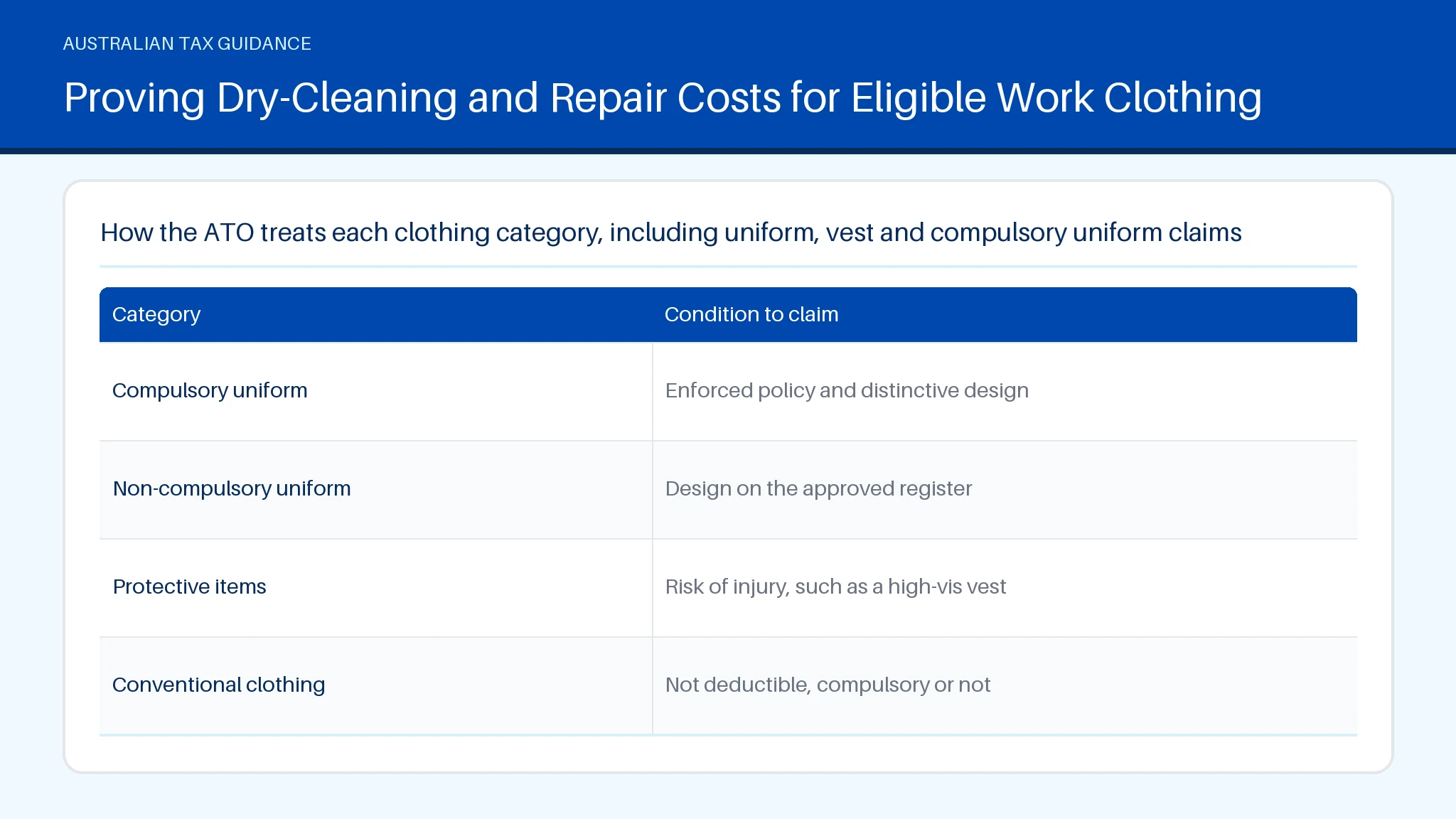
A non-compulsory uniform is only deductible if the employer has entered the design on AusIndustry's Register of Approved Occupational Clothing. Without registration, the ATO treats the clothing as conventional, even if staff wear it every shift. A compulsory uniform is different: a strictly enforced policy plus distinctive branding is enough, and a protective clothing tax deduction stands on its own risk-based test.
| Category | Condition to claim |
|---|---|
| Compulsory uniform | Enforced policy and distinctive design |
| Non-compulsory uniform | Design on the approved register |
| Protective items | Risk of injury, such as a high-vis vest |
| Conventional clothing | Not deductible, compulsory or not |
Protective clothing and footwear must do protective work to qualify. The ATO accepts items such as steel-capped or rubber-soled safety boots, fire resistant overalls, heavy-duty gloves, safety glasses, aprons and a sun protection tax deduction for hats and sunscreen used outdoors. A claim fails where the shoe is an ordinary dress or runner style, the item has no employer logo and no registered non compulsory design, or your employer reimbursed the cost. The ATO warns on clothing tax deduction errors each year, so only claim a deduction for purchase, repair and washing you actually paid for and can evidence.
Claim eligible clothing at work-related expenses in your return, splitting the purchase cost from the laundry cost. Purchase and repair claims need receipts. Laundry is claimed at $1 per load where the load holds only eligible items and 50c where you wash them with private clothes, per the ATO's rates. Deductible purchases include a branded apron, protective safety boots and a sun protection tax deduction for a wide-brim hat. An unbranded trouser or ordinary shoe is excluded. If a rule is unclear, the ATO contact number on ato.gov.au is the primary source, or use the Deductit tax deduction calculators to see the formula.
Eligibility turns on three checks: the item is occupation-specific, protective, or a qualifying uniform; you paid the cost; and you kept records. Work relate clothing that fails all three is private. Australian tax deductions for laundry follow the per-load rates, and the $150 written-evidence threshold applies to laundry only, not to purchases. A logo alone does not rescue a plain shoe, and everyday clothe items stay out. Verify any relate clothing rule against ato.gov.au rather than a published ATO phone number, and browse the deduction library for the underlying rule.
A retail supervisor wears a branded polo and matching trouser that staff may choose to wear, so the uniform is not compulsory. Because the design is on the approved register, the non compulsory uniform clothing expense of $240 for the year is deductible, and laundry follows the per-load rate. Had the employer never registered the design, no deduction would apply. Had the policy been strictly enforced, the same items would be a compulsory uniform instead, with compulsory wear supported by a written policy and with no compulsory shoe claim.
Laundry claims up to $150 do not need receipts, but the ATO still expects a reasonable basis for the figure, such as loads per week multiplied by weeks worked. Keep the working. Above $150 in total, written evidence is required, including dry cleaning dockets. Records should name the item, so a steel cap boot, a high vis clothing tax deduction item, a branded pant or a registered non compulsory uniform is identifiable. A plain trouser, unbranded attire or other clothing expense for conventional wear should stay out of the calculation entirely.
Tax-deductible work clothing falls into four ATO groups: protective items, occupation-specific clothing, compulsory uniforms, and registered non-compulsory uniforms. Cleaning and repair costs follow the same eligibility as the item itself, so a protective clothing and equipment deduction covers mending torn overalls and a steel cap boots tax deduction covers resoling safety boots. Hold the invoice for each service. A dry-cleaning docket for a branded jacket is deductible; the same docket for a black trouser or a plain clothe item is not. Record the washing method behind any laundry expense, and note that Australian tax deductions never extend to items your employer paid for or an unbranded shirt with no logo.
Occupation-specific clothing is distinctive to one trade and not worn by the public, so a chef's checked trouser and toque qualify while plain kitchen blacks do not. Trade gear works the same way: a protective clothing and equipment deduction covers a welder's fire resistant jacket, and a steel cap boots tax deduction covers a safety cap boot bought for a site. A carpenter buying $190 of safety boots and $85 of hearing protection claims both, plus the washing of protective overalls at the per-load rate. The ATO warns on clothing tax deduction claims for a non compulsory item or an unregistered uniform non compulsory design, and a plain clothe item stays private. Record purchases in your Deductit workspace as you go.
Eligibility rests on protection, occupation-specific design, or a qualifying uniform. Calculation splits purchase receipts from per-load laundry rates. Records cover invoices and your wash working. Deductit shows the ATO rule and formula behind each claim, without giving personal tax advice.
How much protective clothing can I claim on tax without receipts?
Laundry for protective clothing can be claimed without receipts up to $150 in total, using the ATO rates of $1 per load of eligible items or 50c per mixed load. Purchases still need receipts.
Can I claim up to $300 without receipts?
The $300 rule covers total work-related expenses, not clothing alone. If your combined work claims are $300 or less you do not need written evidence, though you must still have spent the money and be able to explain the claim.
What types of clothing can be claimed as tax deductions?
Four categories are deductible: protective clothing and footwear, occupation-specific clothing, compulsory uniforms with a permanent logo, and non-compulsory uniforms on the approved register. Repairs and dry cleaning for those items are also deductible, and businesses claim staff protective gear as a business expense.
What are the most overlooked tax deductions in Australia?
Commonly missed claims include safety boot resoling, sun protection items for outdoor shifts, hearing and eye protection, and laundry of high-vis gear. Work pants are only claimable when protective, occupation-specific or part of a qualifying uniform.
What are the ATO red flags for tax return deductions?
The ATO flags claims for conventional clothing, laundry figures with no working, expenses an employer reimbursed, and round-sum amounts that match the $150 or $300 thresholds exactly.
You may also find these related guides helpful: find.